
University admissions in the United States are decentralized. Each college or university, and often each program, sets its own requirements, deadlines, and selection process. Assessment is commonly multi-factor, combining academics with additional evidence, but the balance varies widely.
How applications work
System type: Decentralized. There is no single national admissions authority for undergraduate entry.
Who sets requirements: Each institution and, in many cases, each school or department within the institution.
How students apply: Students usually apply directly to each institution using one or more of the following:
- A shared application platform, for example the Common Application
- The institution’s own online application portal
- State or regional platforms used by public institutions in some states
Structural variation: Requirements and deadlines vary significantly by:
- Institution type, for example public or private, community college or four-year
- Selectivity and capacity constraints
- Program, for example Nursing, Architecture, or Performing Arts
- Applicant type, for example first-year, transfer, international, or returning adult
Application types and commitments
Main routes
U.S. institutions commonly use several application routes, depending on the institution, program, and applicant type.
- First-year admission: For students entering after secondary school
- Transfer admission: For students moving from another tertiary institution, often after 1–2 years
- Community college pathways: Two-year study that may lead to later transfer to a four-year institution
- Direct institutional applications: Applications submitted through a university’s own portal
- Shared application platforms: Platforms such as Common App, where participating institutions use one shared application system
Binding vs non-binding models
Some U.S. institutions offer different application plans.
- Early Decision: Usually binding. If admitted, the student normally commits to attend, with limited exceptions set by the institution’s policy.
- Early Action: Usually non-binding. Students receive an earlier decision but do not normally have to commit immediately.
- Regular Decision: Non-binding. This is the standard application cycle at many institutions.
- Rolling admission: Applications are reviewed as they are received, often until places are filled or a final deadline is reached.
❗ Early Decision is usually binding, so the commitment rules, withdrawal expectations, and financial aid conditions are set by the institution and must be understood before submission.
Deadline patterns
Deadlines are institution-set. Early plans often fall in the earlier part of the application cycle, while Regular Decision deadlines commonly fall later. Rolling admission may remain open until capacity is filled.
Key caveats
Program-level requirements can create earlier internal deadlines even when the main application deadline is later. This is common for programs requiring auditions, portfolios, prerequisite checks, or additional departmental forms.
Eligibility and qualification recognition
Who decides eligibility
Eligibility is decided primarily by the admitting institution and sometimes by the specific program.
Recognition model
There is no single national qualification recognition decision for university admission. Institutions decide how international qualifications are evaluated and may request external credential evaluation.
Baseline expectations
Typical expectations include:
- Completion of an upper secondary qualification that the institution considers comparable to U.S. high school completion
- Evidence of readiness for the chosen program, for example subject preparation for Engineering
- English proficiency evidence where required by the institution or program
How applicants are assessed
Dominant model: Institution-led, multi-factor review. Many institutions describe this as holistic or comprehensive review, but the exact weighting is set locally.
Primary selection factors
Typical priority order includes:
- Academic record, including courses taken, grades, and academic trends
- Fit with program prerequisites, including required subjects or prior study
- Standardized test scores where required or considered
- Written materials, such as personal statements or essays
- Recommendations, including teacher or counselor references where requested
- Activities and experience, such as extracurriculars, leadership, work, or service
Factors not primary nationally
There is no national requirement to include interviews, portfolios, or admissions tests for all applicants. These are institution-specific or program-specific.
Where variation occurs
- Some institutions and programs are strongly academics-dominant
- Some use test-optional or test-required policies, which vary by institution and can change by intake
- Some programs add auditions, portfolios, interviews, prerequisite checks, or licensing-related requirements
Application platforms and key documents
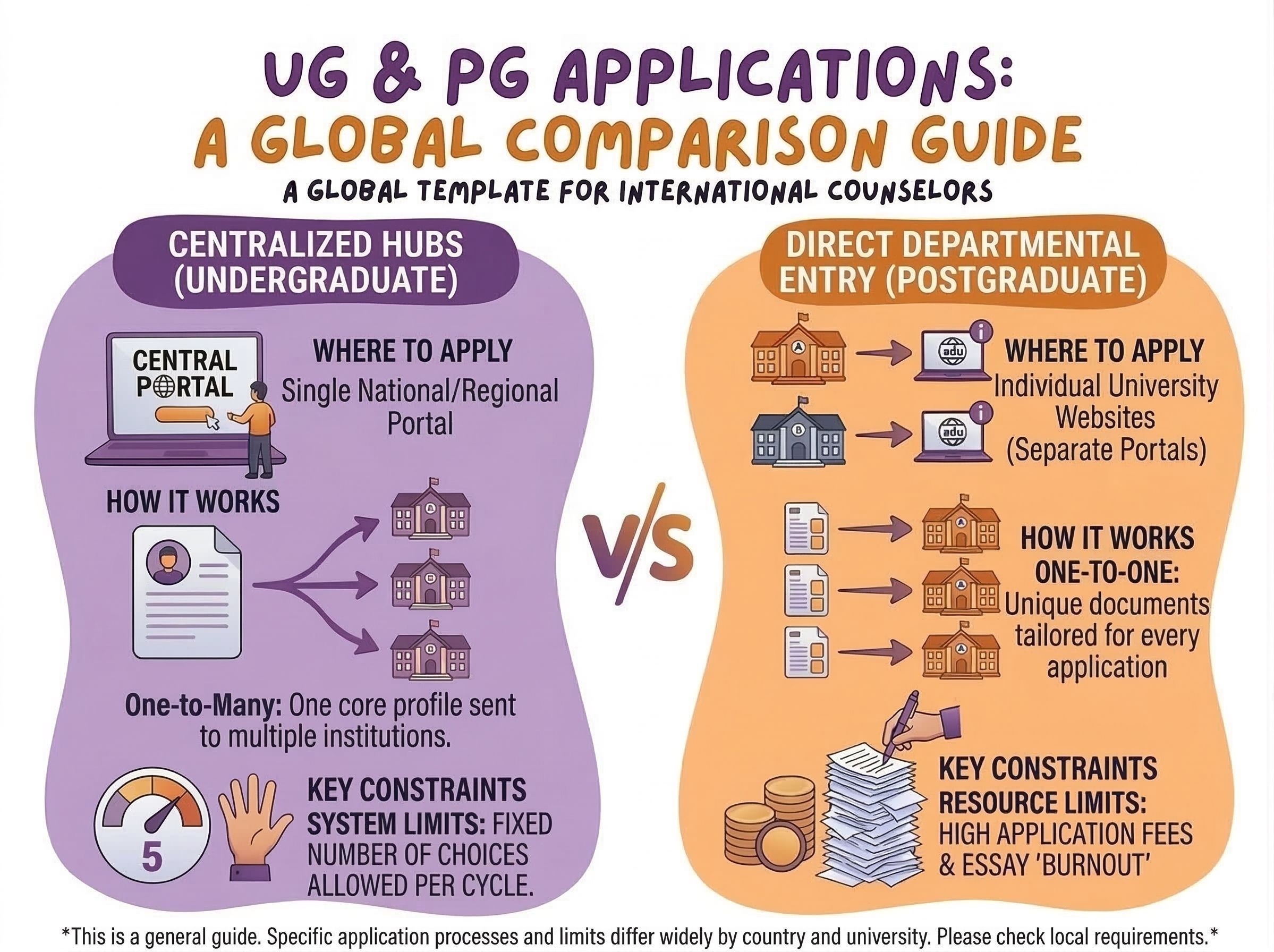
Common App
Common App is a shared application platform used by many U.S. colleges and universities. Students can use one platform profile to apply to multiple participating institutions, but each institution still controls its own deadlines, supplements, fees, requirements, and admissions decisions.
Institutional portals
Many institutions also use their own application portals. Some use these instead of shared platforms, while others use them after submission for document tracking, decision updates, financial documentation, housing, enrollment, or visa-related steps.
State or public-system platforms
Some public university systems use state or system-level application platforms. These may cover multiple campuses within the same state or university system, but requirements and review processes can still vary by campus and program.
Direct applications
Direct applications are common where an institution does not use a shared platform, where a program has its own process, or where the applicant is applying as a transfer, postgraduate, pathway, online, or non-degree student.
Platform rules and limitations
The U.S. does not have one national undergraduate application platform or one national choice limit. Platform rules vary. A shared platform may simplify form completion, but it does not standardize admissions requirements, deadlines, essays, document requests, or decisions across institutions.
Alternative platforms
Common App is widely used, but it is not universal. Some institutions use other shared platforms, state/system platforms, or their own portals. Students may need to manage more than one platform in the same application cycle.
Documents required generally include, but are not limited to
- Application form or platform profile
- Academic transcripts and qualification certificates
- Certified translations, where required
- Course or subject details for international curricula, where requested
- Personal statement, essays, or institution-specific written responses
- English proficiency evidence, where required
- Standardized test scores, where required or considered
- Passport identity page, commonly requested for international processing
- Financial documentation, often requested for international students at or after admission
- Program-specific materials, such as portfolios, auditions, prerequisite evidence, or additional forms
School documents and references
What schools commonly provide
Schools may provide academic records, transcripts, counselor or teacher recommendations, school profile information, predicted or expected results where relevant, and context about the student’s curriculum or academic environment.
Who submits
Submission methods vary by institution and platform. In shared platforms such as Common App, schools and recommenders may submit documents through the platform. In institutional portals, universities may ask for uploads, emailed documents, or direct recommender submissions.
Recommendations
Letters of recommendation are institution-set. Some institutions require counselor and/or teacher recommendations, while others make them optional or do not use them.
Transcripts and academic records
International applicants are often asked to provide official or school-certified academic records. Some institutions may request records directly from the school, while others allow student upload followed by later verification.
Where process differs by route
Transfer, community college, postgraduate, and program-specific applications may request different documents from first-year applications. Some institutions may also request external credential evaluation for international qualifications.
Student responsibilities
Students are usually responsible for:
- Researching programs and confirming institution- and program-specific entry requirements
- Confirming the correct application route or platform for each institution
- Creating accounts in the correct platform or institutional portal
- Completing application forms accurately
- Providing personal statement, essay, or supplemental written content where required
- Paying application fees where applicable
- Submitting transcripts, certificates, translations, and supporting documents when requested
- Arranging test score reporting for English proficiency or standardized tests where required
- Requesting and tracking recommendations where required
- Completing program-specific steps such as portfolios, auditions, interviews, or prerequisite checks
- Monitoring email and portals for document requests and decisions
- Responding to offers and completing acceptance steps by institutional deadlines
- Preparing visa steps after the institution issues Form I-20 or Form DS-2019, if applicable
Key application timelines
Submission windows
Many institutions accept applications across a broad window, with earlier deadlines for early plans and later deadlines for regular plans. Rolling admission may remain open until capacity is filled.
Decision timing
Decisions may be released on fixed dates by plan or on a rolling basis. Timing varies by institution and applicant volume.
Lead-time expectations
Where programs require portfolios, auditions, interviews, or prerequisite checks, students often need additional lead time before the main deadline to complete those steps.
Common intake pattern
Fall entry, usually August to September, is the most common intake for many institutions.
Spring entry, usually January, is also common.
Some programs also offer Summer starts, often May to June.
For Fall entry, applications commonly open around August to October, with many deadlines clustered between November and January, though rolling admissions may continue later.
Decisions may arrive:
- Earlier, often December to February, for early plans
- Later, often February to April, for regular plans
- Throughout the cycle for rolling admissions
Visa-processing lead time should be planned after the institution issues the immigration document, for example Form I-20. Timelines can become compressed if that document is issued late.
❗ The main deadline may not be the earliest deadline. Portfolios, auditions, interviews, or prerequisite checks can have earlier cutoffs than the main application date, especially in competitive or creative programs.
Typical intake timeline
Timing varies by institution, program, and application plan.
- Research and shortlist: Aug–Oct
- Early applications: Oct–Nov
- Regular applications: Nov–Jan
- Decisions released: Dec–Apr
- Acceptance and deposit: Apr–May
- Visa document and visa steps: May–Jul
- Fall intake begins: Aug–Sep
English proficiency
Whether proof is required
English proficiency proof is commonly required for applicants whose prior education was not taught in English, but requirements are set by institutions and programs.
Accepted evidence types
Accepted evidence typically includes recognized English tests such as IELTS or TOEFL, and sometimes institution-approved alternatives such as specific curricula, school-based evidence, or pathway program completion.
Typical minimums
There is no national minimum. Requirements are set by institutions and programs and can differ by level of study and discipline.
Waiver logic
Where waivers exist, they are institution-defined. An example might be completion of a specified period of English-medium study under defined conditions.
Standardized or entrance testing
Whether required
There is no national entrance exam for U.S. undergraduate admissions.
Who sets policy
Institutions and programs decide whether to require or consider tests.
Named examples
Common examples include:
- SAT
- ACT
Testing is a policy choice made by each institution and can vary by program and intake.
Decision logic and offers
How decisions are communicated
Decisions are usually communicated through the institution’s application portal and by email.
Offer and outcome types
Common outcomes include:
- Admission
- Denial
- Waitlist
- Request for additional information
Post-offer sequencing
After admission, institutions provide acceptance instructions and, for international students who need a visa, begin the process to issue the appropriate immigration document once required information is received.
Offer types
Conditional offer: A place is offered if the student meets stated conditions, often final results, missing documents, or other requirements.
Unconditional offer: The place is confirmed without academic conditions, but the student may still need to complete non-academic steps such as document verification, identity checks, payment or enrollment requirements, depending on the institution.
Deposits and acceptance steps
Whether deposits are common
Many institutions require an enrollment deposit to confirm a place, but there is no national rule.
What deposits can unlock
Deposits often trigger next steps such as:
- Course registration access
- Housing processes
- Orientation registration
- For international students, progress toward Form I-20 issuance once required information is complete
National rule position
Deposit policies, amounts, and refundability are set by each institution.
Student visa or residence permit overview
Official names
- F-1 Student Visa for academic studies
- M-1 Student Visa for vocational studies
- J-1 Exchange Visitor Visa for exchange programs, where applicable
Trigger event
The institution issues Form I-20 for F-1 or M-1, or Form DS-2019 for J-1, through a Student and Exchange Visitor Program certified sponsor. The student then pays the SEVIS I-901 fee.
Typical high-level steps
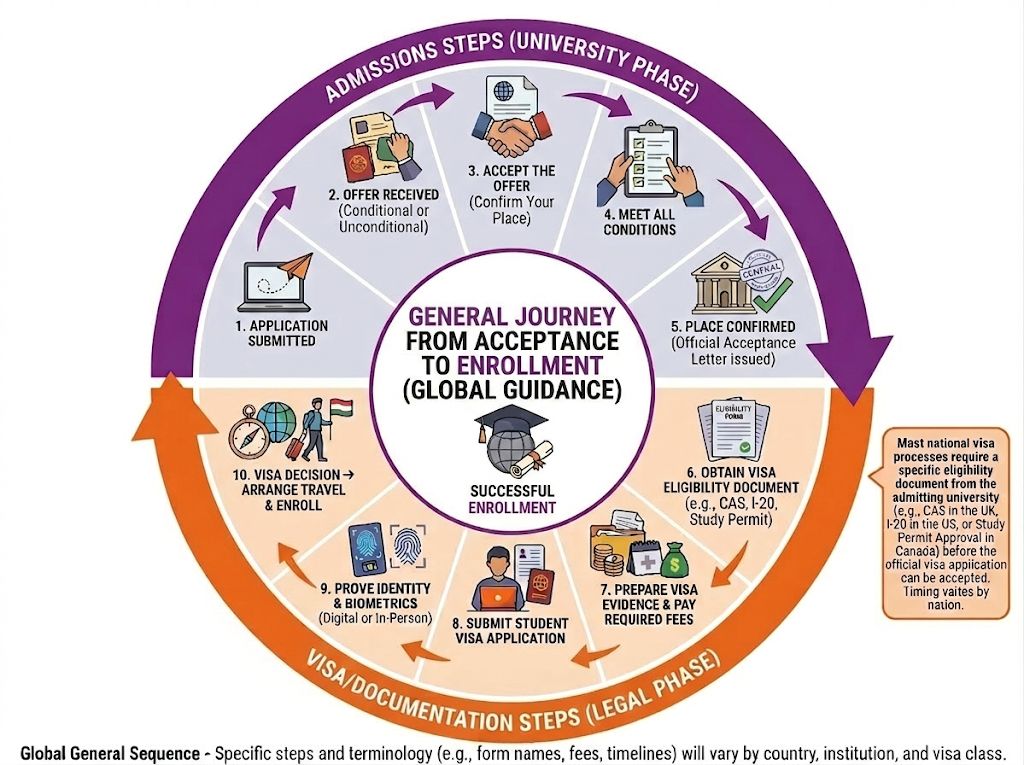
- Receive Form I-20 or DS-2019 and check the details
- Pay the SEVIS I-901 fee
- Complete the U.S. visa application form, DS-160, and pay the visa application fee
- Book and attend a visa interview where required
- If approved, receive the visa and prepare to travel
- Enter the United States within the permitted window and complete institution check-in and enrollment steps
Timing guidance
- Many students begin visa steps one to three months before program start, once the I-20 or DS-2019 is issued
- Appointment availability can affect timelines, so students should begin promptly once the trigger document is received
- Entry to the United States is generally permitted no more than 30 days before the program start date shown on the I-20 or DS-2019
Core evidence categories
This is not exhaustive, but usually includes:
- Identity and passport details
- Form I-20 or DS-2019 and SEVIS payment confirmation
- Proof of admission and program details
- Evidence of funding for tuition and living costs
- Ties and intent consistent with the visa classification, as assessed in the visa process
For the detailed step-by-step visa process, use the dedicated country visa guide.
Country-specific rules and exceptions
- Capacity and timing can affect outcomes. Rolling admission and program capacity limits can mean that applying earlier in an open window affects availability, even when the published final deadline has not passed
- Public universities may follow state or system policies, including additional in-state considerations, while still making institution-level admissions decisions
- Waitlists are common and may extend close to the start date
- Different immigration document triggers apply. F-1 and M-1 generally use Form I-20, while J-1 uses Form DS-2019
❗ With rolling admission, earlier can be safer. Places can fill before the published final deadline, so students should avoid waiting until the last date if a program is capacity-limited.
Key differences for UAE-based counselors
- Admissions is not centralized. Requirements and deadlines are institution-specific and program-specific
- Multi-factor review is common. Essays and recommendations may be required depending on the institution
- Application plans may include binding Early Decision and non-binding Early Action
- Shared application platforms may be used across many institutions, but portals and document rules still differ
- Visa sequencing depends on the institution issuing Form I-20 or DS-2019 and payment of the SEVIS I-901 fee before the visa application
Common counselor questions
Is there a national admissions authority for U.S. universities?
No. Each institution sets its own requirements, deadlines, and selection process.
Do all U.S. universities require SAT or ACT?
No. Testing policies are institution-set and may be test-required, test-optional, or not considered, depending on the institution and sometimes the program.
Are interviews required for admission?
Not nationally. Some institutions or programs use interviews, but many do not.
When does the visa process start?
Usually after admission, once the institution issues Form I-20 or DS-2019 for J-1 and the student pays the SEVIS I-901 fee.
Can students enter the U.S. far in advance of the start date?
Entry is generally permitted no more than 30 days before the program start date shown on the I-20 or DS-2019.
Are deposits always required to accept an offer?
No national rule applies. Many institutions use enrollment deposits, but policies vary, including refundability and deadlines.