
Hong Kong has a mixed admissions landscape. Local secondary students mainly apply through JUPAS, while many international and non-local applicants apply directly to individual institutions, often through routes described as Non-JUPAS or direct admission. Selection is usually qualification-based and program-based, with some programs adding interviews, tests, or portfolio review.
How applications work
Mixed system: JUPAS and direct or institutional routes
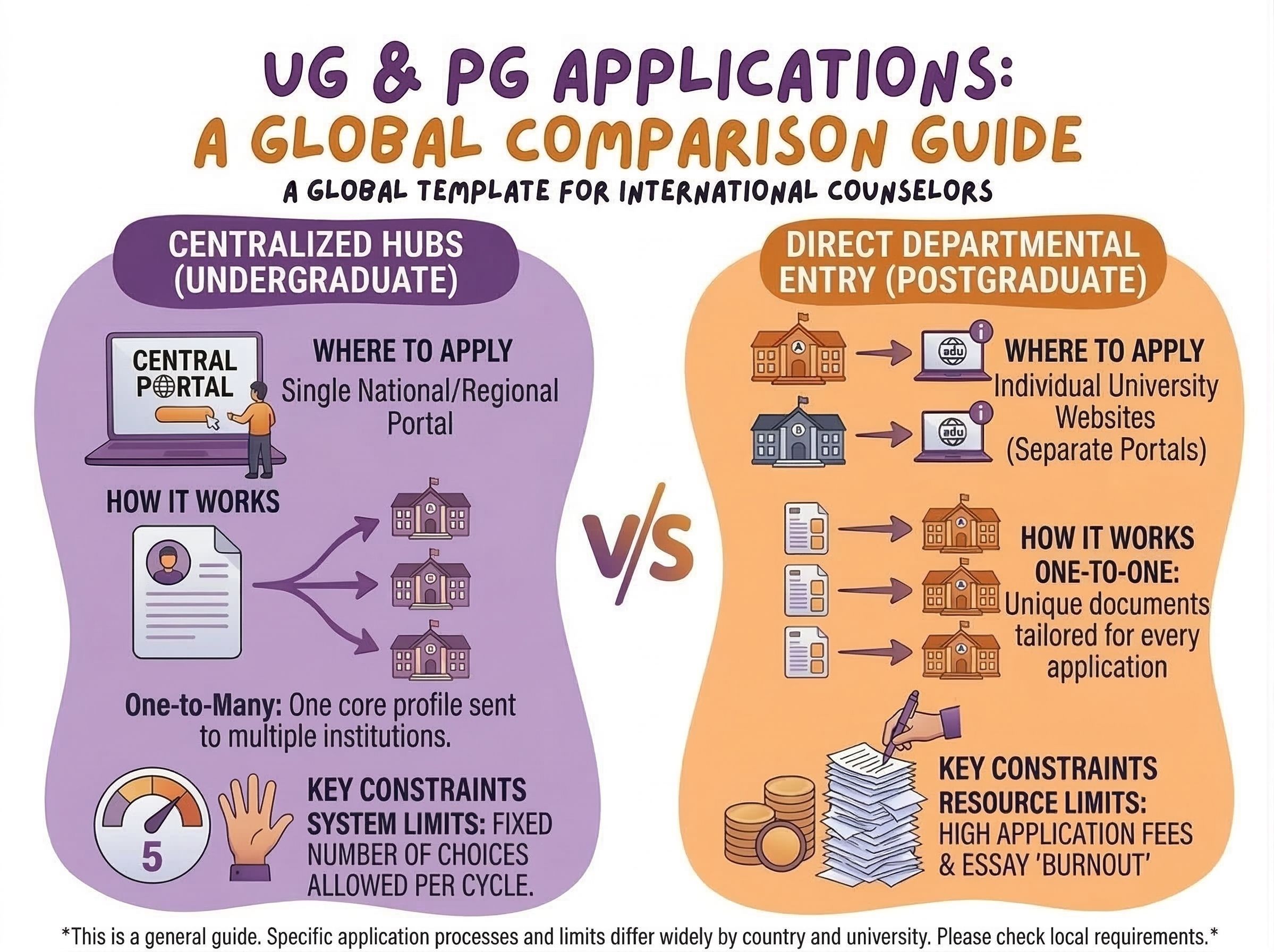
- JUPAS (Joint University Programmes Admissions System) is a joint admissions scheme mainly for local applicants with HKDSE results
- Non-JUPAS or direct applications are submitted to each institution separately and are widely used for applicants with non-HKDSE qualifications, including many non-local and international applicants, depending on the institution and program
Who sets requirements
- Scheme level, JUPAS: Provides the common application framework and cycle, with participating institutions and programs listed within the scheme
- Institution and program level: Sets entry requirements, required documents, selection methods, and decision timelines for direct or Non-JUPAS applications, as well as program-specific steps within JUPAS
How students apply
- JUPAS applicants submit program choices and required information through the JUPAS platform
- Direct or Non-JUPAS applicants submit applications through each institution’s admissions portal, separately for every institution they apply to
Structural variation
Application naming differs by institution, for example:
- Non-JUPAS
- Direct
- International
The underlying model is still institution-run admission outside JUPAS.
❗ International usually means Non-JUPAS or direct. JUPAS is mainly for HKDSE applicants, while most non-local students apply through each university’s own portal, so students should confirm the correct route early to avoid missing the right deadlines.
Application types and commitments
Main routes
- JUPAS route: Mainly for eligible local HKDSE applicants applying to participating programs and institutions
- Direct or Non-JUPAS route: Institution-run applications for applicants with non-HKDSE qualifications and or non-local applicant status, depending on institutional policy
Binding vs non-binding models
There is no single national binding model, such as a nationwide Early Decision system, across Hong Kong.
Acceptance commitments and timelines are set by institutions and programs.
Deadline patterns
- JUPAS follows a structured annual cycle with set stages
- Direct or Non-JUPAS deadlines vary by institution and program
- Some institutions use fixed rounds, while others use rolling review for part of the cycle
Key caveats
Applicants targeting multiple institutions outside JUPAS usually need to apply separately to each one.
❗ Outside JUPAS, there is no one application. If a student is targeting several universities, they usually need separate direct applications, separate document uploads, and separate tracking, so organization becomes a key success factor.
Eligibility and qualification recognition
Who decides eligibility
Eligibility is mainly decided by the institution and program the student applies to.
Recognition model
Institutions usually publish accepted qualification types, such as:
- International Baccalaureate (IB)
- GCE A Levels
- SAT, in some cases
- Other national school-leaving qualifications
They then assess applicants against program requirements.
The Hong Kong Qualifications Framework (HKQF) and Qualifications Register (QR) support system-level understanding of qualification levels in Hong Kong, but they do not function as a single national admissions clearinghouse for international qualifications.
Baseline expectations
Students are generally expected to present:
- A completed secondary qualification, or an equivalent qualification still in progress with predicted or interim results
- Any program prerequisites
- Any language evidence required by the institution
How applicants are assessed
Dominant model: Academic qualification-based selection set by institutions and programs, with additional program-specific assessment where required.
Primary selection factors
- Academic performance in recognized qualifications, using final results and or predicted results depending on timing
- Program prerequisites, such as subject background or math and science requirements where applicable
- English language evidence, where required by the institution or program
- Program-specific assessments, such as interview, written test, portfolio, or audition where required
Factors usually not primary nationally
- There is no single national admissions scoring model applied to all applicants outside JUPAS
- Non-academic activities may be considered in some cases, but are not a universal national determinant
Where variation occurs
Variation is highest by:
- Institution type, such as UGC-funded vs. self-financing
- Program, especially medicine, health, architecture, design, performing arts, and some competitive business or technology programs
Application platforms and key documents
JUPAS
The Joint University Programmes Admissions System (JUPAS) is the shared application scheme mainly for eligible local applicants using HKDSE results. It manages program choices, application stages, and offer rounds for participating programs, but institutions still set entry requirements and program-specific selection steps.
Direct or Non-JUPAS applications
Many non-local, international, and non-HKDSE applicants apply directly to individual institutions. These routes may be called Non-JUPAS, direct admission, international qualifications, or a similar institution-specific term.
Institution portals
Direct and Non-JUPAS applicants usually apply through each university’s own admissions portal. These portals are used for applications, document uploads, application fees, decision updates, offer acceptance, deposits, and later enrollment steps.
Program-specific selection
Some programs require extra assessment, such as interviews, written tests, portfolios, auditions, design tasks, or subject-specific evidence. These steps are set by the institution or program and may have separate deadlines.
Undergraduate vs postgraduate routes
Undergraduate applicants use either JUPAS or direct/Non-JUPAS routes depending on qualification type and applicant status. Postgraduate applicants usually apply directly to the institution, faculty, school, or department.
Platform rules and limitations
Hong Kong does not have one shared application platform for all applicants. JUPAS rules apply to eligible applicants in that scheme, while direct and Non-JUPAS routes follow each institution’s own rules, document requirements, deadlines, and offer process.
Documents required generally include, but are not limited to
- Application form or institution portal profile
- Passport or identity document
- Academic transcripts and certificates
- Predicted or interim results, where accepted
- English language evidence, where required
- Personal statement or program statement, where required
- Reference letters or referee details, where required
- CV or activities record, where requested
- Program-specific materials, such as portfolio, audition materials, written test, interview task, or scholarship form
- Immigration-related documents, usually requested later for visa or entry permit steps
School documents and references
What schools commonly provide
Schools may provide academic transcripts, predicted or interim results where accepted, final certificates when available, curriculum information, grading scale details, school profile information, and confirmation of the student’s academic background.
Who submits
Submission methods vary by route and institution. JUPAS applicants follow the scheme’s document and result-handling process, while direct or Non-JUPAS applicants may upload documents through institution portals or provide official documents, certified copies, or school verification when requested.
References
References are not a single national requirement for all Hong Kong undergraduate applications. They may be requested for direct/Non-JUPAS routes, scholarships, postgraduate programs, competitive programs, or institution-specific selection processes.
Predicted and interim results
Institutions may use predicted, interim, or pending results for applicants whose final qualifications are not yet available. Final admission or enrollment may still depend on official final results and meeting all stated conditions.
Where process differs by route
JUPAS, direct/Non-JUPAS, postgraduate, scholarship, creative, health-related, and highly selective programs may each request different school, referee, or evidence documents. Requirements are set by the institution, program, or scheme.
Student responsibilities
Students are usually responsible for:
- Checking whether the correct route is JUPAS, direct admission, Non-JUPAS, international application, or postgraduate application
- Confirming institution- and program-specific entry requirements
- Creating accounts in the required JUPAS or institution portal
- Completing each application accurately
- Paying application fees where applicable
- Uploading transcripts, certificates, predicted results, English evidence, and supporting documents when requested
- Completing program-specific steps such as interviews, written tests, portfolios, auditions, or additional forms
- Monitoring JUPAS, institution portals, and email for document requests, decisions, and offer instructions
- Accepting offers and completing deposit, verification, registration, or enrollment steps by stated deadlines
- Preparing visa or entry permit steps after receiving the required offer and sponsor instructions, if applicable
Key application timelines
JUPAS, typical pattern
- Application submission usually takes place in the months before the HKDSE examination and results release
- Offers and confirmations happen in staged rounds after results and assessment steps
Direct or Non-JUPAS, typical pattern
- For major intakes, applications often open months in advance and may run through multiple rounds
- Decisions may be released in batches or on a rolling basis depending on the institution and program
Lead-time expectations
Students who require a visa or entry permit should leave extra time after receiving an offer, because the immigration process is separate from admissions and requires sponsor submission and processing.
Typical intake timeline
Timings vary significantly by institution, program, and whether the route is JUPAS or direct/Non-JUPAS.
- Research and shortlist: Sep–Nov
- Direct applications open: Sep–Nov
- Main application windows: Nov–Jan
- Interviews and extra steps: Dec–Apr
- Decisions and offers: Jan–Aug
- Acceptance and deposits: Mar–Aug
- Visa or entry permit steps: May–Aug
- Main intake begins: Sep
English proficiency
There is no national minimum English requirement across all Hong Kong higher education admissions. Requirements are set by institutions and programs.
Proof may be required for applicants whose prior education was not taught and assessed in English, depending on the institution and program.
Common accepted evidence types
- Recognized English language test scores, such as IELTS or TOEFL, where accepted by the institution
- English-medium schooling evidence, where accepted by institutional policy
- Qualification-specific English components, where accepted
Waivers
Waivers, where available, are usually institution-defined and depend on the student’s curriculum and education history.
Standardized or entrance testing
There is no single national admissions test required for all applicants across Hong Kong institutions.
Testing policy is set by the institution and program and may include:
- Recognition of international qualifications that already include standardized assessment, such as IB Diploma or GCE A Levels
- Program-specific tests, interviews, auditions, or portfolio assessment
- In the JUPAS context, HKDSE results are central for eligible applicants
Decision logic and offers
How decisions are communicated
Decisions are usually communicated through:
- The JUPAS system for JUPAS-route applicants
- The institution’s admissions portal and or email for direct or Non-JUPAS applicants
Common offer and outcome types
- Offer of a place, sometimes conditional
- Rejection or unsuccessful outcome
- Waitlist or reserve outcome, where used
Post-offer sequencing
This usually includes:
- Acceptance and deposit or payment steps, where applicable
- Document verification and identity checks
- Issuance of documents needed for the visa or entry permit process
- Registration and enrollment steps
Offer definitions
Conditional offer: A place is offered if the student meets stated conditions, often final results, missing documents, or other requirements.
Unconditional offer: The place is confirmed without academic conditions, but the student may still need to complete non-academic steps such as document verification, identity checks, payment, enrollment requirements, or right-to-study checks.
Deposits and acceptance steps
There is no single national rule requiring deposits across all Hong Kong institutions.
Deposits and payment schedules are institution-specific and program-specific and are more common where institutions use them to confirm acceptance and unlock enrollment steps.
Typical acceptance steps may include
- Accepting the offer in the institution’s system by the deadline
- Paying a deposit or initial tuition installment, where required
- Submitting original or certified documents for verification, where requested
- Completing registration and student records steps
Student visa or residence permit overview
Official name
Visa or Entry Permit for Study in the Hong Kong Special Administrative Region
Trigger event
The student has an acceptance for an eligible program and nominates a local sponsor, often the admitting educational institution.
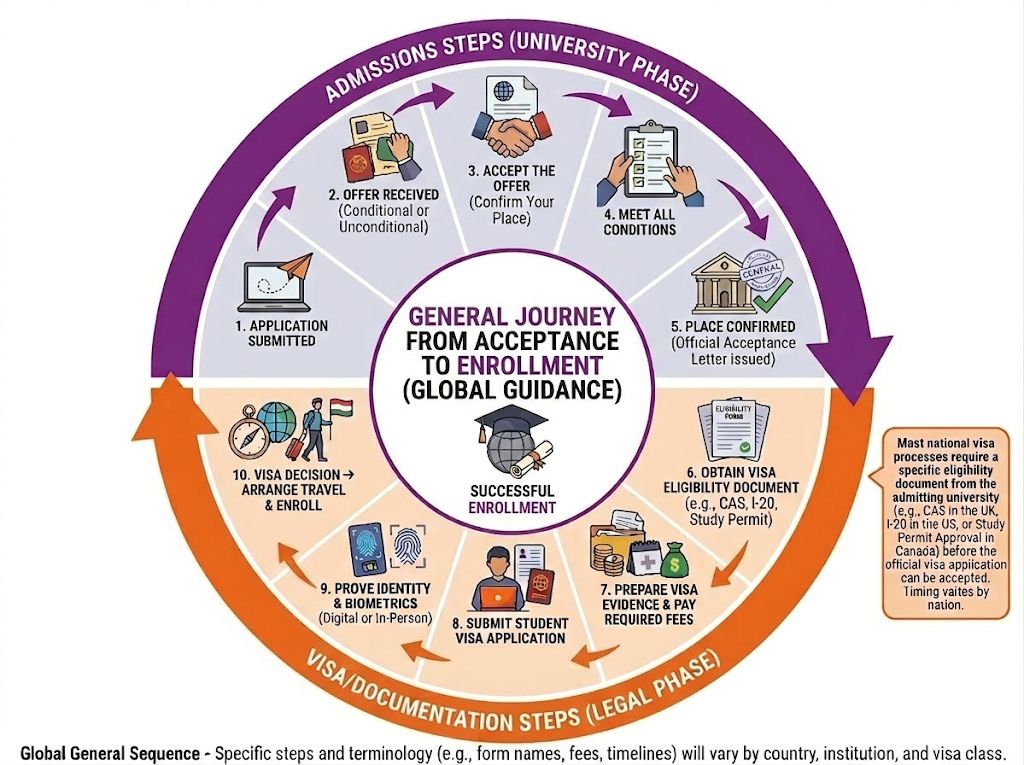
Typical steps
- Receive and accept the institution’s offer and complete any required acceptance steps
- Arrange the institution’s sponsorship process, where the institution acts as local sponsor if applicable
- Submit the visa or entry permit application and supporting documents as instructed
- Wait for the Immigration Department’s processing and respond to any requests for additional information
- Receive the visa or entry permit outcome and follow instructions about label or permission details
- Travel and complete institution registration and enrollment using the approved study permission
Timing guidance
- Processing is commonly quoted as around 6 weeks after the Immigration Department receives all required documents
- Processing can take longer during peak periods or if extra verification is needed
- Students should avoid booking non-refundable travel before the visa or entry permit is approved where possible
Core evidence categories
This is not exhaustive, but usually includes:
- Proof of admission or acceptance and program details
- Identity documents, such as passport or ID
- Sponsor information, whether institution or eligible individual sponsor
- Evidence of financial support and accommodation arrangements where required
- Academic and supporting documents requested for the application
❗ Study permission usually requires a local sponsor. In many cases the admitting institution sponsors the application, and the visa or entry permit timeline comes after the offer and acceptance steps, so students should leave time for sponsor submission and processing before booking travel.
For full details, students should use the detailed Hong Kong visa guide.
Country-specific rules and exceptions
- Route split matters: JUPAS is mainly designed for local HKDSE applicants, while many non-local and international applicants use institution-run direct routes
- Local sponsorship requirement: Entry for study usually requires a local sponsor, often the admitting institution or, in some cases, an eligible individual
- Non-local student intake limits: Some publicly funded institutions may operate within government-set ceilings or parameters on non-local intake
Key differences for UAE-based counselors
- Admissions is not run through a single national common app for all applicants
- Students may need separate direct applications across institutions outside JUPAS
- There is a clear split between the local HKDSE and JUPAS route and the direct or Non-JUPAS route used by many non-local students
- Selection is typically qualification-driven and program-driven, with additional assessments used selectively
- The visa or entry permit process is commonly handled through a local sponsor, often the institution, and comes after the admissions offer
Common counselor questions
Can international students apply through JUPAS?
JUPAS is mainly for eligible local applicants with HKDSE results. Many international and non-local applicants use direct institution-run routes instead, depending on the university’s policy.
Is there one national deadline for Hong Kong university applications?
No. JUPAS follows a structured cycle, but direct or Non-JUPAS deadlines are set by each institution and program.
Do all programs require interviews or extra tests?
No. Many programs use qualification-based selection, but some require interviews, tests, auditions, or portfolios.
Is there a national English test minimum for admission?
No. English requirements are set by institutions and programs, and there is no single national minimum across all universities.
When should the student start the visa or entry permit process?
Usually after an offer is issued and the sponsor or institution provides instructions for the visa or entry permit submission.
Who can sponsor a student visa or entry permit application?
A local sponsor is required. This is often the admitting educational institution, or in some cases an eligible individual sponsor under immigration rules.
Studee customer support
Studee can support you with application process questions and next-steps.