
Canada’s higher education system includes universities and colleges that offer a wide range of academic and career-focused options. Study is usually modular and credit-based, with a mix of lectures, smaller discussion classes, labs, and project work depending on the subject. After graduation, many students move into work or further study, and employability often depends on skills, experience, and local labor market demand.
How degrees are structured
Most post-secondary education is run by provinces and territories, so structures can differ slightly by location and institution type. Universities mainly offer academic degrees, while colleges often focus on applied learning and career-ready qualifications, and many also partner with universities.
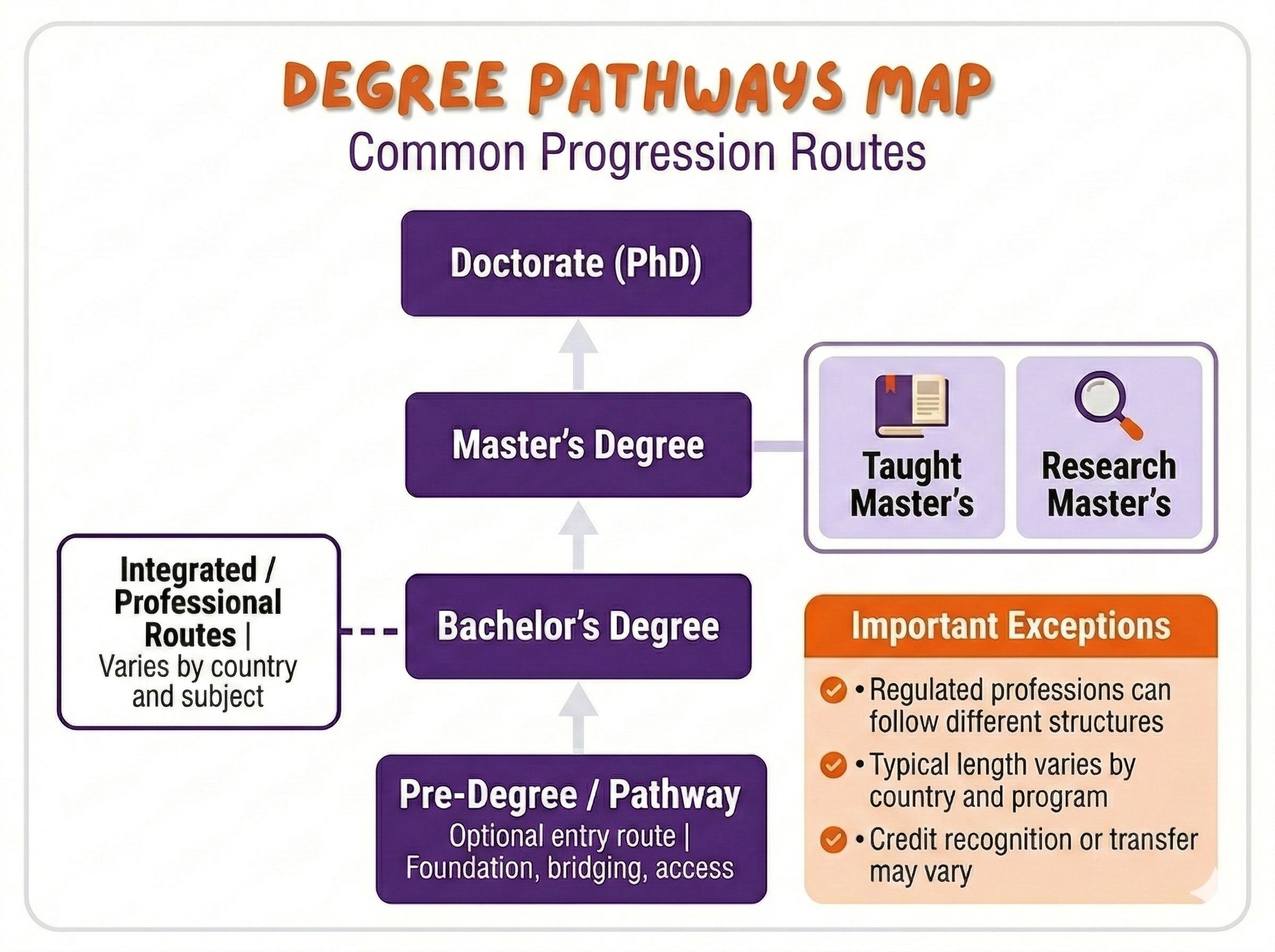
Common degree levels and usual lengths
- Bachelor’s degree: often 3 to 4 years
- Master’s degree: often 1 to 3 additional years after a bachelor’s
- Doctoral degree: often 3 to 4 additional years after a master’s
Modular structure
- Courses are usually taken as separate modules, with credits earned per course and requirements built up over time
Teaching and assessment
- Common formats include lectures, seminars, tutorials, labs, studios, and group projects
- Assessment often combines exams with coursework such as essays, reports, presentations, labs, and capstone projects
Flexibility and pathways
- Many programs allow some choice of courses, and students can often change direction within a field after the first year
- Transfer routes between colleges and universities exist in some provinces, but rules vary
Important exceptions
- Regulated fields such as medicine, dentistry, nursing, engineering, teaching, and some professional programs may have fixed structures and additional accreditation or licensing steps after graduation
❗ “College” can mean different things depending on the province. Many colleges offer strong applied programs and some have transfer pathways into universities, but transfer rules and credit recognition vary, so students should check the pathway structure before assuming an easy switch.
Academic strengths & popular study fields
Canada is known for strong public research, applied learning options, and close links between education and industry in many regions. Strengths often reflect the local economy, so what feels “strong” can vary by province and city.
Well-known strengths across Canada
- Engineering and technology
- Computer science, data-related fields, and digital industries
- Health and life sciences
- Business and management
- Environmental science, climate-related fields, and sustainability
Industry ecosystem links
- Many programs connect to employers through co-op, internships, applied projects, or placement-style learning
- Tech and innovation clusters are notable in several major cities, while other regions specialize in areas like natural resources, agriculture, and marine or environmental work
Patterns in international student choices
- International students often choose career-aligned fields with clear job pathways, but choices vary widely by student goals and region
Regional and institution differences
- Program focus can differ between research-led universities and more applied, career-focused colleges
- Specialisms can be shaped by local employers, provincial funding priorities, and regional industries
Student life & learning style
Student life in Canada can look very different depending on whether you study in a large city, a mid-sized town, or a smaller community. Learning tends to expect independence, steady work across the term, and active use of support services when needed.
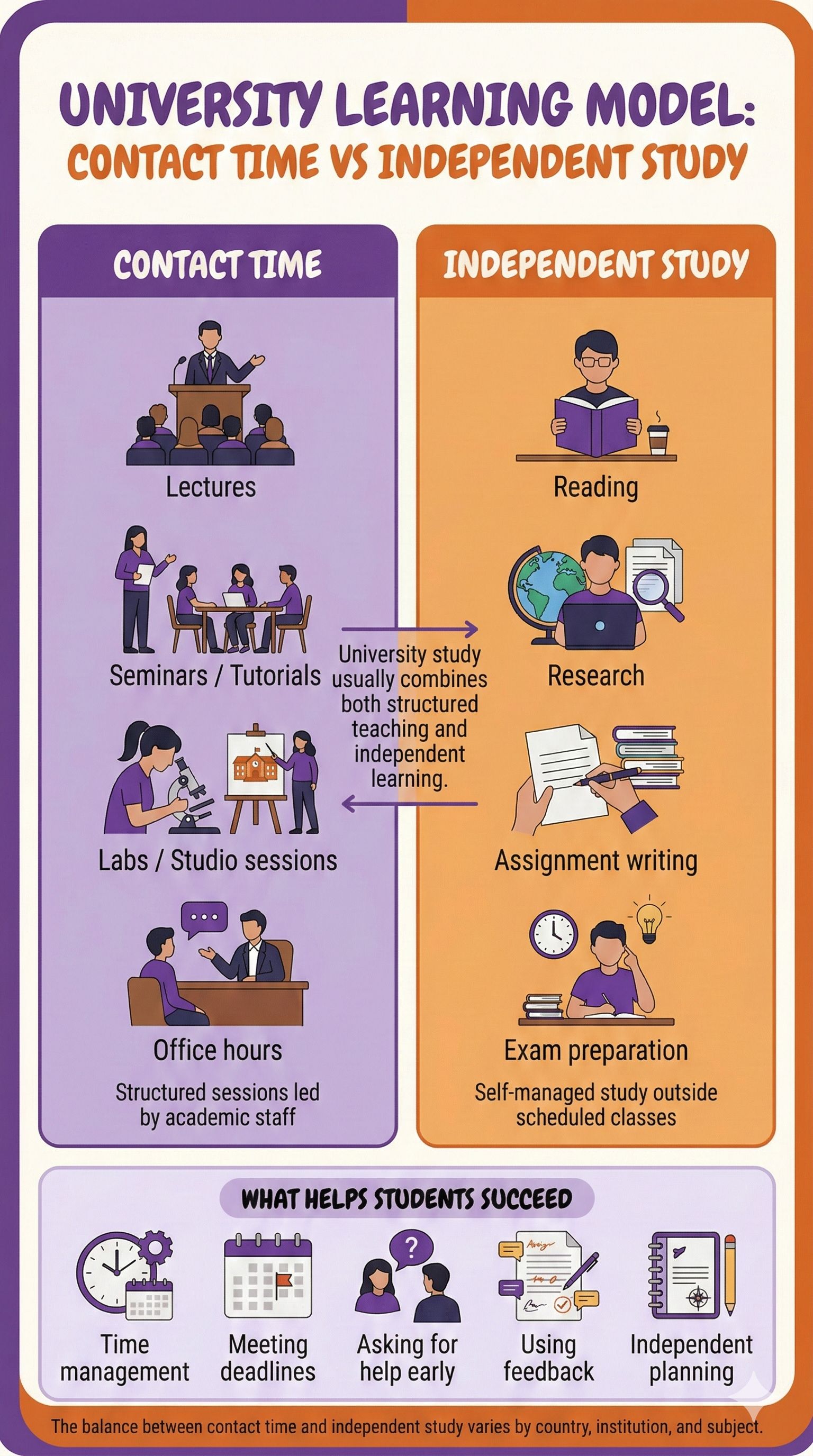
Classroom culture and independence
- Students are usually expected to manage their own schedule, keep up with readings, and meet deadlines without reminders
- Asking questions, joining discussions, and attending office hours is generally normal and encouraged
Contact hours and self-study
- Many programs mix scheduled class time with significant independent study, especially in essay-based subjects
Group work and feedback
- Group projects are common in many fields, especially business, engineering, and technology
- Feedback often comes through marked assignments, rubrics, and meetings with teaching staff
Campus and commuting
- Some students live on or near campus, especially early on, while many commute in big cities
- Clubs, societies, volunteering, and recreation are a big part of student experience where students choose to engage
Accommodation and daily life
- Options often include university residences, shared apartments, homestays, or family housing
- Weather and distances can shape daily routines, especially in winter and in spread-out cities
What happens after graduation
After graduating, students often move into work, professional training, or further study. Career outcomes depend on the subject, the local job market, and how much relevant experience a student gained during study.
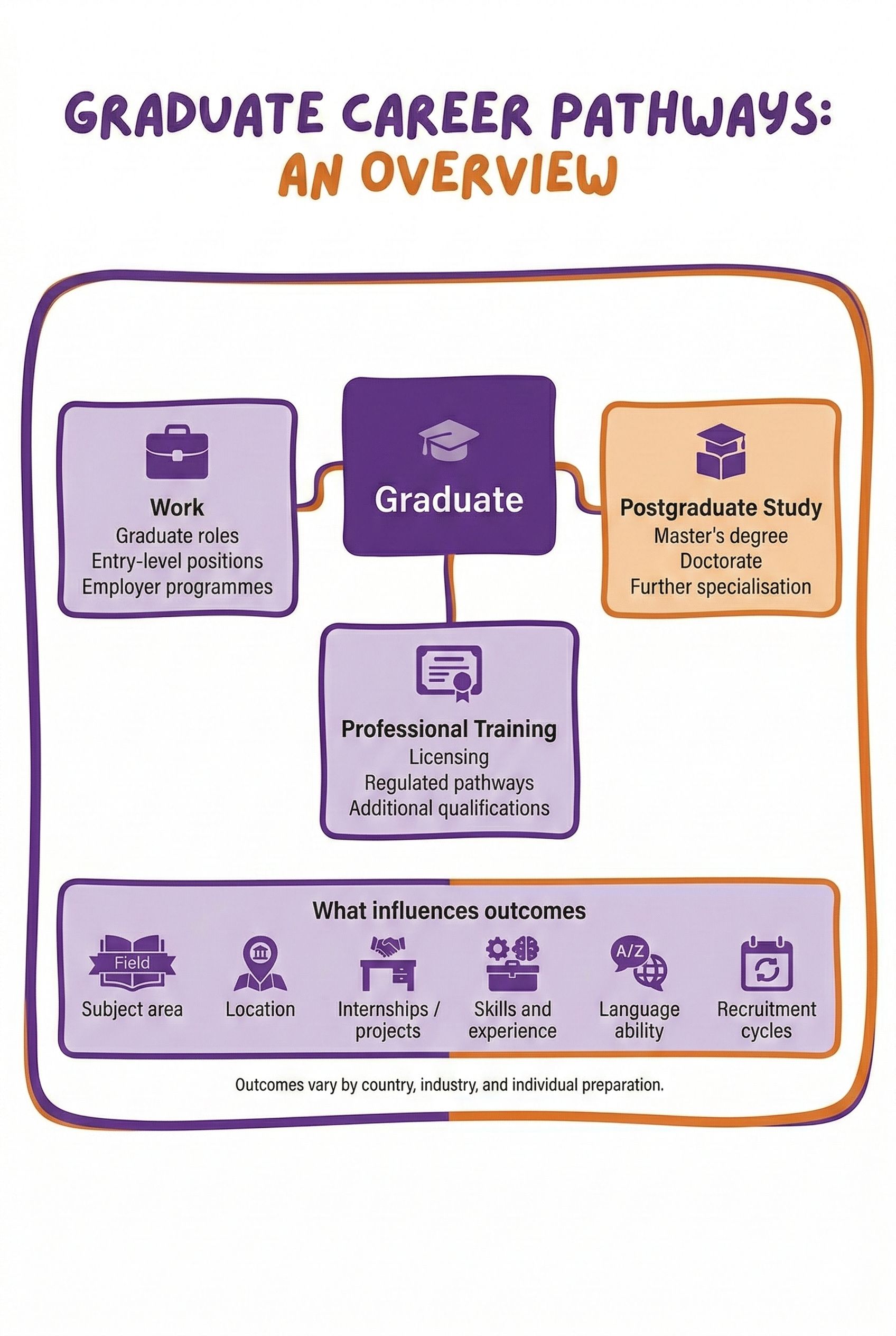
Common next steps
- Work in Canada or internationally
- Further study such as a master’s degree, doctorate, or professional qualifications
How employability typically works
- Employers often look for a mix of academic results, practical experience, and transferable skills such as communication and teamwork
- Work experience gained through co-op, internships, part-time work, research assistant roles, or industry projects can be important
- Career services can help with CVs, interviews, networking, and job search strategy, but students usually need to be proactive
National measurement
- Canada tracks labor market outcomes and earnings patterns by education level and field through national statistics
Variation is normal
- Pathways can differ a lot by subject area, province, and the strength of the local job market
❗ In Canada, experience often drives outcomes as much as grades. Co-op, internships, research roles, and part-time work can make a big difference in job searches, so students should plan early for experience-building alongside their course.
Costs & funding overview
Costs in Canada usually include tuition, housing, living expenses, local transport, and health insurance arrangements where required. Costs vary significantly by province, city, and housing choice, and international tuition can be much higher than domestic tuition.
What families should budget for
- Tuition and compulsory fees
- Housing and utilities
- Food and daily living costs
- Local transport and study materials
- Health coverage arrangements where required by the institution or province
What makes costs higher or lower
- Large cities are often more expensive than smaller towns
- Renting privately can cost more than student residences in some locations
- Program type and subject area can affect tuition levels
- Living style choices such as shared housing, cooking at home, and transport use can make a big difference
How families usually fund study
- Family funding is common for international students
- Scholarships and bursaries may be available through institutions and external organizations
- Education loans may be possible for some students depending on home country options and eligibility rules
- Part-time work during study can support living costs for some students, but it is not a reliable way to cover full costs
❗ Canada’s costs aren’t “one national price.” International tuition and living costs can differ sharply by province and city, so families should budget using the specific location and program, not a Canada-wide average.
Typical costs
These figures are best used as high-level planning ranges. Exact costs vary by province, city, institution, program, and student status.
Typical cost of a degree
Official data shows that average international undergraduate tuition in 2025/2026 is C$41,746 per year at publicly funded Canadian degree-granting institutions. On that basis, tuition alone for a typical 4-year bachelor’s degree is often around C$166,984 total, before scholarships or other support. Some subjects cost more than the overall average.
Typical cost of living
For an official national planning benchmark, Canada’s study permit financial requirement is currently C$22,895 for living expenses for a single applicant, separate from first-year tuition and travel costs. This is a useful baseline for planning, but actual living costs can be higher depending on province, city, housing, and lifestyle.
Scholarships
Scholarships for international students are available in Canada, but they are not the main source of funding for most students. Many opportunities are institution-specific, and national scholarship options do exist but are not structured as one single universal funding system for all international students. For official information on scholarship options, see EduCanada’s international scholarships page.
Who is this country a good fit for?
Canada can suit students who want a safe, multicultural environment with many study options and a mix of academic and applied learning styles. It can also suit students who value practical experience and want flexibility to explore within a broad field.
Students who tend to thrive
- Self-managing students who can plan their week and keep up with continuous assessment
- Students who learn well through a mix of theory and practical work
- Students who are comfortable asking for help and using support services early
Good fit by academic interests
- Strong fit for students interested in technology, engineering, business, health, environmental fields, and many research-led areas
Good fit by lifestyle preferences
- Students who like a diverse social environment and a wide choice of city or town settings
- Students open to outdoor activities and seasonal weather changes
May feel challenging if
- You strongly prefer highly structured day-to-day supervision and frequent reminders
- You find it difficult to participate in class discussions or group projects
What may feel different in Canada’s higher education system
Studying in Canada often involves more independence and self-advocacy than students may be used to at school. Teaching is usually structured, but students are expected to manage readings, deadlines, coursework, communication, and support-seeking proactively.
Teaching style
- Teaching often includes lectures, seminars, tutorials, labs, studios, workshops, or project-based sessions, depending on the subject
- Students are usually expected to prepare before class, ask questions, join discussions, and attend office hours when they need help
- Learning style can differ between universities, colleges, large city campuses, smaller institutions, and applied programs
Assessment style
- Assessment commonly includes exams, essays, reports, lab work, presentations, group projects, participation, and capstone tasks
- Many programs use continuous assessment across the term, not only final exams
- Academic integrity rules are important, and students are expected to understand expectations around independent work, collaboration, citation, and use of sources
Independence level
- Students are expected to manage their schedule, track deadlines, keep up with readings, and ask for help early
- Academic advising, tutoring, office hours, wellbeing support, and career services are often available, but students usually need to use them actively
- Experience-building can be important, so students may need to plan ahead for co-op, internships, research roles, volunteering, or part-time work where relevant
Campus culture
- Student life can vary between residential campuses, commuter campuses, big-city institutions, and smaller college-town settings
- Clubs, societies, volunteering, recreation, and student services can be a major part of the experience where students choose to engage
- Weather, distance, transport, and housing can shape daily routines, especially in winter or in spread-out cities
❗ Support exists, but students usually need to take the first step. In Canada, asking questions, using office hours, and planning early for coursework and experience can make a big difference.
Canada study permit overview
Most international students who study a full degree in Canada need a study permit. Depending on nationality, students may also need a visitor visa or an electronic travel authorization to enter Canada, but the study permit is the main immigration document linked to study.
For most degree students, the key documents include a letter of acceptance from a designated learning institution (DLI) and, in many cases, a provincial attestation letter or territorial attestation letter (PAL/TAL). The PAL/TAL is usually provided through the institution and confirms that the student has a place within the province or territory’s student allocation. Students usually need these documents before their study permit application can move forward.
Main visa points
| Visa point | What students should know |
|---|---|
| Visa type | Study permit; some students may also need a visitor visa or electronic travel authorization to enter Canada |
| Main dependency | The student usually needs a letter of acceptance from a designated learning institution and, where required, a PAL/TAL |
| Typical application timing | Students should usually plan after receiving the required acceptance and attestation documents, and well before the course start date |
| Typical decision time | Processing times vary by country, season, application completeness, and whether biometrics or extra checks are needed |
| Interview | A visa interview is not usually a standard requirement, but students may be asked for biometrics, medical exams, documents, or further information |
| Extra requirements | Students may need to show they meet identity, financial, academic, medical, biometrics, and admissibility requirements |
Why this matters
The Canada visa timeline is closely connected to the admissions and document timeline. A student may have an offer, but they usually still need the required DLI acceptance documents, any required PAL/TAL, financial evidence, biometrics, and a study permit decision before they are ready to travel.
❗ A Canadian offer does not automatically mean a student is ready to apply for a study permit. DLI status, PAL/TAL requirements, financial evidence, biometrics, processing times, and travel planning all need to fit around the course start date.