
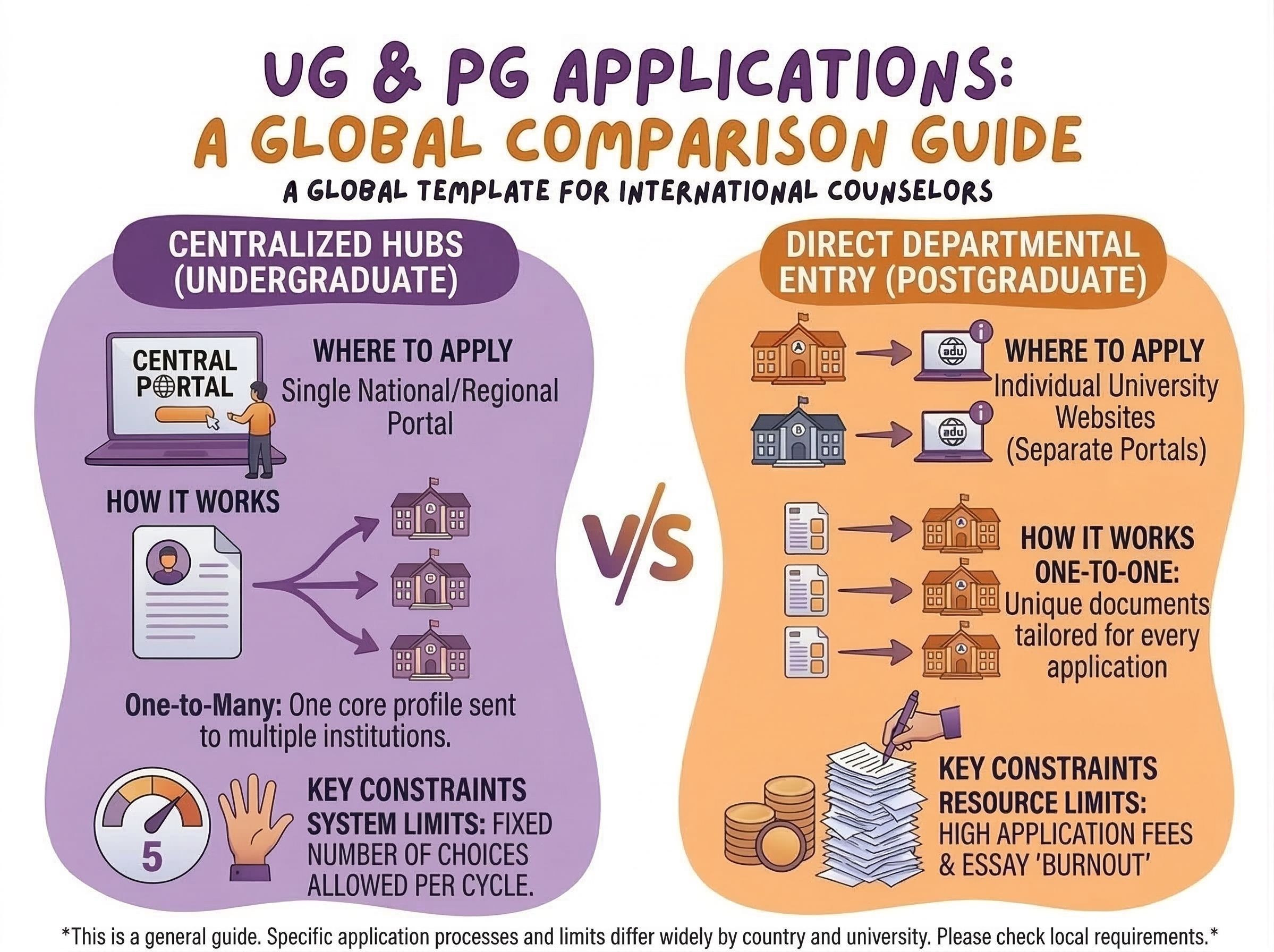
New Zealand university admissions are decentralized. Each university, and often each program, sets its own entry requirements, document rules, and selection steps. For most applicants, decisions are based mainly on academic eligibility plus any program-specific requirements, such as portfolios, auditions, or interviews.
How applications work
System type: Decentralized. There is no single national application portal for all universities.
Who sets requirements: Individual universities and programs.
How students apply: Students typically apply directly to each university using that university’s online application system. Some universities may route parts of the process through their own portals for documents and offer acceptance.
Structural variation: Requirements and timelines vary by:
- Level, for example foundation, pathway, undergraduate, or postgraduate
- Program type, such as open entry vs. limited entry
- Capacity constraints and additional selection steps, which are common in clinical and creative programs
Application types and commitments
Main routes
New Zealand uses a decentralized application model. Students usually apply directly to each university, with route and requirements set by the institution and program.
Common routes include:
- Direct bachelor’s entry: For students who meet academic, subject, and language entry requirements
- Pathway or foundation routes: For students who do not yet meet direct academic or English entry requirements
- Limited entry programs: Competitive programs with capped places, fixed deadlines, or extra selection steps
- Postgraduate applications: Usually direct to the university, with program-specific academic, supervisor, or professional requirements where relevant
Binding vs non-binding
New Zealand does not use a national binding admissions model. Commitment usually happens when a student accepts an offer and completes the institution’s enrollment, payment, or place-confirmation steps.
Deadline patterns
Many programs accept applications on a rolling basis, but limited entry, high-demand, clinical, creative, or professional programs may use earlier closing dates or fixed selection rounds.
❗ Rolling applications can still close early when a program reaches capacity or moves into a selection round.
Key caveats
Some programs only start at specific intakes, even if the university accepts applications across much of the year. Program-specific steps such as interviews, auditions, portfolios, or selection tests may also have separate deadlines.
Eligibility and qualification recognition
Who decides eligibility
Universities decide admission to their programs.
Recognition model
Universities assess whether a student’s prior study is equivalent to New Zealand entry expectations. For some overseas qualifications, students may be asked to obtain an assessment from the New Zealand Qualifications Authority (NZQA), such as an International Qualification Assessment (IQA).
Baseline expectations
For domestic secondary qualifications, the national minimum standard for entry is University Entrance, which is linked to NCEA. Programs may still set higher or additional requirements.
❗ NZQA assessments can add weeks of lead time. Students should only apply for an IQA if the university asks for it, or if it is clearly required for their route, and should build extra time into the plan if external verification is needed.
How applicants are assessed
Dominant model: Academic eligibility plus program-specific checks.
Primary selection factors
Typical priority order includes:
- Academic record, including school-leaving qualification, grades, results, and prerequisite subjects
- Program prerequisites, such as required subjects, prior study, or minimum achievement in specific areas
- Additional selection steps where required, such as portfolio, audition, interview, aptitude testing, references, or admissions statements
Factors usually not primary nationally
There is no national requirement for broad extracurricular, leadership, or community profiles to be assessed across all programs.
Where variation occurs
- Limited entry programs may rank applicants competitively and use interviews or tests
- Postgraduate selection often places more weight on prior tertiary study, relevant background, and sometimes supervisor or project fit
Application platforms and key documents
Direct university applications
New Zealand does not have one national university application portal. Students usually apply directly through each university’s own online application system.
Institution portals
Universities use their own portals to collect applications, documents, offer responses, enrollment steps, and sometimes visa-supporting information. Students applying to more than one university usually need to manage separate accounts and deadlines.
Pathway and foundation routes
Pathway, foundation, and English preparation programs may use the university’s portal or a linked pathway provider process. These routes can have different entry requirements, start dates, and document rules from direct bachelor’s entry.
Limited entry programs
Limited entry programs have capped places or extra selection steps. They may require earlier application deadlines, interviews, auditions, portfolios, references, aptitude tests, or additional forms.
Undergraduate vs postgraduate routes
Undergraduate applicants usually apply directly to the university for the relevant degree or pathway. Postgraduate applicants also apply directly, but may need additional documents such as a CV, research proposal, supervisor approval, or evidence of prior tertiary study.
Platform rules and limitations
New Zealand does not have one national application deadline, national choice limit, or central offer system. Application rules, document formats, deadlines, and decision timing vary by university, program, and intake.
Documents required generally include, but are not limited to
- Application form or university portal profile
- Passport identity page and name-change evidence, where relevant
- Academic transcripts, grade reports, and qualification certificates
- Certified translations if documents are not in English
- Evidence of prerequisite subjects or credits, where required
- English language evidence, where required
- Program-specific materials, such as a portfolio, audition materials, writing sample, CV, references, interview booking, or selection test result
- Immigration-related documents, often requested later for visa or enrollment steps
School documents and references
What schools commonly provide
Schools may provide academic transcripts, predicted or interim results where accepted, final certificates when available, curriculum information, grading scale details, and confirmation of the student’s academic background.
Who submits
Submission methods vary by university and program. Some universities allow students to upload school documents through the application portal, while others may request official documents, certified copies, or verification from the school or awarding body.
References
References are not a national requirement for all New Zealand undergraduate applications. They may be requested for specific programs, scholarships, limited entry routes, postgraduate study, professional programs, or institution-specific procedures.
Predicted and interim results
Universities may use predicted, interim, or expected results where final qualifications are not yet available. Final admission or enrollment may still depend on official final results and meeting stated conditions.
Where process differs by route
Limited entry, postgraduate, pathway, clinical, creative, and professional programs may ask for different school, referee, or evidence documents from standard undergraduate applications. Requirements are set by the university or program.
Student responsibilities
Students are usually responsible for:
- Checking program-specific entry requirements, prerequisites, and deadlines
- Confirming the correct university or pathway application route
- Creating accounts in the relevant university portal or portals
- Completing each application form accurately
- Paying application fees where applicable
- Uploading transcripts, certificates, translations, and supporting documents when requested
- Providing English language evidence where required
- Completing program-specific steps such as tests, interviews, auditions, portfolios, references, or selection tasks
- Monitoring university portals and email for document requests and decisions
- Accepting an offer and completing enrollment or payment steps by stated deadlines
- Preparing student visa steps after receiving an Offer of Place or enrollment evidence, if applicable
Key application timelines
Submission windows
Many applications can be submitted months in advance and may be assessed as they become complete. Limited entry programs often have defined closing dates.
Decision timing
Decisions may be issued on a rolling basis for open-entry programs, while limited entry programs often issue decisions after a selection round.
Lead-time expectations
When an application requires external verification, such as an NZQA assessment, lead times can increase and should be built into the overall schedule.
Typical intake timeline
Variation is high across universities, programs, and intakes.
- Research and shortlist: Jun–Sep
- Main intake applications: Aug–Dec
- Limited entry deadlines: Sep–Dec
- Decisions and offers: Oct–Feb
- Acceptance and enrollment: Nov–Feb
- Student visa steps: Nov–Feb
- Main intake begins: Feb–Mar
- Mid-year intake begins: Jul
English proficiency
Proof of English is commonly required for international applicants unless the student qualifies for an institutional waiver or has approved prior study in English.
Accepted evidence types
Typical evidence includes:
- Recognized English language tests, for example IELTS or TOEFL
- Approved prior education in English, where accepted by the institution
There is no single national minimum for all university admissions. Requirements are set by institutions and programs, and sector guidance may be used as an indicative reference point.
Standardized or entrance testing
There is no national general entrance test for New Zealand university admissions.
Some programs set their own testing or aptitude requirements.
Example
- UCAT ANZ is used by a consortium of Australia and New Zealand universities for entry to certain medicine, dentistry, and clinical science programs where applicable
Decision logic and offers
Decisions are communicated by each university through its applicant portal and or email, sometimes with follow-up steps for enrollment.
Common outcome types
Conditional offer: A place is offered if the student meets stated conditions, often final results, missing documents, or other requirements.
Unconditional offer: The place is confirmed without academic conditions, but the student may still need to complete non-academic steps such as document verification, identity checks, payment, enrollment requirements, or right-to-study checks.
Not offered or waitlist: These may be used for competitive programs.
Post-offer sequencing
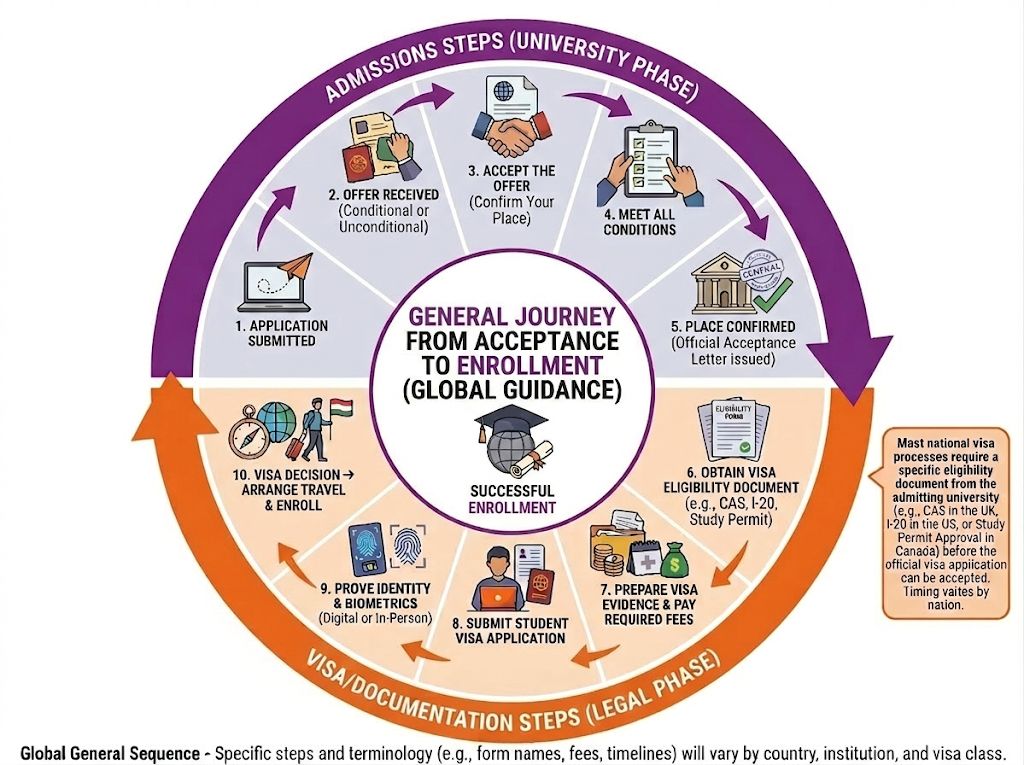
For students who need a visa, the sequence usually follows:
Accept offer or enroll → use the offer or enrollment evidence for the visa application
Deposits and acceptance steps
There is no national rule on deposits for university study.
Deposits and payment timing, where required, are set by institutions and may be linked to:
- Confirming acceptance or enrollment
- Holding a place in capacity-limited programs
- Issuing enrollment documentation needed for visa steps
Student visa or residence permit overview
Official name
Student visa (New Zealand)
Trigger event
An offer of place or evidence of enrollment from a New Zealand education provider, commonly required for study longer than 3 months.
Typical steps
- Receive an offer of place or enrollment evidence from the provider
- Apply online with Immigration New Zealand
- Provide identity evidence and any required information, including medical or police checks where applicable
- Provide required evidence and pay applicable fees
- Receive a decision and follow instructions for travel and enrollment
Timing guidance
- Apply as early as possible once the offer or enrollment evidence and supporting documents are ready
- Immigration New Zealand strongly encourages applying around 3 months before intended travel to reduce peak-time delays
- Processing times vary by season and application volume, and Immigration New Zealand publishes current wait-time information
Core evidence categories
This is not exhaustive, but usually includes:
- Identity, such as passport
- Offer of place or enrollment evidence
- Financial evidence showing ability to support living costs and pay fees, where applicable
- Health and character evidence, including medical or police checks where applicable
- Travel or insurance-related evidence where required by visa conditions or provider process
❗ Visa steps usually start after an Offer of Place or enrollment evidence is issued. If a university needs extra documents before confirming enrollment, delays at that stage can compress the visa timeline, so students should respond quickly to document requests.
For the detailed visa guide, refer to the dedicated New Zealand student visa guide.
Country-specific rules and exceptions
- University Entrance is the national minimum standard for students using the New Zealand secondary system, but programs can still set additional requirements
- Some overseas qualifications may require an NZQA assessment depending on the intended use and institutional requirements
- Limited entry programs may use competitive ranking and extra selection steps that are not used across all programs
Key differences for UAE-based counselors
- There is no single national university application portal. Students usually apply separately to each university
- Rolling assessment is common for many programs, but limited entry courses may use selection rounds and earlier closing dates
- The main intake is often at the start of the academic year, with additional intakes available for some programs
- Visa trigger documentation is an offer of place or enrollment evidence, not CAS, I-20, or CoE terminology
- Qualification evaluation may involve NZQA, which can add processing time
Common counselor questions
Do students apply through a central system like UCAS?
No. Applications are generally made directly to each university through its own platform.
Is University Entrance required for international students?
University Entrance is the national standard linked to New Zealand secondary qualifications. International students are assessed on their own qualifications using university equivalency rules.
Are there national deadlines for applications?
No. There are no national deadlines across all universities. Deadlines depend on the institution, program, and intake.
Is there a national English language minimum for admission?
No. English requirements are set by institutions and programs, though sector guidance may show common expectations.
Are entrance tests required for most degrees?
Not nationally. Tests are program-specific. Some clinical programs use UCAT ANZ where relevant.
What document is usually needed to start the student visa process?
Usually an offer of place or evidence of enrollment from a New Zealand education provider.
Studee customer support
We can help with your application steps and sequencing.