
Turkey has a mixed admissions structure. Turkish nationals usually enter undergraduate study through a central exam and placement system, while international students usually apply directly to universities under institution-set rules, often using TR-YÖS and or internationally recognized qualifications.
How applications work
Mixed system: national and institutional routes
- Centralized placement is used mainly for domestic undergraduate entry through the national exam and placement system run by ÖSYM
- Decentralized admissions are common for international students, who usually apply directly to each university, whether public or foundation or private
Who sets requirements
- The Council of Higher Education (YÖK) sets the higher-level framework for the sector and recognizes certain admission and assessment routes for international applicants
- Universities set program-level requirements, application windows, required documents, quotas, and how they use exams and qualifications for selection
How students apply
Domestic route: Students register for the national exam process with ÖSYM, and placements are issued through the central system.
International route: Students apply through the university’s international admissions process and submit results or credentials the institution accepts, often including TR-YÖS.
Application types and commitments
Main routes
Turkey uses a mixed application model. Domestic undergraduate entry is mainly handled through the national exam and placement system, while many international applicants apply directly to universities.
Common routes include:
- Domestic undergraduate route: Central exam and placement through the Measurement, Selection and Placement Center (ÖSYM)
- International undergraduate route: University-run admissions using institution-approved exams, qualifications, or school results
- TR-YÖS route: A national international student admission exam route used by some universities
- Direct institutional applications: Common for international applicants, especially for English-taught programs
- Graduate applications: Usually managed by universities, faculties, or departments
- Program-specific selection routes: Courses that require interviews, portfolios, auditions, entrance exams, or additional evaluation
Binding vs non-binding
Turkey does not use a single national binding admissions model. Commitment usually happens when the student accepts an offer and completes the university’s registration, payment, or enrollment steps.
Deadline patterns
Domestic undergraduate admissions follow ÖSYM’s national exam and placement calendar. International admissions are usually institution-set and may run in one or more rounds before the intended intake.
❗ International applicants may face different deadlines at each university because application rounds, exam result deadlines, quotas, and document verification timelines are institution-set.
Key caveats
For international applicants, “eligible to apply” does not always mean eligible for every program. Universities may accept different combinations of TR-YÖS, other exam results, school qualifications, language evidence, and program-specific materials.
Eligibility and qualification recognition
Who decides eligibility
Universities decide admissions eligibility for their programs, within the national higher education framework.
Recognition model
For international applicants, universities commonly recognize a set of international qualifications and exams listed in their admissions calls and may use TR-YÖS as a standardized exam route.
Baseline expectations
Students are usually expected to have:
- Completed upper secondary education equivalent to the level needed for entry
- Met any program language requirements
- Met any subject prerequisites set by the institution
How applicants are assessed
Dominant model
- Domestic undergraduate: Exam score plus central placement is the dominant national route
- International undergraduate: Institutional selection using approved inputs, often including TR-YÖS and or internationally recognized credentials
Primary selection factors
For international undergraduate routes, common priority factors include:
- TR-YÖS score and or other accepted exam or qualification results, as defined by the university
- Secondary school academic record, including transcripts and grades
- Program-specific checks, where relevant, such as portfolio, audition, interview, or exam
- Language readiness for the program’s language of instruction, including evidence or placement into a preparatory year
Factors usually not primary nationally
Personal statements, extracurricular profiles, and recommendation letters are not the dominant national selection model, although some programs may request them.
Where variation occurs
Variation depends on:
- How strongly TR-YÖS is weighted
- Whether alternative exams are accepted
- Whether departments run interviews or tests
- How language preparation is handled
Application platforms and key documents
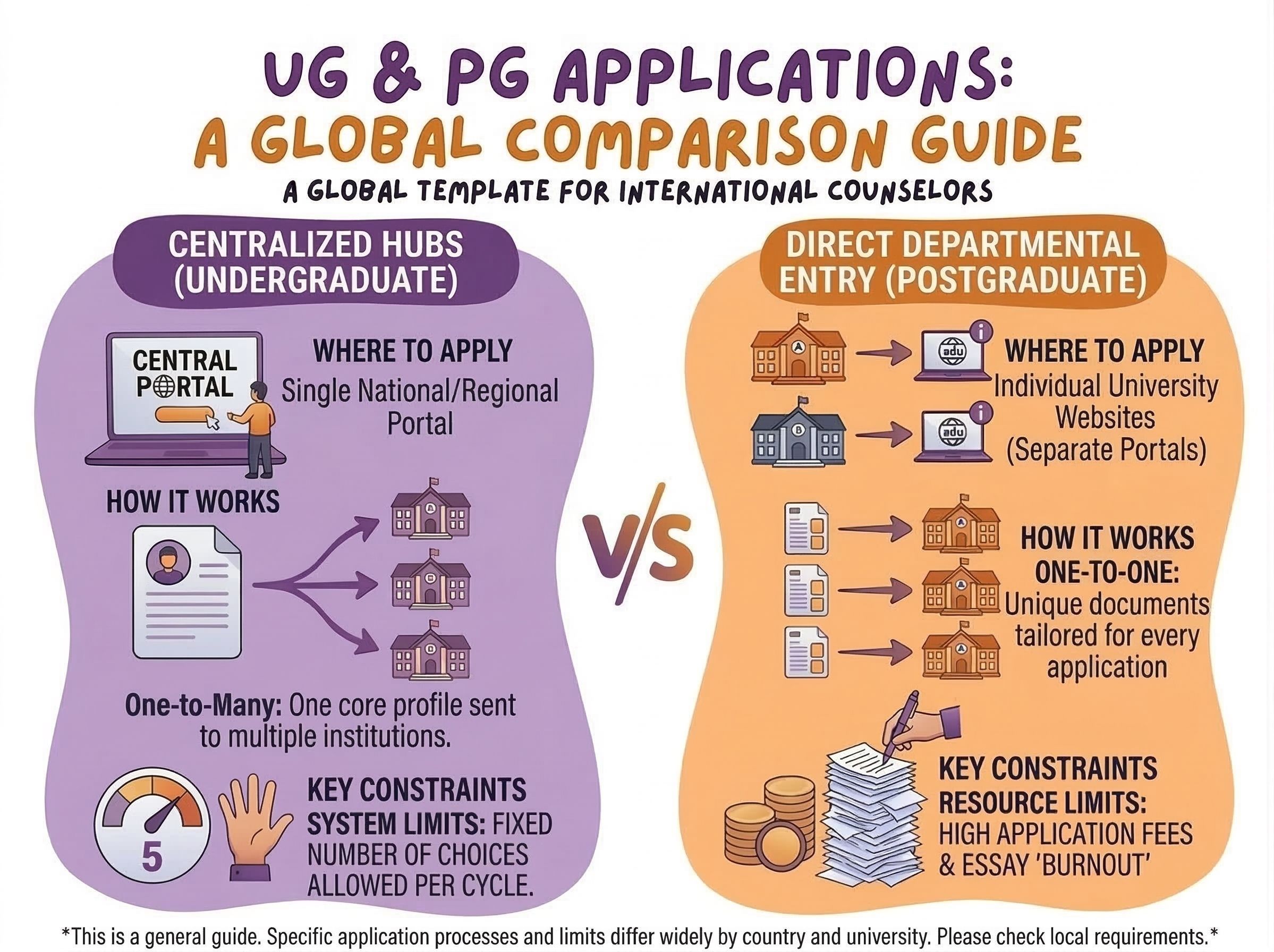
Main routes
Turkey uses a mixed application model. Domestic undergraduate entry is mainly handled through the national exam and placement system, while many international applicants apply directly to universities.
Common routes include:
- Domestic undergraduate route: Central exam and placement through the Measurement, Selection and Placement Center (ÖSYM)
- International undergraduate route: University-run admissions using institution-approved exams, qualifications, or school results
- TR-YÖS route: A national international student admission exam route used by some universities
- Direct institutional applications: Common for international applicants, especially for English-taught programs
- Graduate applications: Usually managed by universities, faculties, or departments
- Program-specific selection routes: Courses that require interviews, portfolios, auditions, entrance exams, or additional evaluation
Binding vs non-binding
Turkey does not use a single national binding admissions model. Commitment usually happens when the student accepts an offer and completes the university’s registration, payment, or enrollment steps.
Deadline patterns
Domestic undergraduate admissions follow ÖSYM’s national exam and placement calendar. International admissions are usually institution-set and may run in one or more rounds before the intended intake.
❗ International applicants may face different deadlines at each university because application rounds, exam result deadlines, quotas, and document verification timelines are institution-set.
Key caveats
For international applicants, “eligible to apply” does not always mean eligible for every program. Universities may accept different combinations of TR-YÖS, other exam results, school qualifications, language evidence, and program-specific materials.
School documents and references
What schools commonly provide
Schools may provide academic transcripts, secondary school diploma or expected graduation evidence, predicted or interim results where accepted, curriculum information, grading scale details, and confirmation of the student’s academic background.
Who submits
Submission methods vary by university and applicant route. Many direct university applications allow students to upload documents themselves, while some institutions may request certified copies, translated documents, notarized documents, or verification from the school or awarding body.
References
References are not a national requirement for all Turkish undergraduate applications. They may be requested for specific programs, scholarships, graduate study, research routes, or institution-specific selection processes.
Predicted and interim results
Some universities may accept expected graduation evidence, interim grades, or pending results during the application process. Final registration may still depend on official final documents and meeting all stated conditions.
Where process differs by route
Domestic ÖSYM routes, direct international applications, TR-YÖS-based admissions, graduate applications, and practice-based programs may each require different school, referee, or evidence documents. Requirements are set by the relevant university, platform, or program.
Student responsibilities
Students are usually responsible for:
- Checking program-specific entry requirements, accepted exams, language requirements, and deadlines
- Confirming whether the correct route is ÖSYM, direct university application, TR-YÖS, graduate application, or another institution-set process
- Creating accounts in the required university or application platform
- Completing the application form accurately
- Paying application, exam, or registration fees where applicable
- Uploading diplomas, transcripts, translations, exam results, and supporting documents in the required format
- Providing English or Turkish language evidence where required
- Completing program-specific steps such as entrance exams, interviews, auditions, portfolios, or language placement
- Monitoring university portals and email for document requests, decisions, and registration instructions
- Responding to offers and completing acceptance or enrollment steps by stated deadlines
- Preparing visa and student residence permit steps after receiving the required university acceptance or registration document, if applicable
Key application timelines
International undergraduate
Application windows are set by each institution and may run in multiple rounds.
Outcomes can depend on:
- Document review
- Quota and seat availability
- Exam timelines, including TR-YÖS where relevant
Domestic undergraduate
The national exam and placement cycle follows ÖSYM’s published calendar.
Decision timing
Some universities release results on a rolling basis, while others publish outcomes after a defined evaluation period.
Typical intake timeline
Variation is high across domestic, international, graduate, and university-run routes.
- Research and shortlist: Sep–Dec
- TR-YÖS preparation and exam route: Nov–May
- Direct applications: Jan–Jul
- Entrance exams and interviews: Mar–Aug
- Decisions and offers: May–Aug
- Registration and payment steps: Jul–Sep
- Visa and residence permit steps: Jun–Oct
- Main intake begins: Sep–Oct
English proficiency
There is no national minimum English requirement for university admission. Requirements are set by institutions and programs.
Common evidence types
Universities may accept:
- International English test results such as IELTS or TOEFL, where required
- University-administered language exams or placement tests in some cases
Waiver logic
Waivers may depend on prior education in English-medium settings or specific qualifications, but this is institution-defined.
For Turkish-taught programs, or where Turkish is required, universities may place students into a Turkish language preparatory year and usually expect students to reach advanced Turkish proficiency by the end of that period.
Standardized or entrance testing
Domestic undergraduate
The national Higher Education Institutions Exam (YKS) administered by ÖSYM is the main standardized route for domestic selection and placement.
International undergraduate
Some universities require or strongly prefer TR-YÖS and or accept other internationally recognized exam or qualification results as defined by the institution.
Testing requirements are therefore:
- Nationally fixed for the domestic route
- Institution-specific and program-specific for international admissions
❗ TR-YÖS is not applied the same way everywhere. It is a national exam route, but universities decide whether it is required, what scores they accept, and how heavily it is weighted compared with school grades or other credentials.
Decision logic and offers
Decisions are usually communicated through the university’s admissions portal and or official notification channels.
Common outcomes
- Offer or acceptance
- Rejection
- Request for additional documents or verification
Offer types
Conditional offer: A place is offered if the student meets stated conditions, often final results, missing documents, or other requirements.
Unconditional offer: The place is confirmed without academic conditions, but the student may still need to complete non-academic steps such as document verification, identity checks, payment, enrollment requirements, or right-to-study checks.
Post-offer sequencing
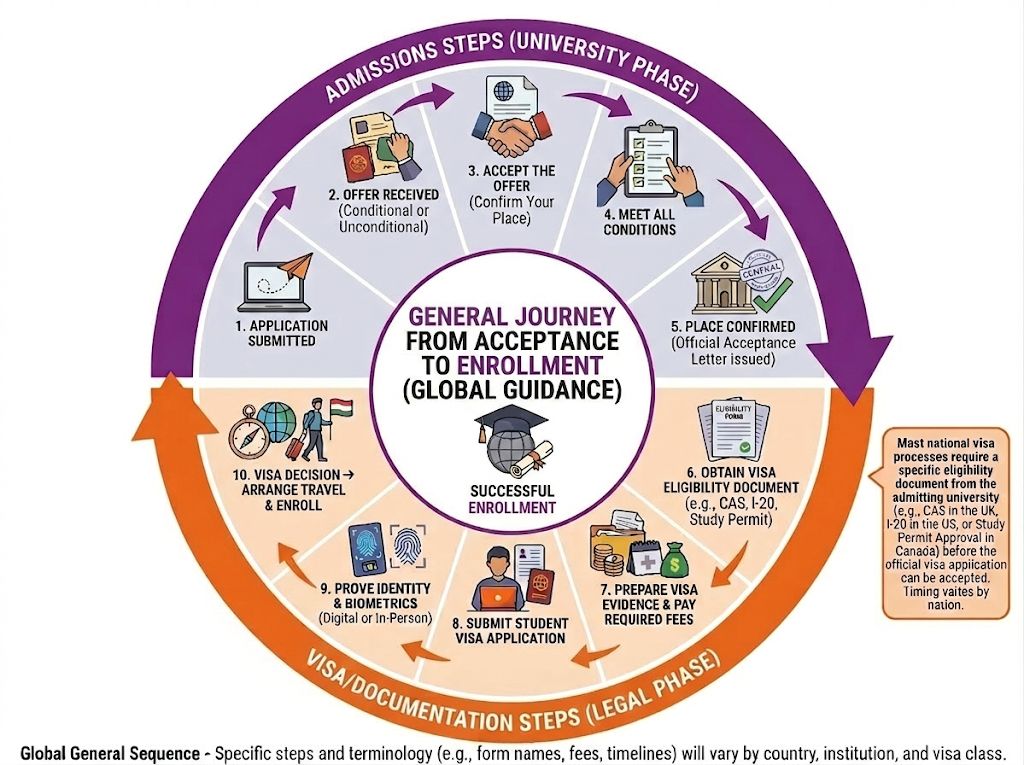
The usual sequence is:
Acceptance and registration steps → issuance of official admission or registration document → visa and residence steps
Deposits and acceptance steps
There is no single national deposit rule across all institutions.
Where payments are used, they may be linked to:
- Seat confirmation
- Tuition installment schedules
- Enrollment and registration activation
This is especially common in foundation or private universities and in some international admissions processes.
Student visa or residence permit overview
Official names
- Student – Education visa, applied for through Turkish missions or consulates where required
- Student residence permit, for study purposes
Trigger event
A university admission or acceptance letter, and or registration document, is usually used to begin the visa process.
The residence permit process is usually started after entry through the official e-Residence (e-İkamet) system.
Typical steps
- Obtain the university’s acceptance or admission document
- Submit the visa application, where required, through the official consular process
- Enter Turkey in lawful status
- Apply for a student residence permit through e-İkamet and book the appointment
- Attend the appointment at the Provincial Directorate of Migration Management with the required evidence
- Receive the residence permit card or decision and complete any final university registration checks as required
Timing guidance
- The visa application is usually started after the acceptance letter is issued and well before travel
- Student residence permit applications are usually made soon after arrival and before the lawful stay period expires
- Appointment and issuance timing can vary by province and case volume
Core evidence categories
This is not exhaustive, but usually includes:
- Passport or identity and entry or visa status
- University acceptance or registration evidence
- Address or accommodation evidence in Turkey
- Health insurance evidence
- Financial means declaration or evidence
- Biometric photographs and fee receipts where required
❗ Most students follow a two-step immigration sequence. The visa, where required, is usually completed before travel, and the student residence permit is usually applied for after arrival through e-İkamet, so students should plan time for the provincial appointment process.
For detailed requirements and current procedures, students should use the official migration authority and consular guidance pages and the detailed Turkey visa guide.
Country-specific rules and exceptions
- Two-track admissions reality: Domestic undergraduate entry is dominated by ÖSYM exam and placement, while international admissions are university-run using recognized inputs, often including TR-YÖS
- TR-YÖS usage varies: It is a nationally administered exam route for international admissions, but institutions decide whether it is required, optional, or how much it counts
- Language preparation is structurally common: Universities may require or assign a preparatory year where students do not meet the language standard for the program’s language of instruction
Key differences for UAE-based counselors
- International admissions are usually decentralized by university, even though a national exam route, TR-YÖS, exists
- Domestic entry relies heavily on a central exam and placement model rather than holistic review
- Students may need to plan for a formal language preparatory year depending on the program’s teaching language and the student’s readiness
- Immigration usually involves two steps: visa where required, then residence permit after arrival
Common counselor questions
Do international students apply through one national portal?
No. International applicants usually apply directly to each university using the institution’s admissions process and accepted inputs.
Is TR-YÖS always required for international undergraduate admission?
Not always. Many universities use TR-YÖS, but some also accept other recognized exam or qualification results. Requirements are set by institutions and programs.
Is there a national English score minimum for admission?
No. English requirements are set by institutions and programs, and accepted evidence and minimums vary.
When does the visa or residence process start?
It usually starts after the university issues an official acceptance or admission letter, followed by residence permit steps after arrival through e-İkamet.
Are decisions usually conditional or unconditional?
Both exist. Conditional outcomes are common where final results or missing documents still need to be confirmed.
Do students need to pay a deposit to secure a place?
There is no national rule. Some institutions require payments linked to confirmation or enrollment steps.
Studee customer support
Studee provides process support and clarifies country-level admissions and visa sequencing for counselors and students.