
Sweden uses a largely centralized application system for most university courses and programs, with national eligibility frameworks and institution-set selection for each program. Assessment is usually based on prior grades or merit ratings, sometimes alongside the Swedish Scholastic Aptitude Test (SweSAT / Högskoleprovet) and program-specific criteria.
How applications work
System model
Sweden is largely centralized for first-cycle and second-cycle higher education, meaning bachelor’s and master’s level study.
Who sets requirements
- National frameworks set the general entry requirements and the legal basis for selection criteria
- Universities and university colleges set specific entry requirements and decide the selection criteria and selection groups for each course or program
How students apply
- Most English-taught programs use Universityadmissions.se, the central portal
- Many Swedish-taught options also sit within the national admissions system
Structural variation
Selection methods can vary significantly by subject. Examples include:
- Arts and design portfolios
- Professional programs with additional assessments
- Master’s selection based on prior degree relevance
Application types and commitments
Main routes
Sweden uses a largely centralized application model for first- and second-cycle higher education. Most applications are submitted through Universityadmissions.se, with program-specific requirements and selection criteria set by universities.
Common routes include:
- First admissions round: The main route for many international applicants, especially for English-taught programs
- Second admissions round: More aligned with applicants already in Sweden, with fewer English-taught options and a shorter permit timeline
- Bachelor’s applications: Usually assessed through national eligibility rules, merit ratings, and selection groups
- Master’s applications: Usually assessed through program-specific criteria, often linked to prior degree relevance and academic background
- Program-specific routes: Courses that require portfolios, auditions, interviews, work samples, or other additional steps
Commitment model
Applications are generally non-binding at the submission stage. Applicants rank their choices, and the national admissions system processes outcomes according to eligibility, selection results, and preference order.
Deadline patterns
Sweden has national application, documentation, and admissions-result windows for fall and spring intakes. The first admissions round is usually the practical route for non-EU/EEA applicants who need time for tuition payment and residence permit steps.
❗ Preference order matters in Sweden because applicants may receive an offer for the highest-ranked option they qualify for, rather than several offers to compare at the same time.
Key caveats
Some programs require additional materials or steps, such as portfolios, interviews, auditions, or program-specific documents. These may have internal deadlines that sit alongside the national application and documentation deadlines.
Eligibility and qualification recognition
Who decides eligibility
Eligibility is assessed within the national admissions framework used by the central application system. This combines:
- National general entry requirements
- Program-specific requirements set by institutions
Recognition model
Bachelor’s level (first cycle):
- Completion of upper secondary education
- The national English requirement
- Any additional program-specific prerequisites
Master’s level (second cycle):
- A completed first-cycle degree, usually equivalent to at least 180 ECTS
- Any additional program-specific academic requirements
Baseline expectations
Applicants must meet both:
- General entry requirements
- Specific entry requirements for each chosen program
How applicants are assessed
Dominant model: Merit-based ranking using a calculated merit rating, mainly from previous studies, with additional national selection routes available for many bachelor’s programs.
Primary selection factors
- Merit rating or prior grades, used to rank applicants
- SweSAT / Högskoleprovet results, where applicable and where the program allocates places through this route
- Program-defined criteria, where used, such as portfolio, interview, audition, or other authorized selection methods
Factors usually not primary nationally
Personal statements and general extracurricular profiles are not part of the standard national selection basis. Where such materials are used, they are program-specific.
Where variation occurs
Master’s programs: Universities decide how selection is done, often based on:
- Relevance of the prior degree
- Academic performance
- Sometimes CV, statement of purpose, references, or structured evaluations
Bachelor’s programs: National rules usually require:
- A minimum share of seats awarded by grades
- A minimum share awarded through SweSAT
- Any remaining seats, where allowed, may be allocated by other methods chosen by the institution
Application platforms and key documents
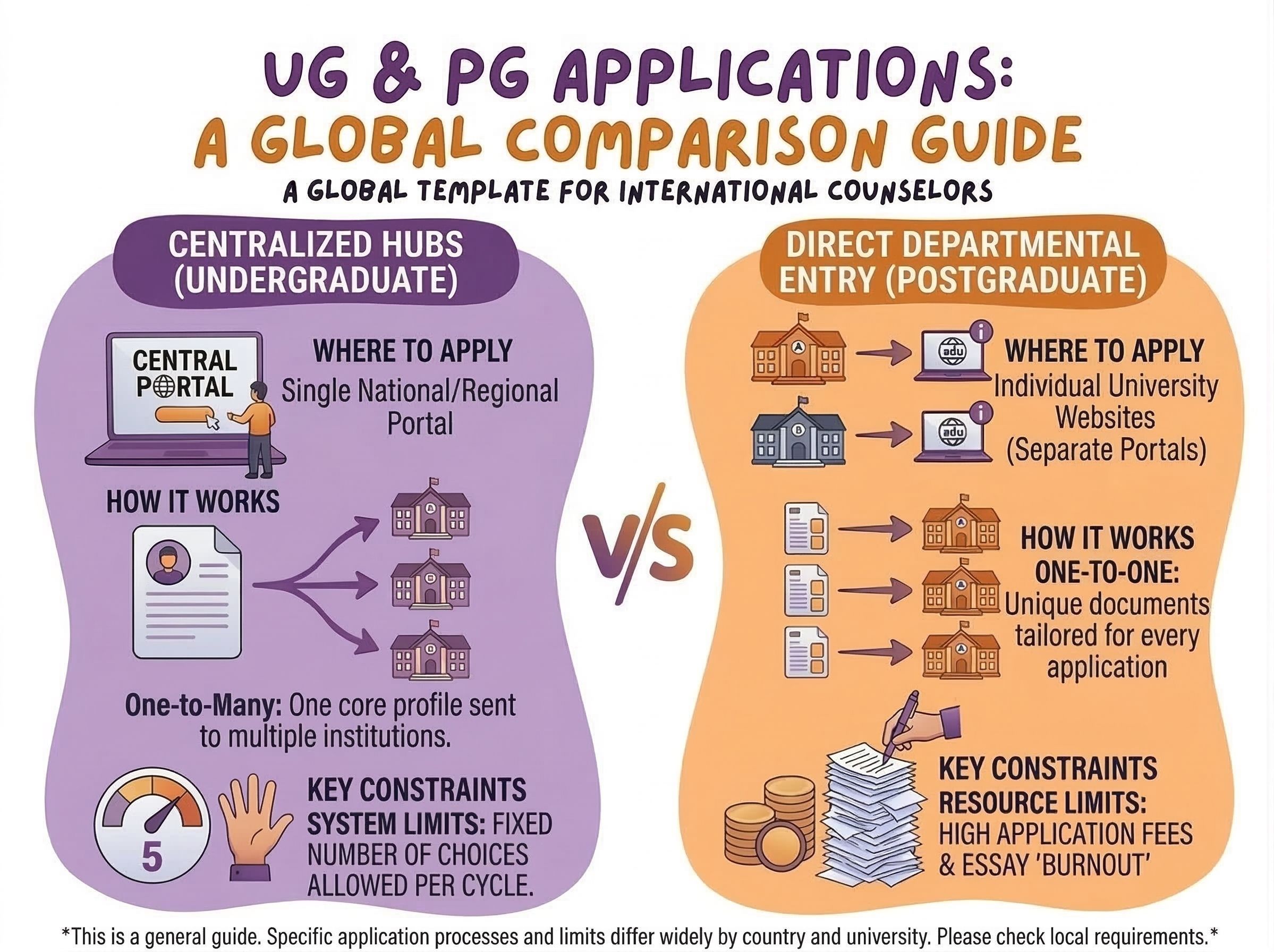
Application platforms and key documents
Universityadmissions.se
Universityadmissions.se is the central application portal for most international-facing Swedish higher education applications. Applicants use it to search programs, submit applications, rank choices, upload documents, pay the application fee where required, track results, and respond to offers where a reply is needed.
National admissions system
The national system handles application submission and admissions results, but universities still set specific entry requirements, selection criteria, and any program-specific documents or assessment steps.
Program ranking and selection
Applicants rank their selected programs. The system processes applications according to eligibility, merit rating, selection groups, available places, and preference order.
First and second admissions rounds
The first admissions round is commonly used by international applicants because it gives more time for admission results, tuition fee steps, and residence permit processing. The second admissions round may have fewer English-taught options and can be too late for many applicants who need a residence permit.
Undergraduate vs master’s routes
Bachelor’s applicants are assessed against general and specific entry requirements, then ranked through selection groups such as grades and, where applicable, SweSAT. Master’s applicants are assessed against second-cycle entry requirements and program-specific selection criteria set by the university.
Platform rules and limitations
Sweden does not use direct applications as the normal route for most degree programs in the national admissions system. However, program-specific documents, portfolios, interviews, or institutional instructions may still be required outside the main application form.
Documents required generally include, but are not limited to
- Application form or Universityadmissions.se application record
- Passport or identity document
- Proof of citizenship or fee status, where relevant
- Official transcripts and graduation certificates
- English proficiency evidence, where required
- Program-specific documents, such as portfolio, CV, statement of purpose, references, work samples, or interview tasks
- Name-change documentation, where applicable
- Tuition payment evidence, where relevant for residence permit sequencing
- Immigration-related documents, usually requested later for residence permit steps
School documents and references
What schools commonly provide
Schools may provide official transcripts, graduation certificates, predicted or interim results where accepted, curriculum information, grading scale details, and confirmation of the student’s academic background.
Who submits
Documents are usually uploaded through Universityadmissions.se according to the national documentation rules. Some documents may need to be official, certified, or sent in a specified format depending on the country of education and document type.
References
References are not a national requirement for all Swedish bachelor’s applications. They may be requested for specific master’s programs, creative programs, scholarships, or program-specific selection processes.
Predicted and interim results
Final-year upper secondary students may face timing issues if final documents are not available by the national documentation deadline. Some applicants may not receive a merit rating in time for the main selection process if required final documents arrive too late.
Where process differs by route
Master’s programs, creative fields, and programs with additional selection may request different school, referee, or evidence documents from standard bachelor’s routes. Requirements are set by the university or program within the national admissions framework.
Student responsibilities
Students are usually responsible for:
- Checking general and specific entry requirements for each program
- Confirming the correct admissions round for their timeline
- Creating a Universityadmissions.se account
- Ranking program choices in the required order
- Completing the application accurately
- Paying the application fee or proving fee exemption status where applicable
- Uploading transcripts, certificates, English evidence, and supporting documents by the documentation deadline
- Completing program-specific steps such as portfolios, interviews, auditions, work samples, or additional documents
- Monitoring Universityadmissions.se for messages, results, and reply instructions
- Responding to offers or reserve outcomes where required
- Completing tuition payment and enrollment steps where applicable
- Preparing residence permit steps after admission and tuition confirmation, if applicable
Key application timelines
Fall intake, typical pattern
- Application opens: October
- Application deadline: mid-January
- Documentation deadline: early February
- Admissions results: late March in many cases
- Semester starts: August to September
Fall intake, second round, typical pattern
- Application opens: mid-March
- Deadline: mid-April
- Decisions: July
Spring intake, typical pattern
A parallel cycle usually exists, with application deadlines commonly around mid-August and decisions later in the year.
For non-EU or EEA students who need a residence permit, the first admissions round is normally the practical route because the second round is often too late for permit processing.
❗ For non-EU and EEA students, the second round is often too late. Residence permit processing can take time, so students who need a permit should usually target the first admissions round to protect their timeline.
Typical intake timeline
Exact dates vary by year, admissions round, and program.
- Fall intake applications open: Oct
- Fall intake deadline: Jan
- Documentation deadline: Feb
- Admissions results: Mar–Apr
- Tuition and permit steps: Apr–Jul
- Fall semester begins: Aug–Sep
- Spring intake deadline: Aug
- Spring semester begins: Jan
English proficiency
Whether proof is required
Yes. English proficiency is part of general eligibility for many English-taught programs and may also appear as a program-specific requirement.
Accepted evidence types
Accepted evidence usually includes:
- Recognized English language tests
- Certain prior studies that meet the national English requirement
Typical minimums
The general entry requirement is commonly aligned to Swedish upper secondary English 6 / English Level 2 equivalence, with published minimum test-score mappings.
Waiver logic
Some applicants meet the requirement through prior schooling or higher education completed in defined contexts under national admissions guidance.
Standardized or entrance testing
Whether required
Entrance testing is not nationally required for all applicants.
Who sets policy
- For many bachelor’s programs, SweSAT / Högskoleprovet is an established national selection route used alongside grades
- Other tests, auditions, and portfolios are program-specific and set by the institution
Named examples
- SweSAT / Högskoleprovet
- Portfolio or audition, common in arts, design, and performing programs
- Interviews or other program-set selection tasks, where permitted
Decision logic and offers
How decisions are communicated
Decisions are published in the national application portal, with outcomes shown for each ranked choice.
Offer and outcome types
- Offered a place, meaning admitted
- Reserve or waiting list outcome
- Not admitted
Post-offer sequencing
- Where a reply is required, applicants confirm acceptance in the portal by the stated deadline
- Fee-paying students follow tuition invoicing and payment steps through the institution
- Students who need a residence permit start the permit process after the relevant trigger document or confirmation is available
Offer type definitions
Conditional offer: A place is offered if the student meets stated conditions, often final results, missing documents, or other requirements.
Unconditional offer: The place is confirmed without academic conditions, but the student may still need to complete non-academic steps such as document verification, identity checks, payment, enrollment requirements, or right-to-study checks.
Deposits and acceptance steps
Deposits
Sweden does not use one single national deposit rule across institutions. Practice varies.
What payments unlock
Where payments are required, they usually relate to:
- Tuition fees for fee-paying students
- Enrollment administration
- Institutional confirmation steps
National clarity
Acceptance and reply steps are defined within the national admissions process, while payment and enrollment steps are handled by institutions.
Student visa or residence permit overview
Official name
Residence permit for studies in higher education, for non-EU or EEA citizens studying for longer than 3 months
Trigger event
Admission to full-time studies. For fee-paying students, tuition payment confirmation is usually part of being treated as finally admitted for residence permit purposes.
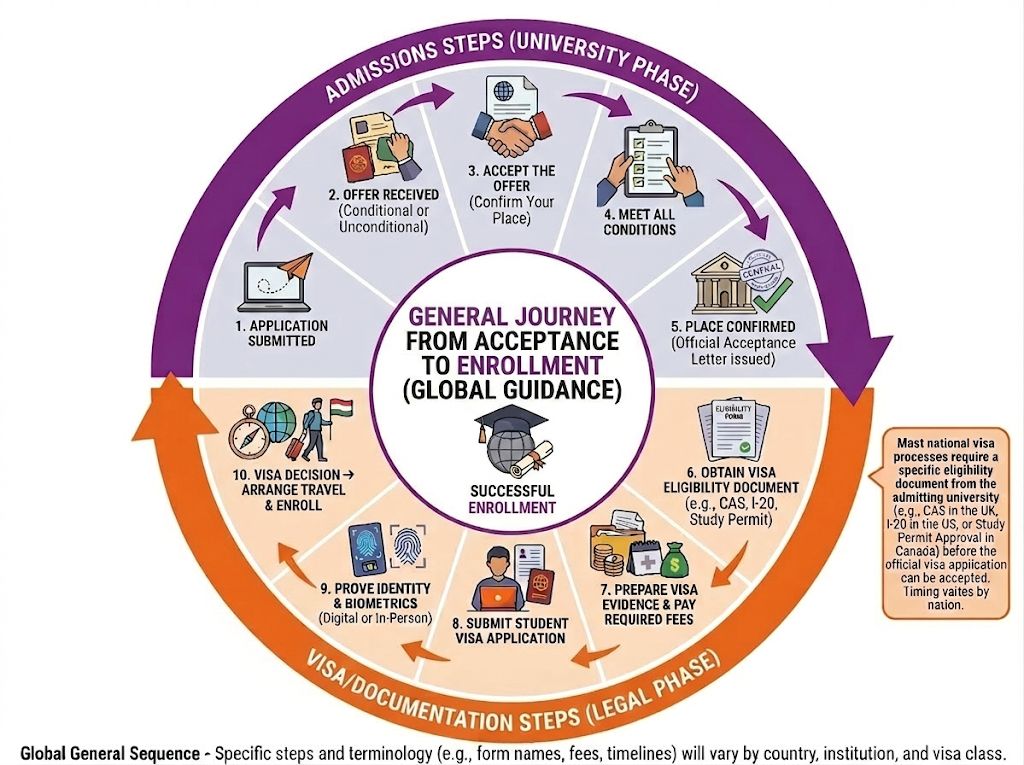
Typical steps
- Receive an admission decision and complete any required acceptance or reply steps
- If tuition-paying, complete tuition payment steps as instructed
- Submit an online residence permit application with the Swedish Migration Agency (Migrationsverket)
- Provide biometrics or complete identity steps if requested
- Wait for a decision and plan travel and arrival based on the permit outcome
Timing guidance
- Apply as soon as admission and tuition status, where relevant, are confirmed
- Processing times vary and can be longer during peak periods
- Students should leave meaningful lead time between admission results and program start
Core evidence categories
This is not exhaustive, but usually includes:
- Valid passport or identity documentation
- Proof of admission to full-time studies
- Proof of paid tuition fees, if applicable
- Proof of ability to support living costs
- Health insurance coverage, where applicable based on permit length and circumstances
❗ For fee-paying students, tuition payment can be a key step before the permit. Universities often need to confirm payment and final admission status before the residence permit application can progress, so students should plan funds and payment timing early after admission results.
For full and current requirements, students should use the detailed Sweden student residence permit guide.
Country-specific rules and exceptions
- Sweden runs two admissions rounds, and the first round is the one designed to support international applicants’ timelines
- Final-year upper secondary students applying for bachelor’s entry may face issues if they cannot provide final documents by the documentation deadline
- Bachelor’s seat distribution commonly includes a minimum share allocated via grades and a minimum share via SweSAT, with remaining places allocated by other methods where allowed
- For master’s programs, institutions decide how merit is assessed within the national framework
Key differences for UAE-based counselors
- A single national portal, Universityadmissions.se, is central to most applications
- The system runs in two national admissions rounds, with the first round usually being the practical route for international applicants
- Bachelor’s selection commonly uses both grades and SweSAT routes, with national rules shaping seat distribution
- Master’s selection is more program-defined and often depends on the match between prior degree content and the target program
- Residence permit timing is closely linked to admission status and, for fee-paying students, tuition payment confirmation
Common counselor questions
Do students apply directly to each university?
Usually not. Most applications, especially for English-taught options, go through Universityadmissions.se, although some program-specific steps may still be required by the institution.
Is there one national set of entry requirements?
There are national general entry requirements, but each program sets its own specific entry requirements and may add required documents or steps.
Are personal statements always required?
No. Statements, CVs, references, portfolios, and interviews vary by program and are more common in master’s admissions and creative fields.
How does the ranking of choices affect outcomes?
Applicants rank programs, and the system processes results so that the applicant may receive an offer for the highest-ranked option they qualify for.
Is SweSAT required for international applicants?
Not always. It is a selection route used for many bachelor’s programs, but it is not universally required.
When does the residence permit process start?
Usually after admission steps are complete. For fee-paying students, tuition payment confirmation is often part of being treated as finally admitted for permit purposes.
Can students apply in the second round and still get a permit in time?
Sometimes, but the second round is often considered too late for many non-EU or EEA applicants who need a residence permit.
Studee customer support
Studee customer support can help with navigation questions on country processes and point students toward the right official sources for program requirements and immigration steps.