
Australia has a large, regulated higher education system with a mix of public universities and other accredited higher education providers. Degrees are usually taught through a blend of lectures, tutorials, workshops, and practical learning, with strong expectations for independent study. After graduation, students often move into work, professional training pathways, or further study, depending on their field.
How degrees are structured
Australian qualifications sit within a national qualifications framework, and higher education providers are regulated nationally. Most degrees are built from units or subjects, and students progress by completing enough units at the required level. The exact structure can vary by institution, but the overall model is widely understood across the country.
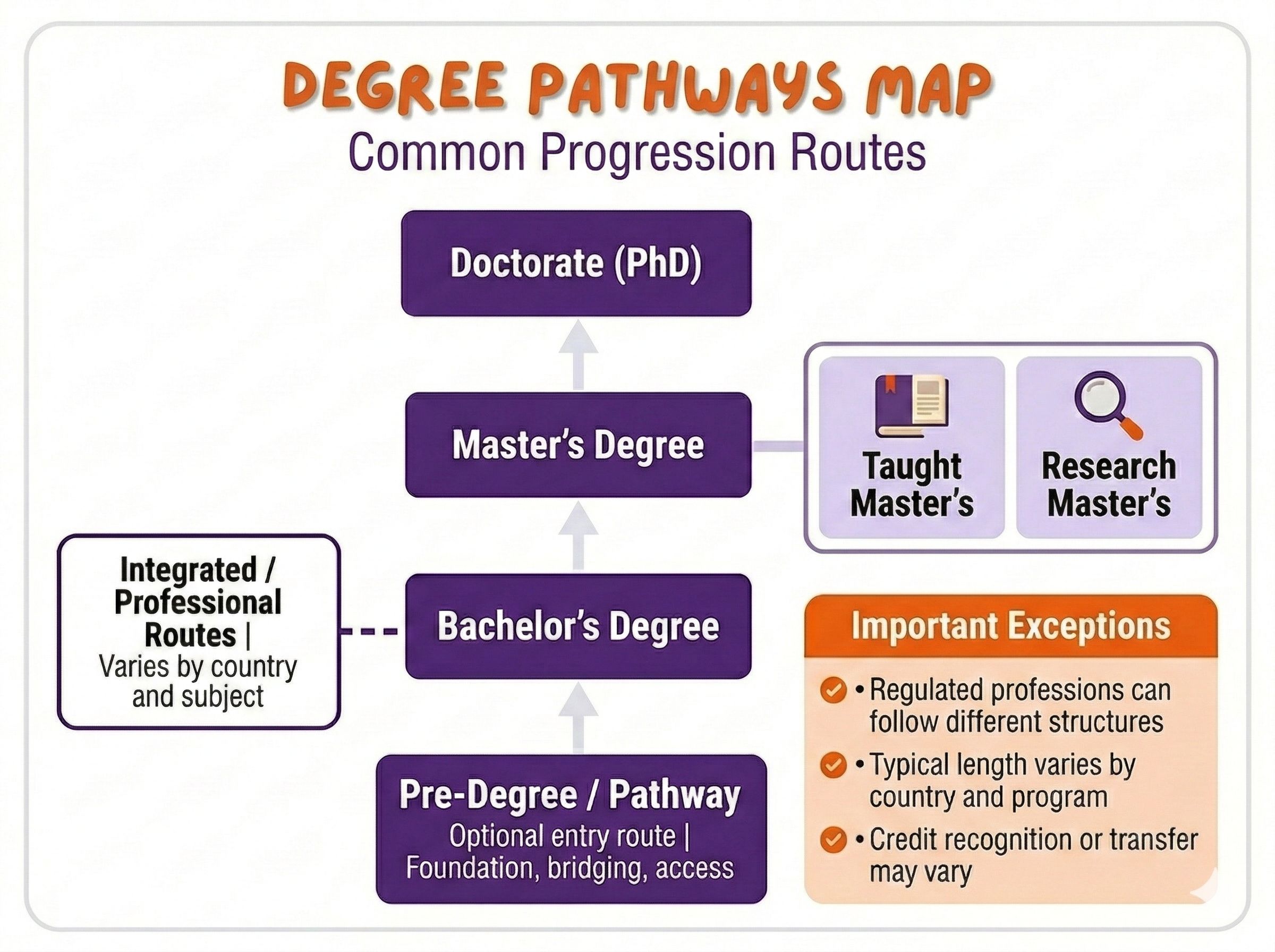
Common degree levels and usual lengths
- Undergraduate certificate: often around 6 months of full-time study
- Bachelor degree: typically 3–4 years full-time
- Honours: often an additional year or an integrated honors structure in some fields
- Masters degrees: often 1–2 years full-time after a relevant undergraduate degree, depending on the type of masters and prior study
- Doctoral degree: commonly 3–4 years full-time for a research doctorate
How study is packaged
- Courses are usually modular, made up of units or subjects students complete across teaching periods
- Study load is commonly described using credit points and a full-time load measure used nationally across the sector
Teaching and assessment
- Teaching often combines lectures with smaller-group tutorials or seminars, plus labs, studio work, or placements where relevant
- Assessment commonly includes a mix of coursework, projects, presentations, lab reports, and exams, depending on the subject
Flexibility and pathways
- Many courses allow some choice through electives, specialisations, or majors, especially in broad bachelor degrees
- Pathways can exist between different qualification levels, but options vary by institution and course design
Key exceptions to know
- Some fields are more structured and have additional required components, especially regulated or practice-based areas such as health, teaching, and certain professional programs
❗ AQF is a framework, not a single national syllabus. Degree levels are standardized, but the unit structure, assessment style, and specialisations can still vary by university and course, so students should check the specific course handbook.
Academic strengths & popular study fields
Australia is known for combining academic learning with applied, industry-linked teaching in many areas, supported by strong research activity across the sector. Strengths can vary by state, city, and local industries, so “what a place is known for” often reflects the region around it.
Well-known strengths in the wider ecosystem
- Environmental and marine sciences, sustainability-related fields, and earth sciences
- Health, public health, and biomedical areas
- Engineering and technology fields with strong applied learning components
- Business, management, finance, and related professional programs
Industry links that are often visible in programs
- Work-integrated learning options, industry projects, and guest teaching are common in many applied courses
- Some subjects have stronger links to specific local sectors such as resources, agriculture, health services, education, and technology
Fields many international students consider
- A wide range of options are common choices, including business, IT, engineering, health-related programs, education, and creative fields, depending on goals and background
❗ Many Australian courses assess you throughout the term. Quizzes, assignments, projects, and participation can carry significant weight, so students who build a weekly study routine often do better than those who rely on last-minute revision.
Student life & learning style
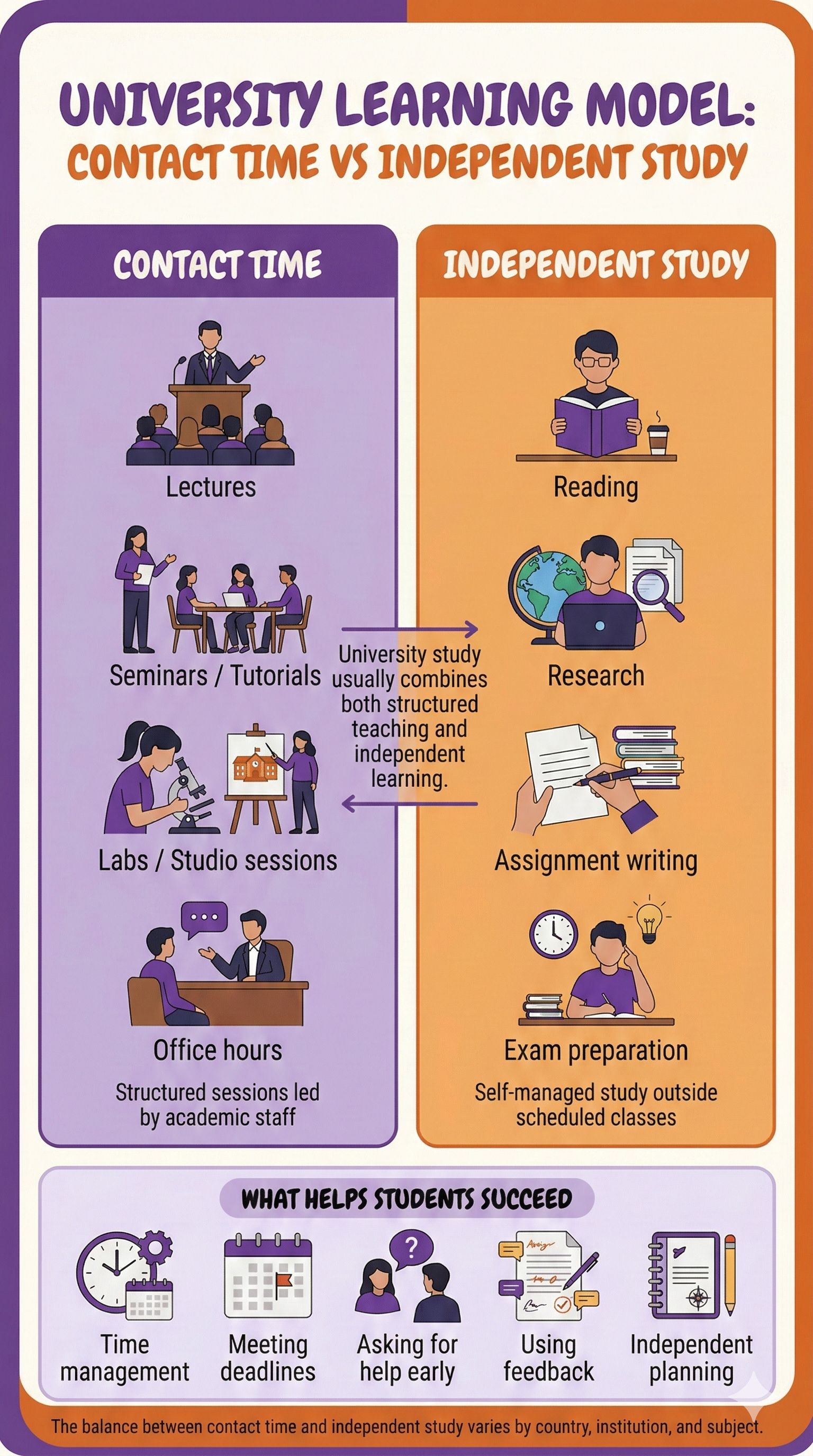
Student life in Australia varies a lot by city and institution, but many students experience a balance of structured class time and significant independent study. Universities often provide learning support and wellbeing services, but students are generally expected to plan their time and seek help proactively.
Classroom culture
- Students are usually expected to ask questions, join discussions, and contribute to group work where required
- Teaching staff can be approachable, but students are often expected to be independent and organized
Contact hours and self-study
- Many courses have fewer scheduled classroom hours than school, with more time expected for reading, assignments, and preparation outside class
How learning feels day to day
- Regular assessment tasks across the term are common, not only final exams
- Feedback may be detailed and criteria-based, with clear rubrics in many courses
Campus vs commuter patterns
- Some universities feel like large campuses with clubs and societies, while others have a more commuter feel, especially in big cities
Accommodation and daily life
- Many students choose between university-linked housing, private rentals, or shared housing
- Daily life costs and commute time can vary strongly by city and neighborhood
What happens after graduation
Graduate pathways in Australia commonly include work, further study, or structured professional training, depending on the field. Many universities offer careers support, employer events, and work-readiness services, but job outcomes still depend heavily on subject area, experience, and local labor demand.
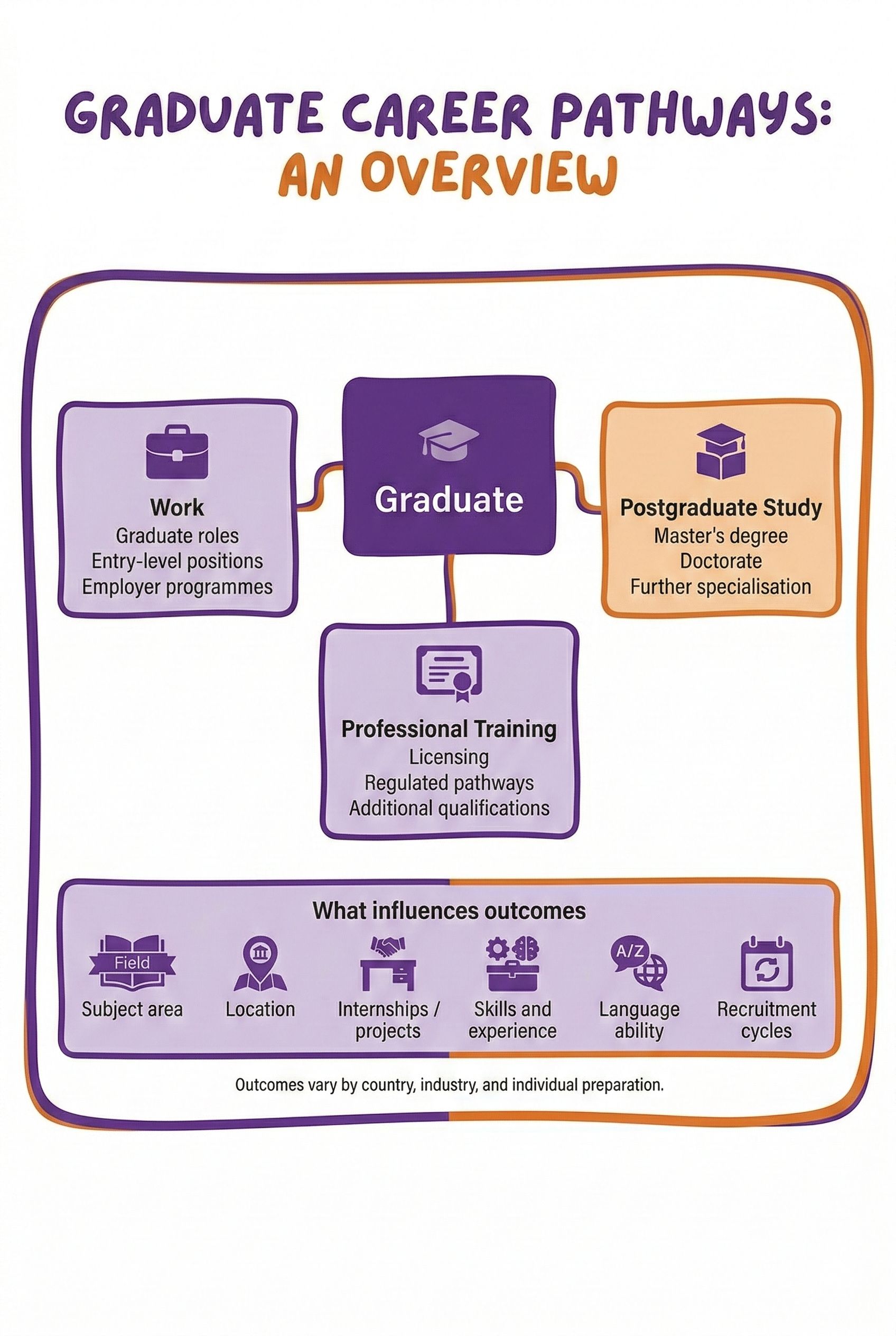
Common next steps
- Entering the workforce in a graduate role
- Continuing to postgraduate study for specialization
- Professional training or supervised practice in regulated fields where relevant
How employability typically works
- Employers often look for a mix of academic results, relevant experience, and communication skills
- Internships, placements, part-time work, volunteering, and project portfolios can help demonstrate readiness for work
- Universities commonly provide careers services, but students usually need to engage early and actively
National measurement
- Australia uses national surveys that track student experience and graduate outcomes after study
Important variation note
- Outcomes can vary significantly by subject area, region, and the strength of the local job market, especially for specialised roles
Costs & funding overview
Families should plan for tuition plus day-to-day living costs such as housing, food, transport, learning materials, and health-related costs where typical for students. Total costs can differ widely by city and lifestyle, and also by course type and study load.
Main cost categories to expect
- Tuition and course-related fees
- Accommodation and living expenses
- Local transport and personal costs
- Learning materials and technology needs for study
What makes costs higher or lower
- Location and housing choices are often the biggest difference
- Course type can affect extra costs, for example lab or studio requirements in some fields
- Study load and program length affect the total amount spent over time
How families usually fund study
- Family funding is common, especially for international students
- Scholarships and bursaries exist, but availability and eligibility vary widely by provider and student status
- For eligible students, government-supported loan schemes may help cover some education costs
❗ Location and housing choice are the biggest cost variables. Two students on the same course can have very different total budgets depending on city, rent, and commute, so families should estimate costs for the specific city and housing plan, not a national average.
Typical costs
These figures are best used as high-level planning ranges. Exact costs vary by provider, city, course, and student status. Tuition fees for international students vary across cities and programs.
Typical cost of a degree
There is no single national tuition figure for international undergraduate study in Australia, because costs vary by provider, level of study, and location. For the most accurate estimate, students should use the Study Australia Course Search to compare programs and view estimated total course costs for their chosen course and provider.
Typical cost of living
For an official planning benchmark, Australia’s student visa financial-capacity settings state that the living costs students may need to declare or provide are intended to indicate the cost of living in Australia, and the currently published minimum annual amount for the primary applicant is AUD 29,710. Actual living costs vary across Australia and may be much higher than the minimum amount needed for a student visa.
Scholarships
Scholarships for international students are available in Australia, but they are not the main source of funding for most students. Australian Government guidance says scholarships, grants, and bursaries are offered by government, education providers, and other public and private organizations, while also noting that the majority of international students in Australia pay full fees. For official information on scholarship options, see the Department of Education scholarships page.
Who is this country a good fit for?
Australia can suit students who want a mix of academic learning and practical skill-building, with a lifestyle that often includes diverse campuses and multicultural cities. It tends to work well for students who can manage independent study and make the most of support services and opportunities outside class.
Students who often thrive
- Comfortable with independent learning, planning ahead, and meeting deadlines consistently
- Happy to speak up, ask questions, and take initiative with teachers and support teams
- Interested in applied learning, projects, and industry-linked study where available
Good fit by interests
- Students exploring broad options in early university years in more flexible degree designs
- Students aiming for strong practical training environments in fields that use labs, studios, or placements
Good fit by lifestyle
- Students who like city-based living and access to part-time activities and diverse communities
- Students who enjoy joining clubs, societies, and campus events to build friendships and networks
May feel challenging if
- You prefer very close day-to-day supervision like school and find self-managed study difficult
- You want one fixed national course structure that is the same at every institution
What may feel different in the Australia’s higher education system
Studying in Australia can feel more independent than school, even when teaching is structured. Students are usually expected to manage their time, prepare for classes, track assessment dates, and use support services when they need help.
Teaching style
- Teaching often includes lectures, tutorials, seminars, workshops, labs, studio sessions, or placements, depending on the subject
- Smaller sessions are often used for discussion, problem-solving, practical work, feedback, or group activities
- Students may be expected to ask questions, contribute to class, and prepare before tutorials or workshops
Assessment style
- Assessment commonly includes coursework, exams, projects, presentations, lab reports, practical tasks, and group work
- Many courses assess students throughout the teaching period, not only through final exams
- Feedback is often criteria-based, with rubrics used to show how work is marked and where students can improve
Independence level
- Students may have fewer scheduled classroom hours than they expect, with more time needed for reading, assignments, and preparation
- Students are expected to plan their week, meet deadlines, understand course requirements, and ask for help early
- Support services are available, but students usually need to book appointments, attend sessions, or contact the right team themselves
Campus culture
- Campus experience can vary by institution and city, from large campus communities to more commuter-based study patterns
- Students may build community through clubs, societies, peer mentoring, volunteering, sport, or course-based activities
- Daily life may involve managing rent, transport, food, part-time work, and study across a large city or regional location
❗ Regular assessment can make the workload feel continuous. In Australia, students often need steady weekly routines for readings, tutorials, assignments, group work, and exam preparation.
Australia Student visa overview
Most international students who study a full degree in Australia need a Student visa (subclass 500). This visa is linked to study with an Australian education provider and is usually planned after the student has received and accepted an offer.
For most degree students applying from outside Australia, the key document is the Confirmation of Enrolment (CoE). This is issued by the education provider after the student has accepted their place and completed the provider’s required enrollment steps. Students generally need a CoE before they can lodge a Student visa application.
Main visa points
| Visa point | What students should know |
|---|---|
| Visa type | Student visa (subclass 500) |
| Main dependency | The student usually needs an offer acceptance and a Confirmation of Enrolment from an Australian education provider |
| Typical application timing | Students are encouraged to apply well before the course start date, once they have the required CoE |
| Typical decision time | Processing times vary, and students should use the official visa processing time guide for current indications |
| Interview | Not all students are interviewed, but some may be asked for more information or further checks during assessment |
| Extra requirements | Students may need to show they meet financial capacity, Genuine Student, English language, health, character, identity, and Overseas Student Health Cover requirements |
Why this matters
The Australia visa timeline is closely connected to the enrollment timeline. A student may have an offer, but they usually still need to accept their place, complete provider requirements, receive a CoE, and prepare visa evidence before the visa stage can move forward.
❗ An Australian offer does not automatically mean a student is ready to apply for a visa. CoE timing, financial capacity, health cover, visa processing, and travel planning all need to fit around the course start date.