
Singapore has a decentralized university admissions system. Each university sets its own entry requirements, selection methods, and deadlines, and applicants usually apply directly through the institution’s online portal. Assessment is typically qualification-based, using credentials such as A Levels, the International Baccalaureate, or other recognized school-leaving qualifications, sometimes with additional selection steps depending on the program.
How applications work
Decentralized system
There is no single national university application platform for all applicants. Each university manages its own admissions process.
Who sets requirements
- Institution and program level: Universities set accepted entry qualifications, subject prerequisites, assessment approach, document requirements, and any additional selection steps
- National level, indirectly: Immigration requirements for the Student’s Pass are set by the Immigration & Checkpoints Authority (ICA) and apply after admission
How students apply
Applicants usually apply online using the university’s admissions portal and follow the applicant group for their qualification type, such as:
- International Baccalaureate Diploma
- Other international high school qualifications
- Local qualifications
Structural variation
Timelines and evidence requirements vary by:
- Qualification type
- Program
- Intake
- Whether additional constraints apply, such as result-release timing or earlier cutoffs for specific applicant groups
❗ In Singapore, deadlines can change by qualification type. The same university may run different windows and document rules for IB versus other international credentials, so students should follow the correct applicant-group pages rather than relying on a single university deadline.
Application types and commitments
Main routes
Singapore uses a decentralized application model. Students usually apply directly to each university, with routes and requirements set by the institution, program, and applicant qualification type.
Common routes include:
- Direct undergraduate applications: Applications submitted through each university’s own admissions portal
- Qualification-based applicant groups: Routes based on the student’s credential type, such as International Baccalaureate, A Levels, polytechnic diplomas, or other international qualifications
- Program-specific selection routes: Programs that require interviews, portfolios, auditions, tests, or additional written responses
- Postgraduate applications: Usually managed directly by the university, school, faculty, or department
Binding vs non-binding
Singapore does not use a single national binding admissions model. Commitment usually happens when a student accepts an offer and completes the institution’s enrollment, payment, or confirmation steps.
Deadline patterns
Application windows are usually organized around the main academic-year intake, but dates vary by institution, program, and qualification type. The same university may publish different application windows for different applicant groups.
❗ Deadlines can change by qualification type, so the correct applicant-group page is often more important than a general university admissions deadline.
Key caveats
Some programs apply results-timing rules. If final results are released after the stated cutoff for a program or applicant group, the student may need to apply for a later intake or may not be eligible for that cycle.
Eligibility and qualification recognition
Who decides eligibility
Universities determine eligibility for admission and overall program suitability.
Recognition model
Institutions publish:
- Accepted qualifications
- Minimum grade expectations
- Subject expectations by applicant type
Where educational history or equivalence is unclear, institutions may request additional verification.
Baseline expectations
Applicants are usually expected to have:
- Completed a recognized secondary or high school qualification suitable for university entry
- Met any program-specific subject prerequisites, where stated
How applicants are assessed
Dominant model: Qualification-based assessment set by institutions and programs.
Primary selection factors
- Academic performance in an accepted qualification
- Program-specific subject prerequisites, where applicable
- Additional selection components if required, such as interviews, portfolios, or assessments
Factors usually not primary nationally
- There is no single national admissions scoring model across all universities
- There is no one nationwide standardized admissions test acting as the main gatekeeper across institutions
Where variation occurs
Variation depends on:
- Institution
- Program
- Qualification type
- How predicted vs. final results are used
- Whether extra selection steps are required
Application platforms and key documents
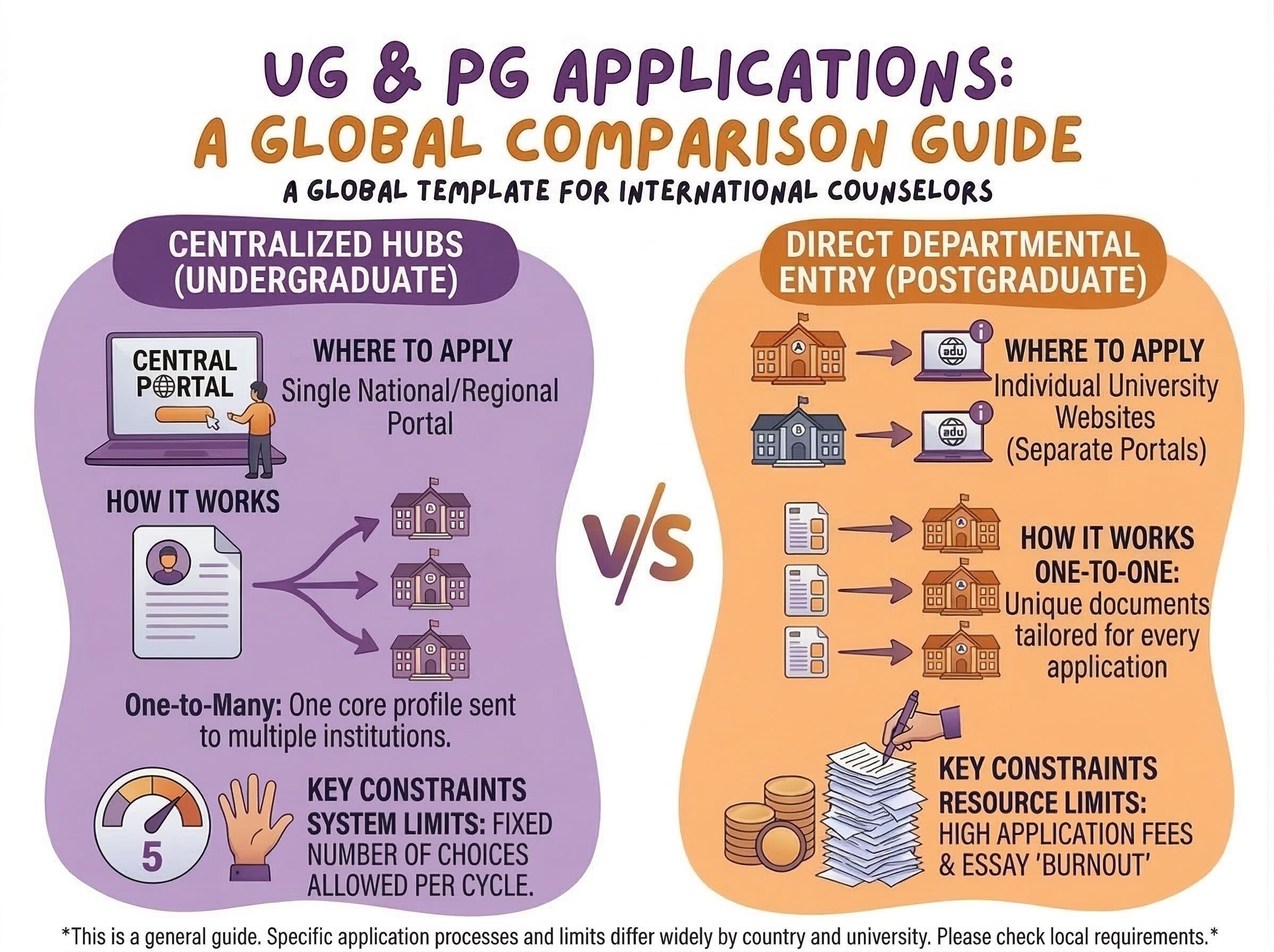
Direct university portals
Singapore does not have one national university application platform for all applicants. Students usually apply through each university’s own online admissions portal.
Applicant groups by qualification type
Universities commonly organize requirements and deadlines by qualification type. For example, an International Baccalaureate applicant and another international qualification applicant may follow different document rules, result-submission timelines, or application windows at the same institution.
Institution portals
University portals are used to collect applications, documents, application fees, program-specific materials, decisions, offer responses, and enrollment actions. Students applying to more than one university usually need to manage separate accounts and deadlines.
Program-specific selection
Some programs require additional selection steps such as interviews, portfolios, auditions, assessments, written responses, or subject-specific evidence. These are set by the institution or program.
Undergraduate vs postgraduate routes
Undergraduate applicants usually apply through the university’s admissions portal according to their qualification type. Postgraduate applicants usually apply directly to the relevant university, school, faculty, or department, with program-specific academic and professional requirements.
Platform rules and limitations
Singapore does not have one national application deadline, national choice limit, or central offer system for all universities. Application rules, document formats, deadlines, and decision timing vary by institution, program, intake, and qualification type.
Documents required generally include, but are not limited to
- Application form or university portal profile
- Passport biodata page for international applicants
- Academic transcripts and certificates
- Official results statements, where available
- Interim or predicted results, where accepted by the institution
- English language evidence, where required
- Personal statement, short answers, or written responses, where required
- Referee details or references, where required
- Program-specific materials, such as portfolio, audition materials, interview tasks, or assessment details
- Immigration-related documents, usually requested later for Student’s Pass steps
School documents and references
What schools commonly provide
Schools may provide academic transcripts, predicted or interim results where accepted, final certificates when available, curriculum information, grading scale details, and confirmation of the student’s academic background.
Who submits
Submission methods vary by university, applicant group, and program. Some university portals allow students to upload documents themselves, while others may request official documents, school verification, or direct submission from the school or awarding body.
References
References are not a national requirement for all Singapore undergraduate applications. They may be requested for specific programs, scholarships, postgraduate study, interviews, or institution-specific selection processes.
Predicted, interim, and final results
Universities may use predicted, interim, or final results depending on the applicant’s qualification type and application timing. Final admission or enrollment may still depend on official final results and meeting stated conditions.
Where process differs by route
Undergraduate, postgraduate, scholarship, competitive, creative, and professional programs may request different school, referee, or evidence documents. Requirements are set by the institution or program.
Student responsibilities
Students are usually responsible for:
- Checking institution- and program-specific entry requirements
- Confirming the correct applicant group for their qualification type
- Creating accounts in the required university portal or portals
- Completing each application form accurately
- Paying application fees where applicable
- Uploading transcripts, certificates, results statements, and supporting documents by the stated deadlines
- Providing English language evidence where required
- Completing program-specific steps such as interviews, portfolios, auditions, assessments, or written responses
- Monitoring university portals and email for document requests, decisions, and offer instructions
- Accepting offers and completing enrollment, payment, or confirmation steps by stated deadlines
- Preparing Student’s Pass steps after the institution enables the immigration workflow, if applicable
Key application timelines
Submission windows
Application windows often open in the months before the academic year starts, but exact dates vary by institution and qualification type.
Some open in the last quarter of the year, while others continue into early-year months.
Decision timing
Many applicants receive outcomes several weeks to a few months after the application closes.
Timing varies depending on:
- Institution
- Applicant group
- Whether final results are still pending
Lead-time expectations
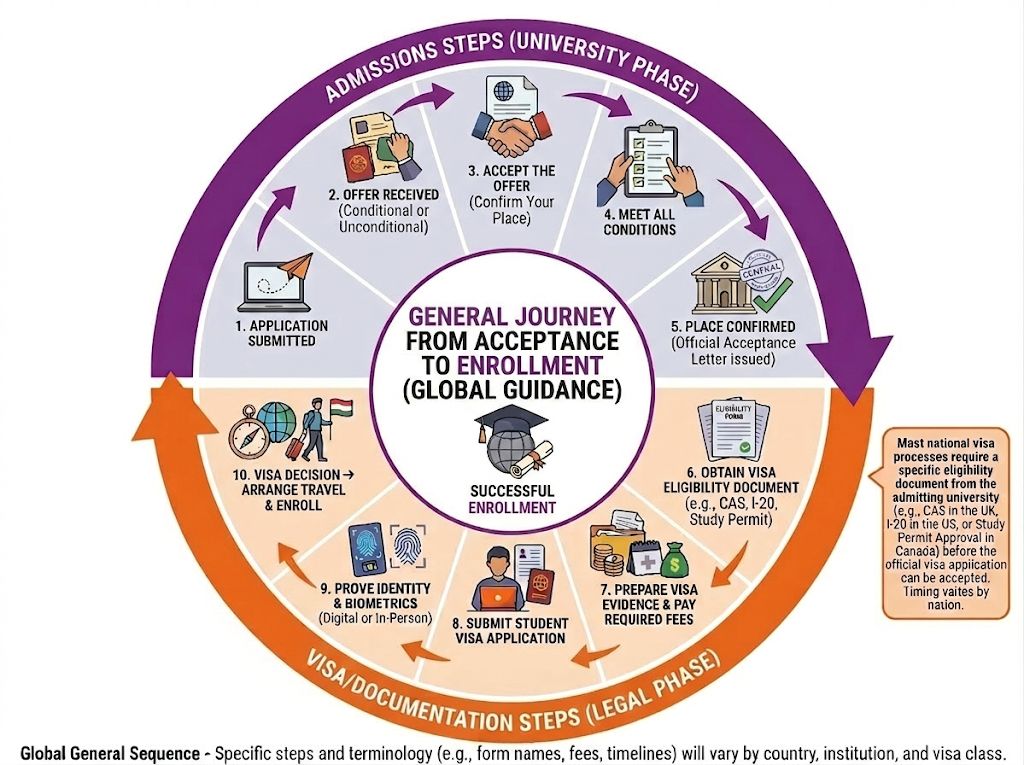
Students should expect a multi-stage process:
Application → Outcome → Acceptance steps → Student’s Pass process
The immigration phase should be planned as a separate post-offer workflow alongside pre-departure preparation.
Typical intake timeline
Timing varies significantly by institution, program, and qualification type.
- Research and shortlist: Aug–Nov
- Main applications open: Oct–Dec
- Application windows: Nov–Mar
- Documents and final results: Jan–Jul
- Decisions and offers: Mar–Jul
- Acceptance and enrollment: Apr–Jul
- Student’s Pass steps: May–Aug
- Main intake begins: Aug–Sep
Timing varies significantly by institution, program, location, and qualification type.
English proficiency
Whether proof is required
There is no national minimum. Requirements are set by institutions and programs.
Accepted evidence types
Commonly accepted evidence includes:
- Recognized English language test results
- Qualifying prior education completed in English, depending on institutional policy
Typical minimums
Minimum scores are institution-specific and sometimes program-specific.
Waiver logic
Some institutions may waive English testing based on prior study medium and credential type, but this varies by university and program.
Standardized or entrance testing
Whether required
There is no single national university entrance test requirement used across all institutions.
Who sets policy
Universities and programs decide whether any testing or additional assessment is required.
Named examples
Selection may rely on:
- Existing school-leaving qualifications
- Internationally recognized credentials
- Interviews
- Portfolios
- Program-specific assessments
Decision logic and offers
How decisions are communicated
Decisions are usually communicated through the university applicant portal and sometimes by email notification.
Offer and outcome types
Conditional offer: A place is offered if the student meets stated conditions, often final results, missing documents, or other requirements.
Unconditional offer: The place is confirmed without academic conditions, but the student may still need to complete non-academic steps such as document verification, identity checks, payment, enrollment requirements, or right-to-study checks.
Post-offer sequencing
After accepting an offer and completing institutional onboarding steps, eligible international students move into the Student’s Pass workflow, following university instructions and ICA requirements.
Deposits and acceptance steps
Whether deposits are common
There is no single national rule. Practice varies by institution and program.
What they unlock
Where used, payment and or acceptance actions may be linked to:
- Enrollment confirmation
- Access to student onboarding systems
- Issuance of documents needed for immigration steps
National rule position
Acceptance and payment rules are set by institutions, not by a national admissions authority.
Student visa or residence permit overview
Official name
Student’s Pass (Singapore)
Trigger event
Acceptance into an approved full-time course.
Institutions typically initiate or guide the application through ICA’s process, and approval is issued as an In-Principle Approval (IPA) letter.
Typical steps
- Receive the offer and complete institutional acceptance and enrollment steps
- Follow the institution’s instructions to submit a Student’s Pass application through ICA’s process
- Receive the outcome and, if successful, the IPA letter
- Use the IPA letter for relevant entry and arrival steps
- Complete required formalities and collect or receive the Student’s Pass according to ICA instructions
Timing guidance
- Start the Student’s Pass process after an offer is accepted and the institution enables the workflow
- Allow weeks rather than days for full processing and appointment steps, especially at peak intake periods
- Leave extra time if ICA or the institution requests additional verification
Core evidence categories
This is not exhaustive, but usually includes:
- Proof of admission or registration to an approved full-time course
- Identity and travel document evidence, such as passport details
- Required declarations and information requested in the workflow
- Any supporting documents requested by ICA or the institution
❗ The Student’s Pass process usually starts after acceptance steps are complete. Universities often unlock the ICA workflow only once enrollment actions are finished, and the key immigration outcome is the In-Principle Approval letter, so students should treat this as a separate post-offer stage.
For full details, students should use the dedicated Singapore visa and permit guide.
Country-specific rules and exceptions
- A Student’s Pass requires admission to an approved full-time course
- Part-time or weekend-only courses are not usually eligible under the standard Student’s Pass route
- Some programs may impose result-timing constraints, especially if final results are released after a stated cutoff for that admissions cycle
Key differences for UAE-based counselors
- Admissions are institution-led, with no single national admissions portal covering all applicants
- Requirements and deadlines can differ substantially by qualification type within the same university
- Selection is usually academic-credential-driven, with additional program steps used selectively
- The immigration workflow is a separate post-offer process anchored to the Student’s Pass and ICA requirements
Common counselor questions
Do students apply through one national platform for all Singapore universities?
No. Applicants usually apply directly through each university’s admissions portal, and processes differ by institution and applicant group.
Is there a national university entrance exam for Singapore?
There is no single national entrance test used across all universities. Selection is usually based on recognized qualifications and program-specific assessments where relevant.
Do deadlines differ depending on the student’s qualification, for example IB vs. other credentials?
Yes. Institutions commonly publish different application windows and document expectations by qualification type.
When do students usually receive decisions?
Decision timing varies by institution and applicant group, but outcomes for major intakes are often released in the months leading up to course start.
What is the typical immigration trigger document after admission?
For the Student’s Pass process, ICA issues an In-Principle Approval (IPA) letter if the application is successful.
Can a student start the Student’s Pass process before receiving an offer?
Usually no. The Student’s Pass requires acceptance into an approved full-time course and is normally initiated after admission steps begin.
Studee customer support
Studee can help counselors and students understand the admissions steps, required documents, and sequencing from offer to enrollment, and can support with organizing next actions across applications and visa preparation.