
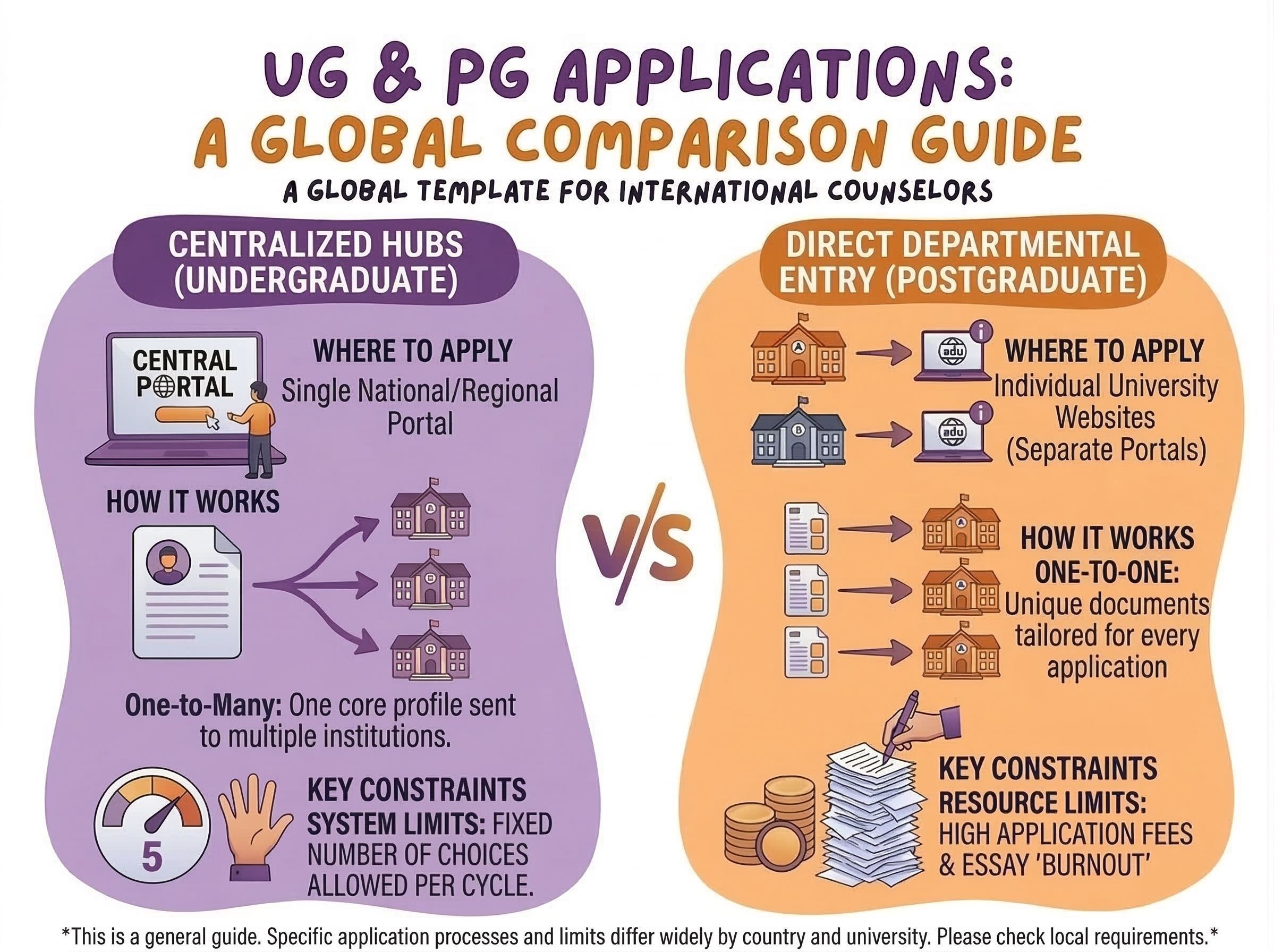
University admissions in the Netherlands are mixed. There is a national enrollment portal, Studielink, but institutions set their own entry requirements and make admissions decisions. The dominant model is eligibility-based admission, meaning students must meet stated diploma and subject requirements, with selection mainly used for capped programs known as numerus fixus.
How applications work
System type: Mixed. There is a national enrollment platform, but admissions decisions are made by institutions.
Who sets requirements: Each university or university of applied sciences, and often the individual program, sets academic and language requirements.
How students apply: Students generally register an enrollment application in Studielink, then complete the institution’s own process, which often includes a separate portal, document upload, and any program-specific procedures.
Structural variation: Application processes vary by:
- Program type, such as research university vs. university of applied sciences
- Degree level, such as bachelor’s vs. master’s
- Whether the program is numerus fixus, meaning it has limited places
- Whether the program includes extra selection steps such as portfolios, interviews, or matching activities
❗ Studielink is the start, not the finish. Students often still need to complete a separate university portal process, including uploads, forms, and sometimes fees. If they only register in Studielink, the application may remain incomplete.
Application types and commitments
Main routes
The Netherlands uses a mixed application model. Students usually start through Studielink, then complete any institution-specific steps required by the university or university of applied sciences.
Common routes include:
- Standard applications: For programs without a national cap, where admission is mainly based on meeting published entry requirements
- Numerus fixus programs: Capped programs with limited places, an earlier national deadline, and a selection or placement process
- Direct institutional steps: Additional university portal tasks, document uploads, fees, or program-specific procedures after Studielink registration
- Master’s applications: Usually institution-led, with deadlines and requirements set by each university or program
Binding vs non-binding
The Netherlands does not use a national binding Early Decision model. Commitment usually happens through accepting an offer or placement and completing enrollment steps, depending on the institution and program.
Deadline patterns
A national January 15 deadline applies for numerus fixus programs. A national May 1 deadline applies for most bachelor’s programs for first-time enrollment through Studielink. Master’s deadlines are not nationally fixed and are set by institutions.
❗ Numerus fixus works differently from standard requirements-based admission because meeting the entry requirements does not guarantee a place; students must complete the selection process and receive a placement outcome.
Key caveats
Studielink registration is not always the full application. Students may also need to complete institution portal steps, upload documents, pay fees, or complete selection, matching, portfolio, interview, or immigration-related steps by separate deadlines.
Eligibility and qualification recognition
Who decides eligibility
The institution or program makes the admission decision.
Recognition model
Institutions usually check whether a student’s prior qualification is comparable to the required Dutch level and whether subject prerequisites are met. They may use national recognition guidance, such as information from Nuffic, the Dutch recognition information center.
Baseline expectations
Entry is normally based on the level and content of the school-leaving qualification, and sometimes on specific subjects or grades. Additional requirements may apply for particular programs.
How applicants are assessed
Dominant admissions model: Requirements-based admission for most programs, with selection concentrated in capped numerus fixus programs and some programs that use additional procedures.
Primary selection factors
- Eligibility against published entry requirements, including diploma level, subject prerequisites, and any program-specific conditions
- For numerus fixus programs, performance in the program’s selection procedure, which leads to a ranking or placement outcome
Factors usually not primary nationally
There is no national requirement for broad holistic review elements such as personal statements or extracurricular activities across the system. Where they are used, they are program-specific.
Where variation occurs
Selection methods and extra steps such as tests, interviews, portfolios, and matching or fit activities vary by institution and program, especially for numerus fixus and specialist fields.
Application platforms and key documents
Studielink
Studielink is the national enrollment application platform for Dutch higher education. Students usually use Studielink to register an application for a program, but the institution still sets entry requirements, reviews documents, makes admissions decisions, and confirms enrollment.
Institution portals
After registering in Studielink, students often need to complete additional steps through the university’s own portal. This may include uploading documents, answering program questions, paying application or handling fees, completing selection activities, or tracking admissions updates.
Numerus fixus routes
Numerus fixus programs have a limited number of places and use a national application deadline. These programs include a selection and ranking process, and placement outcomes are communicated through Studielink according to the national process.
Undergraduate vs master’s routes
Bachelor’s applicants commonly use Studielink as part of the national enrollment process. Master’s applicants also use Studielink in many cases, but program deadlines, document requirements, and selection procedures are set by the institution and can vary more widely.
Platform rules and limitations
The Netherlands does not have one single application process after Studielink. Platform steps, document uploads, selection activities, fees, and internal deadlines vary by institution, degree level, and program type.
Documents required generally include, but are not limited to
- Passport or identity document
- Prior qualification certificates and transcripts
- Certified translations, where required
- Proof of English proficiency for English-taught programs, where required
- Proof of Dutch proficiency for Dutch-taught programs, where required
- Program-specific materials, such as a portfolio, audition materials, CV, motivation questions, interview tasks, or selection assignments
- Institution forms or portal uploads
- Immigration-related documents, where required for institutional sponsorship
School documents and references
What schools commonly provide
Schools may provide transcripts, predicted or interim results, final certificates when available, curriculum information, and confirmation of the student’s academic background.
Who submits
Submission methods vary by institution and program. Some universities ask students to upload documents through an institutional portal, while others may request certified copies, official documents, or verification from the school or awarding body.
References
References are not a national requirement for all Dutch undergraduate applications. They may be requested for specific programs, scholarships, master’s programs, selective routes, or institution-specific procedures.
Predicted and interim results
Institutions may use predicted, interim, or expected results when final qualifications are not yet available. Final enrollment may still depend on receiving official final results and meeting all stated conditions.
Where process differs by route
Numerus fixus, master’s, selective, creative, and specialist programs may request different school or referee documents from standard bachelor’s routes. Requirements are set by the institution or program.
Student responsibilities
Students are usually responsible for:
- Checking program-specific entry requirements and deadlines
- Creating a Studielink account and registering the application
- Completing any institution portal steps after Studielink
- Uploading transcripts, certificates, translations, and supporting documents when requested
- Providing language evidence where required
- Completing numerus fixus selection, matching, portfolio, interview, or other program-specific steps where required
- Monitoring Studielink, institution portals, and email for updates
- Responding to placement, offer, or enrollment instructions by stated deadlines
- Completing acceptance, tuition, and enrollment steps
- Providing immigration documents to the institution after the institution starts the IND sponsorship process, if applicable
Key application timelines
Submission windows
Many students apply during the year before the intended start date. Institutions may set earlier internal deadlines than the national ones, especially for international students because of immigration processing and housing timelines.
National deadlines
- January 15: Numerus fixus programs
- May 1: Bachelor’s programs, as the general national deadline for first-time enrollment
Decision timing
- For non-capped programs, timing varies by institution and program once documents are complete
- For numerus fixus programs, ranking and placement outcomes are issued on a nationally fixed timetable after the deadline, commonly around mid-April
Institutions often require students who need immigration permission to complete internal steps well before travel, because the IND application is submitted by the institution as sponsor.
Typical intake timeline
Timing varies by institution, program, and whether selection or immigration processing is required.
- Research and shortlist: Sep–Dec
- Numerus fixus deadline: Jan
- Main bachelor’s deadline: May
- Selection and placement outcomes: Apr–Jul
- Enrollment and tuition steps: May–Aug
- IND sponsorship and MVV steps: May–Aug
- Main intake begins: Sep–Oct
English proficiency
There is no national minimum. Requirements are set by institutions and programs.
Proof is commonly required for English-taught programs unless a waiver applies, such as prior education in English or a recognized qualification, as defined by the institution.
Accepted evidence types typically include internationally recognized tests such as:
- IELTS
- TOEFL iBT
- Cambridge English qualifications
Exact tests and minimum scores vary by program.
Waiver logic and validity periods, such as how recent a test must be, are institution rules.
Standardized or entrance testing
National position
The Netherlands does not have a single national university entrance exam for all applicants.
Who sets policy
Institutions and programs set any testing or selection requirements.
Examples
Depending on the program, these may include:
- Selection assessments for numerus fixus programs
- Interviews
- Auditions
- Portfolios
- Program-run aptitude or fit activities
Decision logic and offers
How decisions are communicated
Students usually receive updates through the institution’s portal and email. For numerus fixus programs, key outcomes are communicated through Studielink.
Offer and outcome types
- Admitted or eligible to enroll, often after document verification
- Conditional offer, pending final results, missing documents, or other stated conditions
- Selection outcome for numerus fixus, such as ranking number, placement offer, or waitlist
- Not admitted, where requirements are not met or the student is not placed in a capped program
Post-offer sequencing
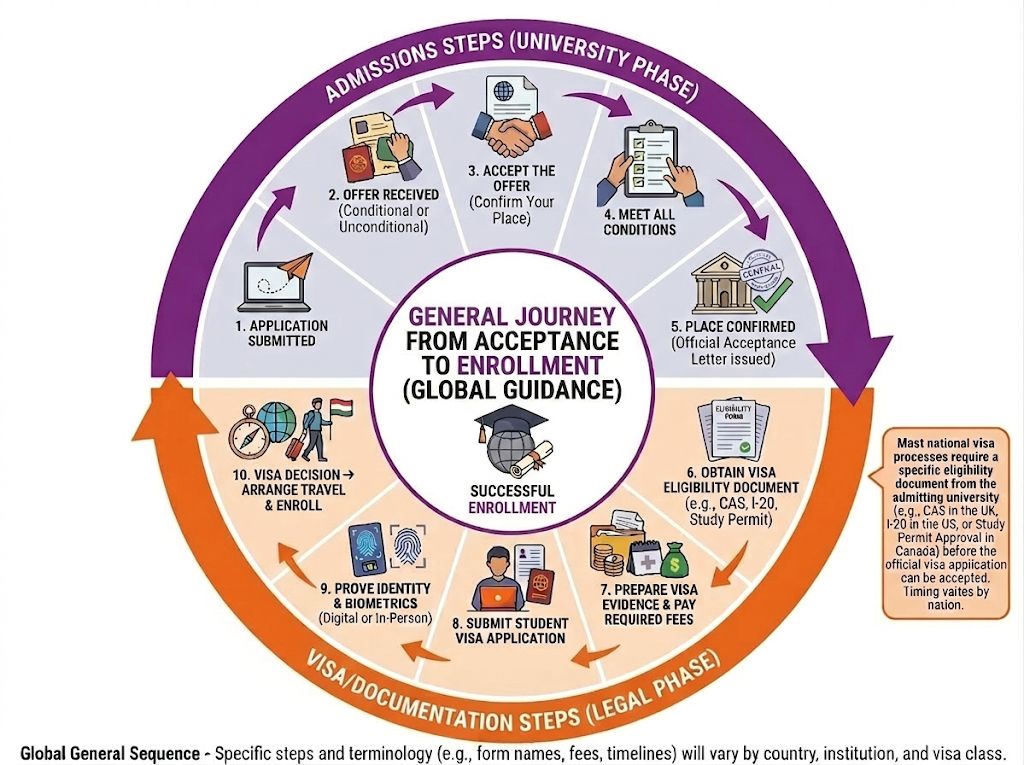
After acceptance and enrollment steps, institutions guide students through tuition and registration and, if needed, begin the immigration sponsorship process with the IND.
Offer type definitions
Conditional offer: A place is offered if the student meets stated conditions, often final results, missing documents, or other requirements.
Unconditional offer: The place is confirmed without academic conditions, but the student may still need to complete non-academic steps such as document verification, identity checks, payment, enrollment requirements, or right-to-study checks.
Deposits and acceptance steps
There is no single national rule on deposits in Dutch higher education admissions. Practice depends on the institution and program.
Where required, payments can be linked to enrollment confirmation steps and, for non-EU or EEA students, may also be tied to the institution beginning immigration sponsorship.
Student visa or residence permit overview
Official names
- Residence permit for study
- Provisional residence permit (MVV) entry visa, only for nationals who require it for stays longer than 90 days
Trigger event
The student is accepted or enrolling, and the educational institution applies as a recognized sponsor to the Immigration and Naturalisation Service (IND).
Typical steps
- The institution starts the immigration procedure and asks the student for required information and documents
- The student provides documents and pays any required fees through the institution’s process
- The institution submits the application to the IND, often as a combined entry and residence procedure where relevant
- The IND issues a decision
- If an MVV is required, the student collects the MVV sticker at a Dutch embassy or consulate and travels to the Netherlands
- The student collects the residence permit card in the Netherlands and completes any required arrival formalities
Timing guidance
- The IND decision period for a study residence permit is typically within 60 days, though this may be extended if the application is incomplete
- Institutions often set internal submission deadlines months before the intended start date, especially for September intakes
- If an MVV is issued, it is valid for 90 days from the date of issue
Core evidence categories
This list is not exhaustive, but usually includes:
- Identity or travel document, such as a passport
- Admission or enrollment evidence and sponsor details
- Financial evidence meeting IND requirements where applicable
- Evidence required for the specific procedure, such as antecedents declaration or address details where requested
❗ For non-EU and EEA students, the university usually applies to the IND as sponsor. That means universities often set earlier internal deadlines to collect documents and submit on time, so students should not rely only on the national Studielink deadlines when planning travel and housing.
For the detailed visa guide, refer to the dedicated country visa guide.
Country-specific rules and exceptions
- National application deadlines are January 15 for numerus fixus programs and May 1 for general bachelor’s first-time enrollment, while master’s deadlines are set by institutions
- Numerus fixus programs use a selection and placement process with nationally scheduled ranking and placement communication through Studielink
- For non-EU or EEA students staying longer than 90 days, the institution typically applies to the IND as sponsor
- Some nationalities also need an MVV to enter the Netherlands for long stays
Key differences for UAE-based counselors
- A national portal, Studielink, is widely used for enrollment, but admissions decisions remain institutional
- Two national deadlines, January 15 for numerus fixus and May 1 for general bachelor’s entry, are important, but institutions may still set earlier internal deadlines
- Most programs are requirements-based, with selection concentrated in capped numerus fixus programs
- For immigration, the institution usually submits the residence permit application to the IND as recognized sponsor rather than the student applying independently
Common counselor questions
Do students apply through one central system?
Studielink is the national enrollment platform, but students usually must also complete the institution’s own application steps, such as document upload and program procedures.
Are all programs selective?
No. Many programs are mainly requirements-based. Selection is concentrated in numerus fixus programs and some programs with additional procedures.
Is May 1 the deadline for everything?
No. January 15 applies to numerus fixus programs, and May 1 is the general national bachelor’s deadline. Master’s deadlines are not nationally fixed and vary by institution.
What is numerus fixus?
It refers to programs with a limited number of places. Applicants must apply by the national deadline and complete the program’s selection process in order to receive a placement outcome.
Who decides if a foreign diploma is acceptable?
The institution or program makes the decision and may use national recognition guidance, such as Nuffic resources, when evaluating foreign qualifications.
Is there a national English test minimum?
No. English proficiency rules and minimum scores are set by institutions and programs, though many accept common tests such as IELTS, TOEFL, and Cambridge.
Who applies for the student residence permit?
For study, the educational institution usually submits the application to the IND as a recognized sponsor, using information and documents provided by the student.
Studee customer support
Studee customer support helps counselors and students navigate admissions process steps and sequencing, including application platforms, document readiness, and visa or permit trigger points.
WhatsApp support link: Counselor support email: