
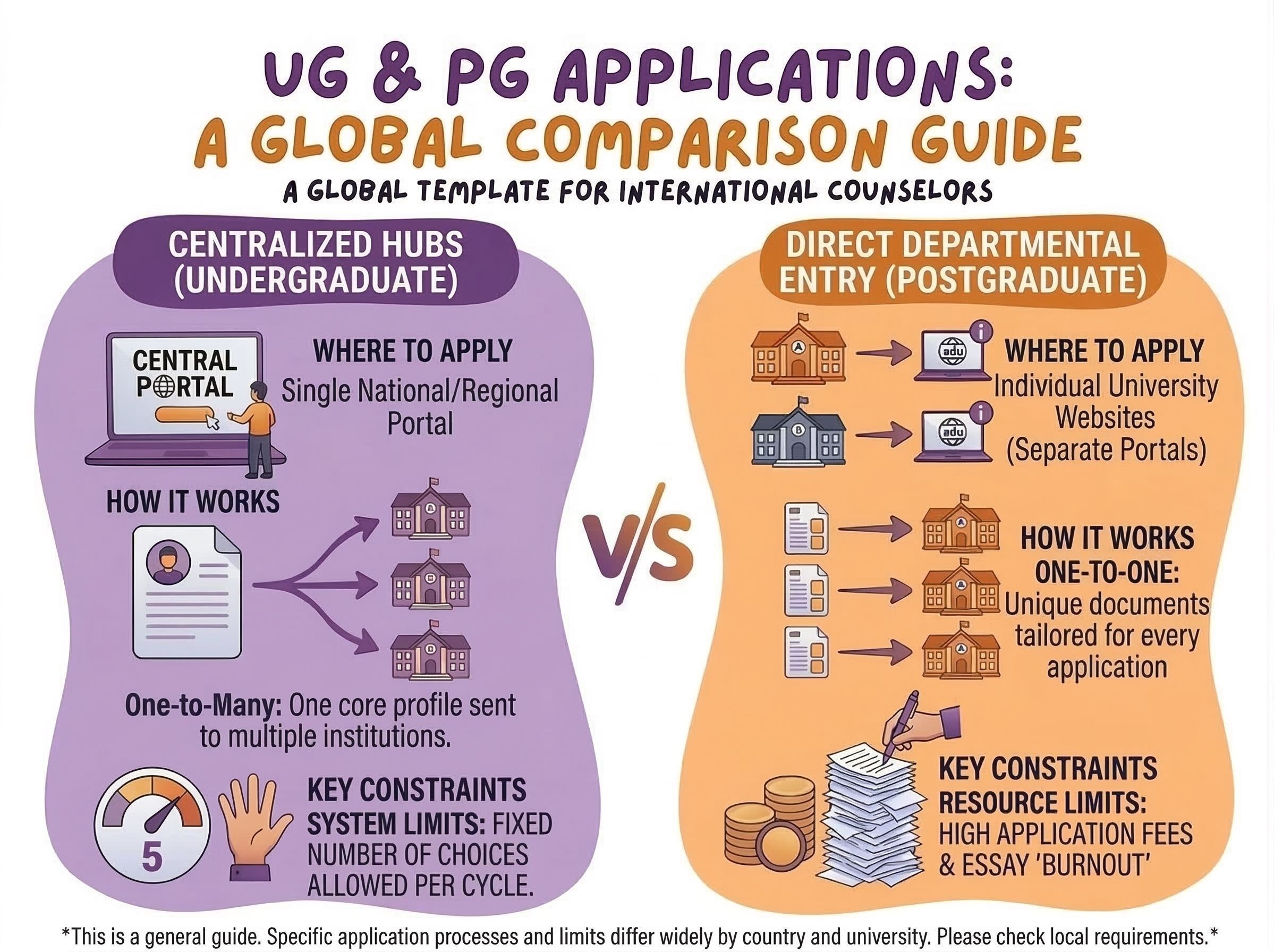
Undergraduate admissions in Ireland are mixed. Many full-time undergraduate courses are processed through the Central Applications Office (CAO), while some routes, especially certain international applications, private providers, part-time or evening study, and postgraduate courses, are handled directly by institutions. The dominant model for Irish school-leavers is points-based selection after final exam results, with offers issued in rounds and accepted through CAO.
How applications work
System type: Mixed. Many undergraduate routes are centralized through CAO, while others are handled directly by institutions.
Who sets requirements:
- CAO runs the application and offer process for participating institutions and courses
- Institutions and programs set entry requirements, course-specific criteria, and any additional selection steps
How students apply:
- CAO application for most full-time undergraduate courses, including Level 8 honors degrees and Level 6 or 7 certificates and diplomas
- Direct to institution in some cases, for example many postgraduate programs, many part-time or evening courses, and some applicant or course categories where institutions require direct application
Structural variation: Requirements and processes can vary by:
- Course type, such as standard vs. restricted courses with extra selection steps
- Applicant category, such as school-leaver, mature applicant, further education award-holder, or international applicant
- Institution policy, including whether some non-EU applicants must apply directly
Application types and commitments
Main routes
Ireland uses a mixed application model. Many full-time undergraduate courses are processed through the Central Applications Office (CAO), while direct institutional applications are used for some international routes, private providers, part-time or evening study, and many postgraduate programs.
Common routes include:
- CAO Level 8 list: Honors degree courses
- CAO Level 6/7 list: Higher certificate and ordinary degree courses
- Restricted courses: Courses with extra selection steps, such as interviews, auditions, portfolios, or specific tests
- Direct institutional applications: Common for many postgraduate programs, some non-EU/international routes, private providers, and non-standard study modes
- Mature or further education routes: Applicant categories that may involve additional evidence or institution-specific criteria
Binding vs non-binding
CAO course choices are submitted in order of preference, but this is not a binding commitment to attend. Commitment usually happens when an applicant accepts an offer and completes the institution’s registration, payment, or enrollment steps.
Deadline patterns
CAO has a national normal closing date, commonly in early February. A free Change of Mind window typically runs from May to July, allowing applicants to update or reorder course choices, although restrictions apply for some applicant categories and restricted courses.
❗ Restricted courses can have earlier requirements than the main offer cycle because applicants usually need to apply by the normal CAO closing date to be considered for interviews, auditions, portfolios, or test-based selection.
Key caveats
For CAO routes, preference order affects offer behavior. Applicants usually receive the highest-preference course they are eligible for on the relevant list in a given offer round, rather than several offers to compare at the same time.
Eligibility and qualification recognition
Who decides eligibility
Individual institutions and programs decide whether an applicant meets minimum entry requirements and course-specific requirements.
Recognition model
- Irish school-leavers are commonly assessed on Leaving Certificate results using the CAO points framework, where applicable
- For other qualifications, such as international school curricula, overseas upper-secondary awards, and some further education awards, institutions set recognition and entry rules
- Applicants may also use national recognition information services provided through the Irish qualifications authority
Baseline expectations
Applicants normally need to meet:
- A program’s minimum entry requirements, often similar to matriculation-style requirements
- Any course-specific subject or grade requirements
For competitive courses, meeting minimum entry requirements does not guarantee an offer. Selection is usually based on comparative performance within the eligible pool.
How applicants are assessed
Dominant model: Post-qualification, points-based competition for many undergraduate courses processed through CAO.
Primary selection factors
Typical priority order includes:
- Final exam results or grades converted to points, for Irish Leaving Certificate routes and other routes where points or score frameworks are used
- Course-specific requirements, such as required subjects, levels, or minimum grades
- Additional selection steps for restricted courses, such as interview, audition, portfolio, or admissions test where specified
Factors usually not primary nationally
For mainstream CAO school-leaver entry, personal statements, extracurricular activities, and recommendation letters are not usually the dominant national selection basis.
Where variation occurs
- Restricted courses can add assessments that materially affect selection
- Mature entry criteria and evidence requirements vary by institution and course
- International routes may be assessed using direct institutional criteria and may not follow Leaving Certificate points logic
Application platforms and key documents
Central Applications Office
The Central Applications Office (CAO) processes applications for many full-time undergraduate courses at participating Irish institutions. CAO manages the application, course-choice order, change windows, and offer rounds, but institutions set entry requirements, course-specific criteria, and any additional selection steps.
CAO course lists
Applicants can use separate CAO lists for Level 8 courses and Level 6/7 courses. Offers are made by list, and the applicant’s order of preference is important because CAO offer logic is based on the highest-preference eligible course on that list.
Restricted courses
Some CAO courses are marked as restricted because they require extra assessment, such as an interview, audition, portfolio, or admissions test. These courses often cannot be added later during Change of Mind, or may only be added under limited rules.
Direct institutional applications
Direct applications are common for many postgraduate programs, part-time or evening courses, private providers, some international applicant routes, and programs not processed through CAO. Institutions may use their own portals, forms, document rules, and deadlines.
International applicant routes
Some non-EU applicants may need to apply directly to an institution rather than through CAO, depending on the course, institution, and applicant category. The correct route should be confirmed through the institution’s admissions page.
Platform rules and limitations
Ireland does not use one platform for every higher education route. CAO rules apply to many full-time undergraduate courses, while direct applications follow institutional rules. Deadlines, document requirements, and offer communication can therefore differ by route.
Documents required generally include, but are not limited to
- Application form or CAO application record
- Passport identity page, where required
- Academic records, final certificates, and transcripts
- Predicted or ongoing results, where requested by an institution
- English language evidence, where required
- Course-specific materials, such as portfolio, audition materials, interview tasks, additional forms, or test registration
- Further education award evidence, where relevant
- Immigration-related documents for non-EEA students, often requested later for visa or residence permission steps
School documents and references
What schools commonly provide
Schools may provide academic transcripts, predicted or ongoing results where requested, final results when available, curriculum information, and confirmation of the student’s academic background.
Who submits
Submission methods vary by route. CAO school-leaver routes often rely on official exam results and CAO-linked processes, while direct institutional applications may ask students or schools to upload or send documents through the institution’s portal.
References
References are not a national requirement for all CAO undergraduate applications. They may be requested for mature applicant routes, direct international applications, scholarships, postgraduate programs, restricted courses, or institution-specific procedures.
Predicted and final results
Many CAO school-leaver offers are made after final results are available. For direct or international routes, institutions may use predicted or interim results where final results are not yet available, with final admission or enrollment depending on stated conditions.
Where process differs by route
Restricted courses, mature applicant routes, further education routes, postgraduate programs, and direct international applications may require different school, referee, or evidence documents from standard CAO school-leaver routes.
Student responsibilities
Students are usually responsible for:
- Checking course-specific entry requirements and applicant-category rules
- Confirming whether the correct route is CAO or direct institutional application
- Creating the required CAO or institutional application account
- Entering CAO course choices in genuine order of preference, where applicable
- Completing the application form accurately
- Paying application fees where applicable
- Submitting academic records, translations, and supporting documents when requested
- Completing restricted-course steps such as tests, interviews, auditions, portfolios, or additional forms
- Monitoring CAO, institution portals, and email for updates and offer rounds
- Accepting offers by the stated deadline
- Completing registration, payment, and enrollment steps after acceptance
- Preparing visa or residence permission steps after receiving the relevant acceptance documentation, if applicable
Key application timelines
CAO submission window
Applications usually open in November and close on the normal closing date in early February, commonly February 1 at 17:00.
Changes to course choices
A major free update window, known as Change of Mind, usually runs from May to July 1 at 17:00, though restrictions apply for some applicant categories and restricted courses.
Restricted-course assessments
These often run between late fall and early spring, depending on the course, and may include interviews, auditions, or tests.
Decision timing
Main CAO offer rounds are typically issued after Irish Leaving Certificate results become available, with later rounds continuing if places remain open.
Many applicants receive their first main offer shortly after results release, and institutions may begin registration soon afterward.
Typical intake timeline
Variation is common by program type, applicant category, and whether the route is CAO or direct.
- CAO applications open: Nov
- CAO normal closing date: Feb
- Restricted course steps: Nov–Apr
- Change of Mind window: May–Jul
- Final results and CAO offers: Aug–Sep
- Acceptance and registration: Aug–Sep
- Visa and IRP steps: Jun–Oct
- Main intake begins: Sep–Oct
Variation is common by program type, applicant category, location, and institution.
English proficiency
Admissions requirements
There is no national minimum English language requirement for higher education admissions. Requirements are set by institutions and programs.
Visa requirements
Where a visa is required, Ireland publishes minimum English language standards for study visas. These differ by course type and test provider, and institutions may set higher admission minimums.
Accepted evidence types
Typical evidence includes approved test-provider results such as:
- IELTS
- TOEFL iBT
- Cambridge
- Duolingo
- Other evidence accepted under current immigration policy
Typical minimums
For visa purposes, examples published for all other courses, meaning not second-level and not preparatory English, include:
- IELTS Academic 5.0
- TOEFL iBT 61
Some providers also refer to CEFR, the Common European Framework of Reference for Languages, which ranges from A1 to C2.
Waiver logic
Admissions and visa waivers, where available, are policy-dependent and program-dependent. Institutions and visa officers may accept alternative evidence in some circumstances.
❗ Admissions English rules and visa English rules are not the same. A student may meet a university’s English requirement but still need to meet the published visa-purpose minimums, or approved evidence types, for immigration depending on their course and route.
Standardized or entrance testing
Entrance testing is not generally required nationally for most undergraduate entry.
Program-specific exceptions
- HPAT-Ireland for undergraduate medicine routes where specified
- GAMSAT for graduate-entry medicine routes where specified
- Some programs may require auditions, portfolios, or interviews instead of standardized tests
Testing policy is set by the relevant program and institution, with CAO administering the application process where applicable.
Decision logic and offers
How decisions are communicated for CAO routes
Offers are issued in rounds. Applicants receive an offer for the highest-preference course they are eligible for on the relevant list.
Common outcomes
- CAO offer on the Level 8 and or Level 6 or 7 list
- No offer in a given round, with possible later offers
- Program-specific outcomes for restricted-course steps, such as invited or not invited to interview, audition, or portfolio review
Post-offer sequencing
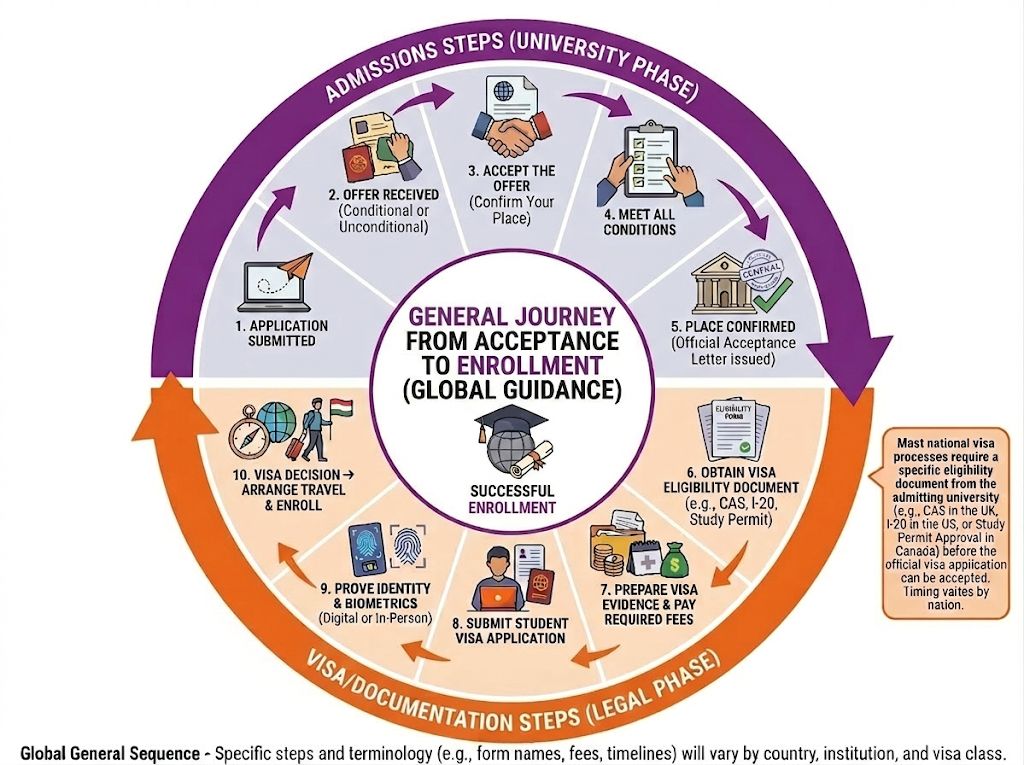
Applicants accept an offer through CAO, then complete the institution’s enrollment and registration steps. For non-EEA students, this is usually the point when visa and residence-permission preparation becomes urgent.
Definitions
Conditional offer: A place is offered if the student meets stated conditions, often final results, missing documents, or other requirements.
Unconditional offer: The place is confirmed without academic conditions, but the student may still need to complete non-academic steps such as document verification, identity checks, payment, enrollment requirements, or right-to-study checks.
❗ In CAO, preference order is crucial. Students do not usually receive multiple offers to choose from in a round. They receive the highest preference they qualify for on that list, so choices should be listed in genuine order of preference.
Deposits and acceptance steps
National rule
There is no single national deposit rule across Irish higher education.
Typical practice
After accepting a place through CAO or direct admission, institutions may require:
- Registration actions
- Tuition deposit or initial fee payment, especially for fee-paying students
- Additional enrollment steps to progress registration
Student visa or residence permit overview
Official names
- Long stay D study visa, where a visa is required for entry
- Irish Residence Permit (IRP) registration, with study permission commonly shown as Stamp 2 or Stamp 2A
Trigger event
The usual trigger is a confirmed letter of acceptance for an eligible full-time course and, where required, enrollment on an eligible program for immigration permission purposes.
Typical steps
- Confirm the course is eligible for immigration purposes, for example listed on the Interim List of Eligible Programmes (ILEP) or successor framework where applicable
- Apply for a long-stay study visa online where required and submit supporting documents
- Receive a visa decision and travel to Ireland
- After arrival, register immigration permission and obtain or renew an Irish Residence Permit
- Follow the conditions of the relevant permission, such as Stamp 2 or Stamp 2A
Timing guidance
- Long-stay study visa applications are typically submitted up to 3 months before travel
- Registration and IRP steps happen after arrival and within the timeframe set by the immigration registration process
Core evidence categories
This is not exhaustive, but usually includes:
- Identity or travel document, such as a passport
- Proof of admission, including acceptance letter and course details
- Financial evidence showing ability to support study and living costs
- English language evidence, where required for visa purposes
- Private medical insurance evidence, where required
For full details, refer to the dedicated Ireland student visa and IRP guide.
Country-specific rules and exceptions
- Order of preference matters: CAO offers the highest-preference eligible course, and lower preferences can be bypassed once a higher preference is offered on that list
- Points framework details: For Irish Leaving Certificate routes, points are commonly calculated from the best six recognized subjects in one sitting, including schemes such as bonus points for Higher Level Mathematics
- Change of Mind constraints: Some applicants or courses, especially restricted courses and certain mature routes, may face limits on adding new choices during the Change of Mind period
- Mature applicant definition varies: A common reference point is age 23 or over by January 1 of the year of entry, but institutions may define mature entry differently and may require supplementary forms
- Non-EEA routing can vary: Some institutions may require applicants living outside the EU to apply directly, so students should confirm the correct route with each institution
Key differences for UAE-based counselors
- Many Irish undergraduate offers are post-qualification, meaning they are issued after final results rather than being based mainly on predicted grades
- A single ranked order of preference drives CAO offers, and students are offered the highest eligible preference rather than multiple simultaneous options
- The Change of Mind window is a formal national feature that allows course-choice reordering up to July 1, with some restrictions
- Restricted courses can require extra assessments such as interviews, auditions, portfolios, or tests alongside academic eligibility
- For non-EEA students, immigration permission typically follows the sequence of D study visa, then arrival, then IRP registration and Stamp 2 or 2A
Common counselor questions
Do all Irish universities use CAO?
No. CAO processes many full-time undergraduate courses, but not all programs and routes use CAO. Many postgraduate and part-time or evening courses are handled directly by institutions.
Are Irish offers usually conditional or unconditional?
For CAO school-leaver routes, offers are usually issued after results are known. Other routes, especially direct international admissions, may use conditional offers where results or documents are still pending.
What is a restricted course?
It is a course that requires additional selection steps, such as interviews, auditions, portfolios, or specific tests, alongside academic eligibility.
How does CAO decide which course to offer?
CAO generally offers the highest-preference course on the relevant list that the applicant is eligible for, based on the program’s selection criteria and available places.
Can students change their course choices after applying?
Yes. CAO provides structured change windows, including a free Change of Mind period, usually from May to July 1, though restrictions apply for some applicant categories and courses.
Is there a national English language minimum for admission?
No. Institutions and programs set admissions requirements. Separate published minimum standards may still apply for visa purposes where relevant.
What residence permission do students usually hold in Ireland?
Degree and other eligible full-time study permissions are commonly shown as Stamp 2 or Stamp 2A, with registration managed through the Irish Residence Permit process.
Studee customer support
We can support your Ireland application journey and sequencing steps.