
Germany has a mixed admissions structure. National coordination exists for some high-demand programs, but most requirements and decisions are set by individual institutions. The dominant model is qualification-based selection, meaning students must hold a recognized university entrance qualification and, where places are limited, are often ranked mainly by grades.
How applications work
System type: Mixed. Most admissions are institution-led, with some nationally coordinated allocation for certain programs.
Who sets requirements: Each university, and often each faculty or program, sets entry requirements, document rules, and selection criteria. Some admissions are coordinated through national service portals for participating programs.
How students apply: Common routes include:
- Applying directly to the university through its online portal
- Applying through uni-assist where the university uses it for international application processing
- Using hochschulstart for participating programs in the dialogue-oriented service procedure (DoSV) and for programs with nationwide admission restrictions
❗ The platform is not the same for every university. Students must confirm the correct route for each program, whether that is direct, uni-assist, or hochschulstart/DoSV. Submitting in the wrong place can mean the application is not considered.
Structural variation: Processes vary by:
- Program type, such as bachelor’s or master’s
- Admission status, such as open vs. restricted
- Whether the university uses uni-assist
- Whether the program participates in DoSV or hochschulstart procedures
Application types and commitments
Main routes
Germany uses a mixed application model. The correct route depends on the university, program, degree level, admission status, and whether the program participates in a coordinated admission process.
Common routes include:
- Open admission programs: Programs where applicants may be admitted if they meet the formal entry requirements and complete enrollment steps
- Restricted admission programs: Limited-place programs where eligible applicants are ranked, often mainly by grades and other formal criteria
- Direct university applications: Applications submitted through the university’s own portal
- uni-assist routes: Applications processed through uni-assist where the university uses it for international applicant document checks
- hochschulstart/DoSV routes: Coordinated procedures used for participating programs and some nationally restricted programs
Binding vs non-binding
Most applications are non-binding until the applicant accepts an offer and completes enrollment. In coordinated allocation procedures, applicants may need to prioritize choices, and the system rules can affect which offer can be held or accepted.
Deadline patterns
Many programs follow semester-based deadlines. Common deadline points are around mid-July for winter semester entry and mid-January for summer semester entry, but institutions and programs can set different dates.
❗ In Germany, the correct application route is program-specific; applying through the wrong platform can mean the application is not considered.
Key caveats
Master’s programs, restricted-admission programs, and specialist fields may have different deadlines, document rules, language requirements, or selection steps from standard bachelor’s applications.
Eligibility and qualification recognition
Who decides eligibility
Universities decide admission, but eligibility depends on whether the applicant holds a recognized higher education entrance qualification, known as Hochschulzugangsberechtigung (HZB), or an accepted equivalent pathway.
Recognition model
Applicants usually need their school qualifications assessed against German entry rules. Some application routes use established databases and evaluation guidance as part of this process.
Baseline expectations
Applicants generally need:
- A recognized HZB or approved alternative route
- Program-specific requirements, such as subject prerequisites
- Language proof where required
- Any aptitude steps required by the program
❗ In Germany, HZB recognition is the first gate. If a student’s school qualification is not recognized for direct entry, they may need an alternative pathway, such as preparatory study, before the university can assess them for the degree program.
How applicants are assessed
Dominant model: Qualification-based and grade-based assessment, especially where places are limited.
Primary selection factors
- Eligibility through a recognized HZB or approved pathway
- Grades and academic results used for ranking where admission is restricted
- Program-specific prerequisites, such as subject requirements, prior coursework, or formal aptitude requirements
Factors usually not primary nationally
Broad holistic elements, such as personal statements or extracurricular activities, are not usually the main national selection logic. If they are used, they are typically program-specific and limited.
Where variation occurs
Variation is high by program and institution. Creative arts, some master’s degrees, and certain professional fields may require:
- Interviews
- Portfolios
- Aptitude tests
- Additional selection criteria
Application platforms and key documents
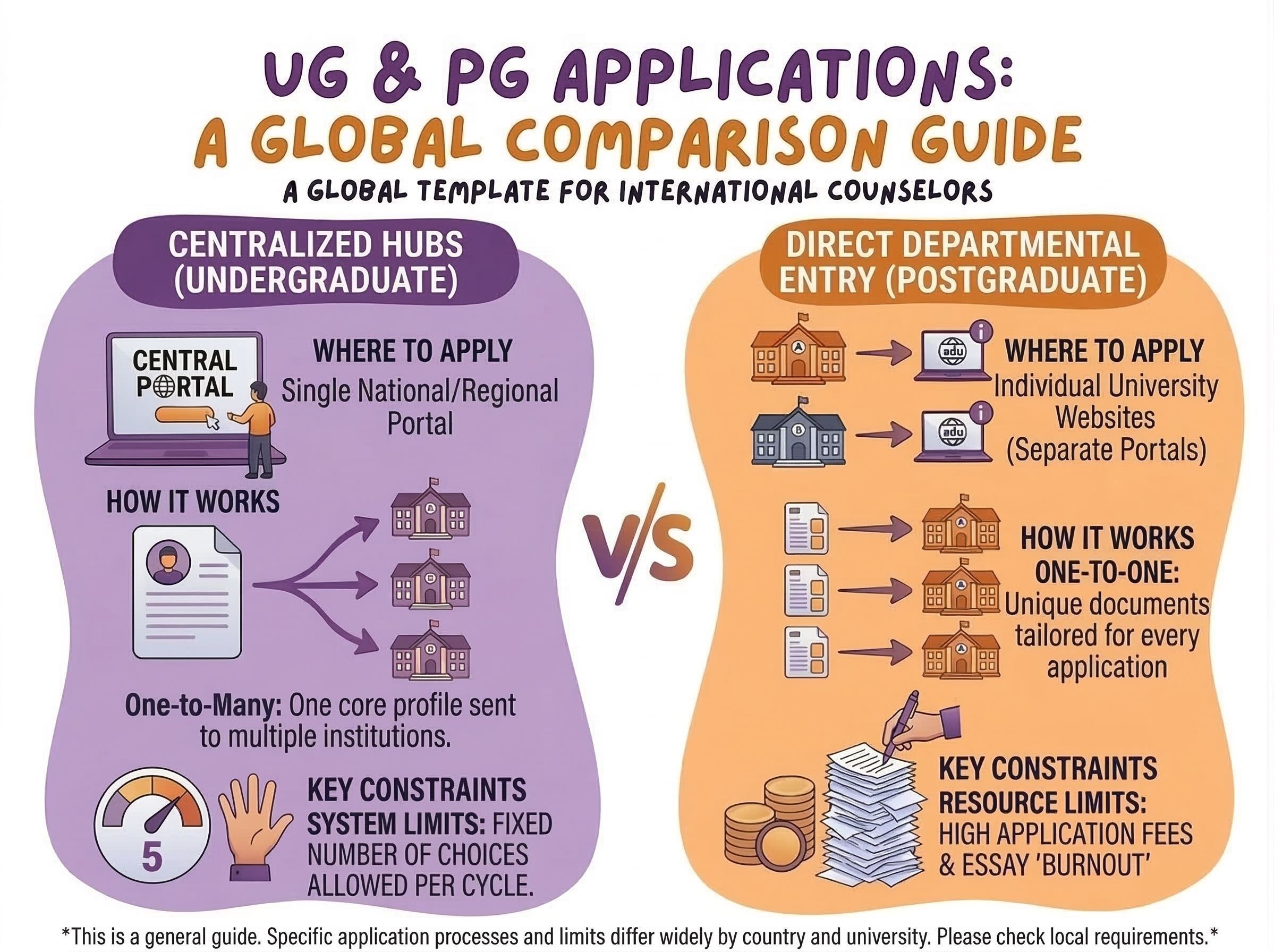
Direct university portals
Many German universities accept applications through their own online portals. This is common where the university handles document checks and admissions decisions directly.
uni-assist
Some universities use uni-assist to process applications from international students. uni-assist checks whether documents are complete and whether qualifications meet formal requirements for the chosen university, but the university makes the final admission decision.
hochschulstart and DoSV
hochschulstart is used for some coordinated admission procedures, including the dialogue-oriented service procedure (DoSV) for participating programs and certain programs with nationwide admission restrictions. It helps coordinate applications and offers, but the exact role depends on the program and procedure.
Open vs restricted admission routes
Open admission programs mainly depend on meeting formal eligibility and enrollment requirements. Restricted admission programs have limited places and use ranking or allocation rules after eligibility is checked.
Undergraduate vs master’s routes
Bachelor’s applicants commonly apply through direct university portals, uni-assist, or hochschulstart/DoSV depending on the program. Master’s applicants usually apply through the university or uni-assist, with requirements set by the university, faculty, or program.
Platform rules and limitations
Germany does not have one single national application platform for all university programs. Platform use, deadlines, document checks, language requirements, and offer coordination vary by university, program, and admission procedure.
Documents required generally include, but are not limited to
- Passport or identity document, where required
- School leaving certificate and transcripts used to assess the higher education entrance qualification
- Certified translations where documents are not accepted in the original language
- Proof of German or English proficiency, depending on the program language
- Curriculum vitae, more common for master’s programs
- Motivation letter or statement, where required by the program
- Proof of prior study, credits, or degree completion for master’s or transfer routes
- Program-specific materials, such as portfolio, aptitude test result, interview evidence, or work samples
- Immigration-related documents, usually requested later for visa or residence permit steps
School documents and references
What schools commonly provide
Schools may provide school leaving certificates, transcripts, predicted or interim results where accepted, grading scale information, curriculum details, and confirmation of the student’s academic history.
Who submits
Submission methods vary by university and platform. Some applications allow students to upload documents themselves, while others may require certified copies, official documents, or verification through the school, awarding body, or application service.
References
References are not a national requirement for all German undergraduate applications. They may be requested for specific programs, scholarships, master’s programs, creative fields, or institution-specific selection procedures.
Predicted and interim results
Some universities or application routes may accept interim or expected results when final documents are not yet available, but final admission or enrollment may still depend on official final certificates and meeting all stated requirements.
Where process differs by route
uni-assist, direct university portals, hochschulstart/DoSV routes, master’s programs, and aptitude-based programs may each request documents in different formats or at different stages. Requirements are set by the university, program, or application route.
Student responsibilities
Students are usually responsible for:
- Checking program-specific entry requirements, language requirements, and deadlines
- Confirming whether the correct route is direct university application, uni-assist, or hochschulstart/DoSV
- Creating accounts in the required application platform or university portal
- Completing the application form accurately
- Paying application or processing fees where applicable
- Uploading certificates, transcripts, certified translations, and supporting documents in the required format
- Completing program-specific steps such as aptitude tests, interviews, portfolios, or additional selection tasks
- Monitoring application portals and email for document checks, missing information, or decisions
- Responding to offers and completing enrollment steps within the stated timeframe
- Preparing visa or residence permit steps after receiving the required admission or enrollment documents, if applicable
Key application timelines
Submission windows
Application windows are often aligned to winter semester and summer semester intakes. Universities publish deadlines at program level.
Decision timing
Decision timing varies by program and admission type. Restricted-admission programs often release decisions after ranking and allocation steps are complete.
Lead-time expectations
Students applying from outside Germany usually need extra time for:
- Document preparation
- Qualification recognition checks
- Visa processing where required
Many bachelor’s programs with local admission restriction commonly close applications around mid-July for winter intake or mid-January for summer intake, though institutions can set different dates.
Typical intake timeline
Variation is high by institution, program level, and admission type.
- Research and route checks: Sep–Dec
- Summer semester applications: Dec–Jan
- Winter semester applications: May–Jul
- Decisions and offer coordination: Jul–Sep
- Enrollment and semester fees: Aug–Oct
- Visa and residence steps: Jun–Oct
- Winter semester begins: Sep–Oct
- Summer semester begins: Mar–Apr
English proficiency
There is no national minimum English proficiency requirement for university admission. Requirements are set by institutions and programs.
Typical evidence types
Programs may accept:
- Standardized English tests specified by the program
- Prior education in English, where accepted by the institution
- Other accepted proofs listed by the university
Waivers
Waivers are program-specific and commonly depend on prior study language and university rules.
Standardized or entrance testing
Standardized or entrance testing is not a national requirement for all applicants. It is program-specific and institution-specific.
Examples that may be required in some contexts include:
- TestAS, used by some institutions as an aptitude assessment for international applicants
- Program-specific aptitude assessments, for example in arts, design, or sport science
- Field-specific tests required by the program or selection procedure
Decision logic and offers
How decisions are communicated
Decisions are usually communicated through the university portal and or the relevant application platform, such as uni-assist or hochschulstart/DoSV.
Offer and outcome types
Common outcomes include:
- Admission offer
- Rejection
- Waiting list or hold status, where used
- Request for additional information or verification
Post-offer sequencing
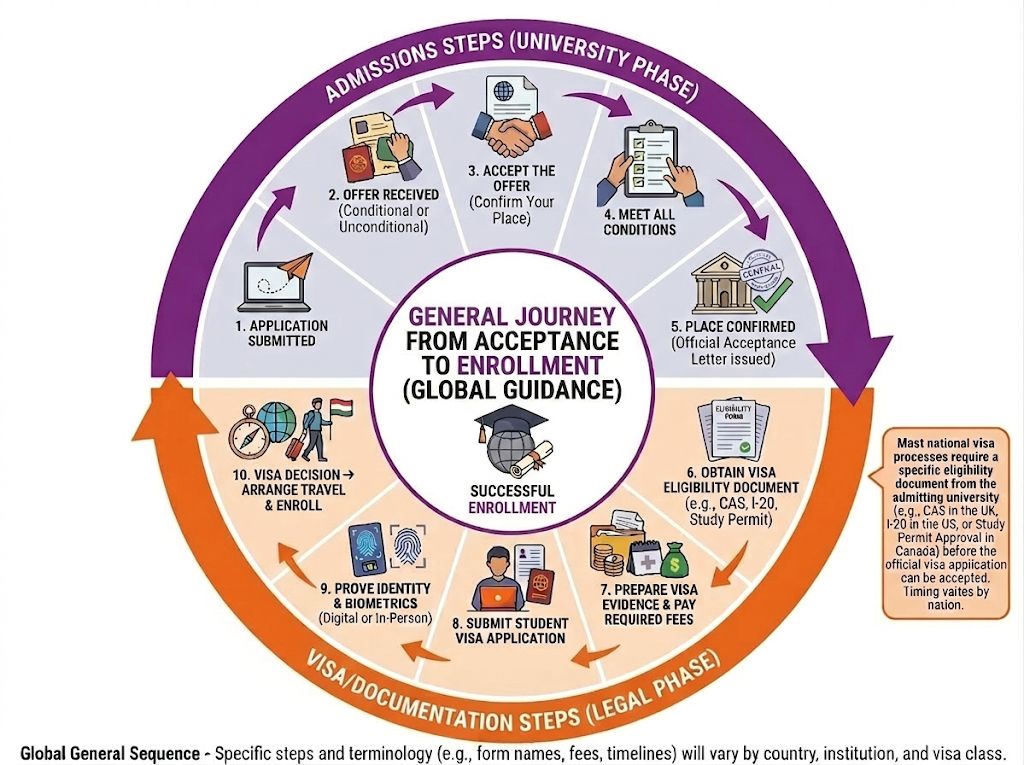
After accepting an offer, students usually complete enrollment steps and then use admission or enrollment confirmation documents to begin immigration steps if required.
Offer types
Conditional offer: A place is offered if the student meets stated conditions, often final results, missing documents, or other requirements.
Unconditional offer: The place is confirmed without academic conditions, but the student may still need to complete non-academic steps such as document verification, identity checks, payment, enrollment requirements, or right-to-study checks.
Deposits and acceptance steps
There is no national rule requiring deposits for university admission.
Acceptance steps are set by institutions and commonly include:
- Confirming acceptance in the relevant portal
- Completing enrollment, known as matriculation, by the deadline
- Paying required charges where applicable, often semester-related contributions or fees
- Providing any outstanding documents for verification
Student visa or residence permit overview
Official names
- National visa for the purpose of studying, where an entry visa is required
- Residence permit for the purpose of studying under Section 16b of the Residence Act
Trigger event
The usual trigger is admission to a higher education institution in Germany, or admission to a preparatory course linked to university entry where applicable.
Typical steps
- Receive admission or enrollment-related confirmation from the institution
- Apply for the entry visa at the responsible German mission abroad, if a visa is required for the student’s nationality
- Provide biometrics and required evidence during the visa process
- Travel to Germany after visa issuance, where applicable
- Apply for the residence permit for study with the local foreigners authority after arrival
- Complete any local registration steps required to support the residence permit process
Timing guidance
- Visa and residence timelines vary by nationality, location, and season
- Students should plan for several weeks to multiple months end to end
- Residence permit application usually happens after arrival and should be started early enough to maintain lawful status
- Institutions often set enrollment deadlines, so immigration steps need to align with them
Core evidence categories
This is not exhaustive, but commonly includes:
- Identity or travel document, such as a passport
- Admission or enrollment proof from the institution
- Financial evidence showing ability to cover living costs
- Health insurance coverage where required
- Biometrics and any additional documents required by the competent authority
For full detail, students should refer to the dedicated Germany student visa guide.
Country-specific rules and exceptions
- The HZB is central. Eligibility depends on whether school qualifications are recognized for direct entry or whether an alternative pathway, such as preparatory study, is required
- Many popular programs are capacity-limited, and selection is mainly grade-based, with outcomes depending on the applicant pool and available places rather than a fixed published threshold
- The correct application route, direct, uni-assist, or hochschulstart/DoSV, depends on the university and program, not only on nationality
❗ Numerus clausus is not a fixed grade threshold. The cutoff changes each semester because it depends on the applicant pool and available places, so published figures should be treated as indicative rather than guaranteed.
Key differences for UAE-based counselors
- Admissions are generally less holistic and more eligibility-led and grade-led, especially for restricted programs
- Recognition of school qualifications for the HZB is a core dependency before selection can be assessed
- Students may need to use different platforms depending on the program
- Semester-based intakes are common, and deadlines are often tied to winter vs. summer semester structures
- German language proof is central for most German-taught programs, while English-taught options follow program-specific rules
Common counselor questions
Do students apply through a single national portal?
No. Germany uses a mixed system. Many applications are made directly to universities, some are processed through uni-assist, and some programs use hochschulstart or DoSV coordination.
Is admission mostly based on grades?
In many cases, yes. Eligibility through a recognized entrance qualification is required, and where places are limited, applicants are commonly ranked mainly by academic results.
What does numerus clausus mean in practice?
It refers to limited-capacity admission. Outcomes depend on demand and available places, and the effective cutoff can vary by semester and institution.
Are conditional offers common?
They can occur, especially where final results or missing documents are pending, but practice varies by institution and program.
Do all students need German language proof?
Not always. German-taught programs commonly require German proof, while English-taught programs set English requirements instead.
Is uni-assist mandatory for international applicants?
No. It depends on whether the university uses uni-assist for the specific program and intake.
When should visa or residence steps begin?
Usually after the student has admission and any required confirmations, and once they can meet the authority’s evidence requirements. Exact steps depend on nationality and where the student applies.
Studee customer support
Studee customer support can help counselors and students navigate the admissions sequence and required steps at the right time.