
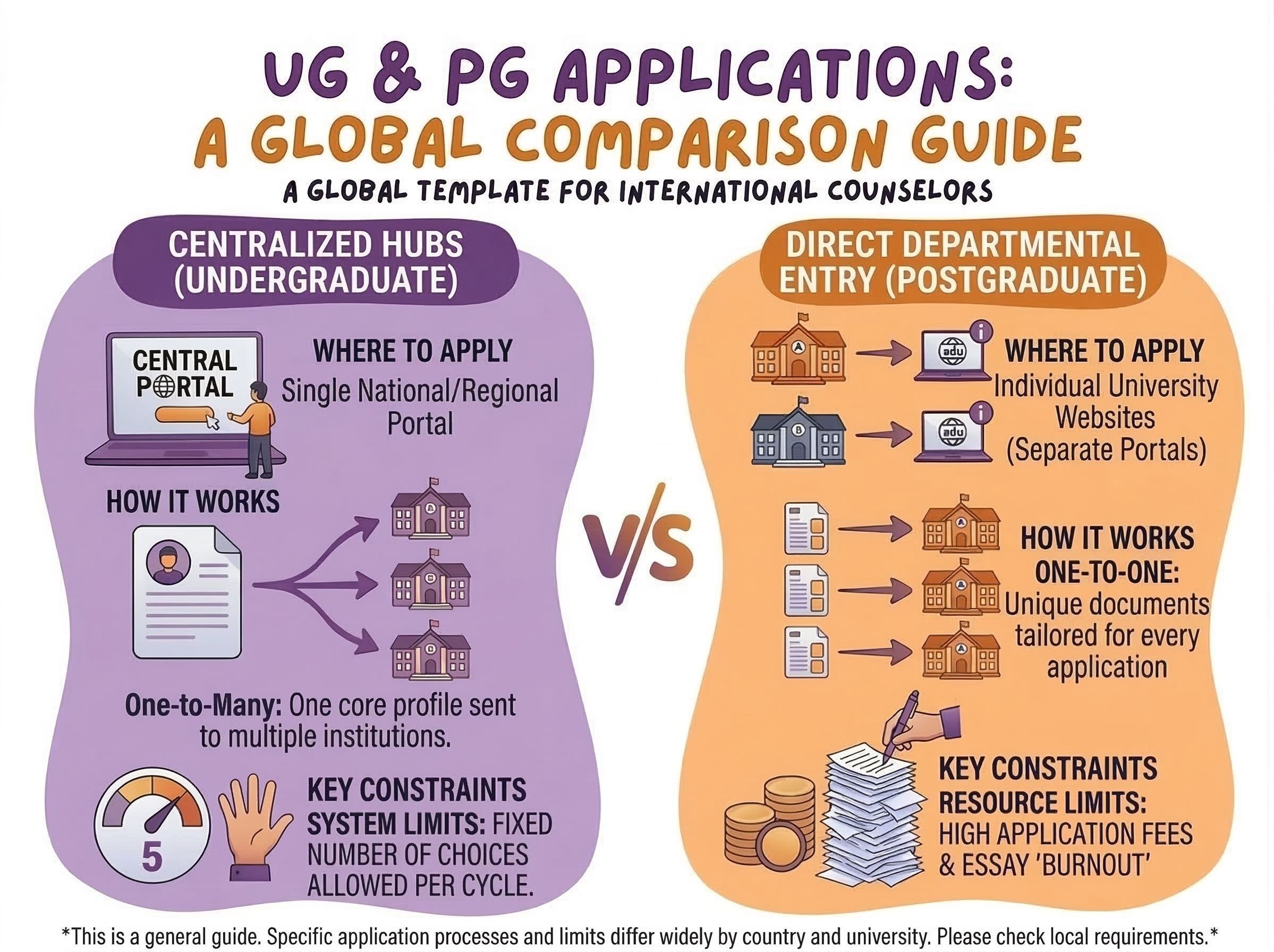
Finland uses a mixed admissions structure. Many degree programs use national joint application rounds through Studyinfo, while others use separate, institution-run applications. Selection is mostly program-specific and usually based on prior qualifications, entrance exams, or a combination of methods. Timelines are set nationally for joint rounds and locally for separate rounds.
How applications work
Mixed system: joint and separate applications
- Joint application rounds are coordinated nationally through Studyinfo (
Studyinfo.fi/Opintopolku) - Separate applications are run by individual institutions or programs when they are not included in a joint round
Who sets requirements
- National level: Joint application timetables and the overall process framework are coordinated nationally
- Institution and program level: Eligibility details, selection methods, required documents, and any program-specific steps are set locally
How students apply
- Applicants submit an application through Studyinfo for programs included in a joint application round
- Applicants follow the institution’s own instructions and platform for separate applications, often linked from Studyinfo program pages
Structural variation
Selection methods vary by:
- Sector, for example universities vs. universities of applied sciences
- Program type, such as exam-based, certificate or grade-based, portfolio or interview-based, or combined methods
Application types and commitments
Main routes
Finland uses a mixed application model. Many programs use national joint application rounds through Studyinfo, while others use separate institution-run applications.
Common routes include:
- Joint application: A nationally coordinated application round where applicants can apply to multiple programs within the same round
- Separate application: An institution- or program-specific process outside the joint application round
- Entrance exam routes: Programs where selection is based partly or fully on an entrance examination
- Certificate or grade-based routes: Programs where prior qualifications or grades are used for selection
- Portfolio, interview, or task-based routes: More common in creative, applied, or specialist fields
Commitment model
Admissions are generally non-binding until the applicant confirms a study place by the stated deadline. Finland also uses national study-place confirmation rules, including “one study place per term” rules that can affect how applicants accept places.
Deadline patterns
Joint application rounds have nationally set windows published through Studyinfo. Separate applications follow institution or program-specific windows, which can differ widely.
❗ Choice rules are round-specific in Finland because the number of choices and whether they must be ranked can depend on the exact Studyinfo application round.
Key caveats
Selection methods vary by institution, sector, and program. Applicants need to follow the specific admissions criteria for each program, even when the application itself is submitted through the same national platform.
Eligibility and qualification recognition
Who decides eligibility
Institutions and programs decide eligibility for their own admissions, using national rules and their published criteria.
Recognition model
Eligibility is based on whether the applicant’s completed upper-secondary qualification for bachelor’s entry, or higher education degree for master’s entry, is considered suitable for the program.
When a formal recognition decision is needed for other purposes in Finland, the Finnish National Agency for Education (EDUFI) provides recognition services. For admissions, however, the institution usually assesses the qualification against program requirements.
Baseline expectations
Applicants must:
- Meet the program’s stated educational background requirement
- Provide verifiable documentation
How applicants are assessed
Dominant model: Program-specific selection, commonly using prior qualifications and or entrance examinations.
Primary selection factors
- Eligibility based on required prior education
- Selection method results, such as:
- Entrance exam score, including digital or subject-based exams where used
- Certificate or grade evaluation, where applied
- Program-required portfolio or work samples, common in arts and design-related fields
- Program-specific assessments where required, such as interview, aptitude test, or additional tasks
Factors usually not primary nationally
Broad holistic components, such as extracurricular profiles, are not a standard national basis for admission. Where motivation statements or interviews are used, they are usually program-specific rather than universal.
Where variation occurs
Variation appears by:
- Institution
- Sector
- Field
- Whether selection is exam-based, grade-based, or combined
- How English proficiency is evidenced
Application platforms and key documents
Studyinfo
Studyinfo is Finland’s national education information and application service. Many higher education programs use Studyinfo for joint application rounds, and program pages are used to confirm eligibility criteria, required documents, application windows, and selection methods.
Joint application rounds
Joint application rounds are nationally coordinated. Applicants submit one application for the programs included in that round, but selection criteria and document requirements are still set by each institution or program.
Separate applications
Some programs use separate applications outside the joint application rounds. These may be managed by the institution or program and may have different deadlines, platforms, documents, and selection steps.
Program-specific selection
Programs may select applicants through entrance exams, certificate or grade evaluation, portfolios, interviews, pre-tasks, aptitude tasks, or combinations of these methods. The exact process is published in the program’s admissions criteria.
Undergraduate vs master’s routes
Bachelor’s programs may use joint or separate applications depending on the institution and field. Master’s programs often have separate or program-specific application processes, with eligibility based on prior higher education and any program-specific requirements.
Platform rules and limitations
Finland does not use one identical application rule for every program. Choice limits, ranking rules, document deadlines, selection methods, and offer confirmation rules depend on the application round and program.
Documents required generally include, but are not limited to
- Application form or Studyinfo application record
- Passport or identity document
- Prior qualification certificates and transcripts or grade reports
- Authorized translations if documents are not in an accepted language
- English proficiency evidence, where required
- Program-specific materials, such as portfolio, work samples, pre-tasks, interview materials, or entrance exam details
- Proof of prior higher education for master’s programs, where relevant
- Immigration-related documents, often requested later for residence permit steps
School documents and references
What schools commonly provide
Schools may provide qualification certificates, transcripts, grade reports, predicted or interim results where accepted, curriculum information, grading scale details, and confirmation of the student’s academic background.
Who submits
Submission methods vary by application round, institution, and program. Some documents are uploaded by the applicant through Studyinfo or an institution system, while others may need to be certified, translated, or verified through the school or awarding body.
References
References are not a national requirement for all Finnish higher education applications. They may be requested for specific programs, scholarships, master’s programs, or selection processes that use interviews, portfolios, or professional evidence.
Predicted and interim results
Some programs may accept pending, predicted, or interim results during the application process, but final admission or enrollment may still depend on official final documents and meeting all stated criteria.
Where process differs by route
Joint application rounds, separate applications, entrance exam routes, portfolio-based programs, and master’s programs may each require different school, referee, or evidence documents. Requirements are set by the institution or program.
Student responsibilities
Students are usually responsible for:
- Checking program-specific eligibility and selection criteria
- Confirming whether the program uses joint application or separate application
- Creating the required Studyinfo or institution application account
- Completing the application form accurately
- Listing choices according to the rules of the relevant application round
- Uploading certificates, transcripts, translations, and supporting documents by the stated deadlines
- Providing English proficiency evidence where required
- Completing program-specific steps such as entrance exams, pre-tasks, interviews, portfolios, or aptitude tasks
- Monitoring Studyinfo, institution portals, and email for updates and outcomes
- Confirming a study place by the stated deadline
- Completing enrollment and any required payment steps
- Preparing residence permit steps after receiving the required acceptance or study-place confirmation documents, if applicable
Key application timelines
- Joint application rounds run on nationally set windows published each cycle and are commonly used for English-taught programs starting in the main autumn intake
- Entrance exams and selection tasks usually take place after the application window closes
- Decisions are released according to the timetable for the round
- Separate applications follow the institution’s own decision schedule
- Residence permit steps for non-EU or EEA applicants usually begin after admission and any required acceptance or confirmation step, and processing times can affect travel planning
Typical intake timeline
Timing varies by institution and by whether the program is in joint or separate application.
- Research and shortlist: Sep–Dec
- Joint application window: Jan
- Separate applications: Dec–Mar
- Entrance exams and tasks: Feb–Apr
- Decisions released: Apr–Jun
- Study place confirmation: Jun–Jul
- Residence permit steps: May–Aug
- Main intake begins: Aug–Sep
English proficiency
Requirement status
There is no national minimum English proficiency requirement. Requirements are set by institutions and programs.
Accepted evidence types
Commonly accepted evidence includes approved English-language tests such as:
- IELTS
- TOEFL
- PTE
- Cambridge English
Programs may also accept other program-defined proofs.
Typical minimums
Any minimum scores are program-specific and must be taken from the published admissions criteria for that program.
Waiver logic
Waivers, where allowed, are also set by institutions and programs. They may depend on:
- Prior education language or medium
- Awarding country
- Awarding institution
Standardized or entrance testing
National requirement
Finland does not have a single national entrance test that applies to all programs.
Who sets policy
Institutions and programs decide whether an exam is required and what it includes.
Examples
Common examples include:
- Program entrance examinations, such as subject-based or aptitude-based exams
- Joint digital entrance exams used by groups of institutions in some admissions contexts, especially in universities of applied sciences
Decision logic and offers
How decisions are communicated
Outcomes are published through the relevant admissions channel:
- Studyinfo for joint rounds
- Institution systems for separate applications
Offer and outcome types
Depending on the program, outcomes may include:
- Admission
- Waiting list
- Rejection
Post-offer sequencing
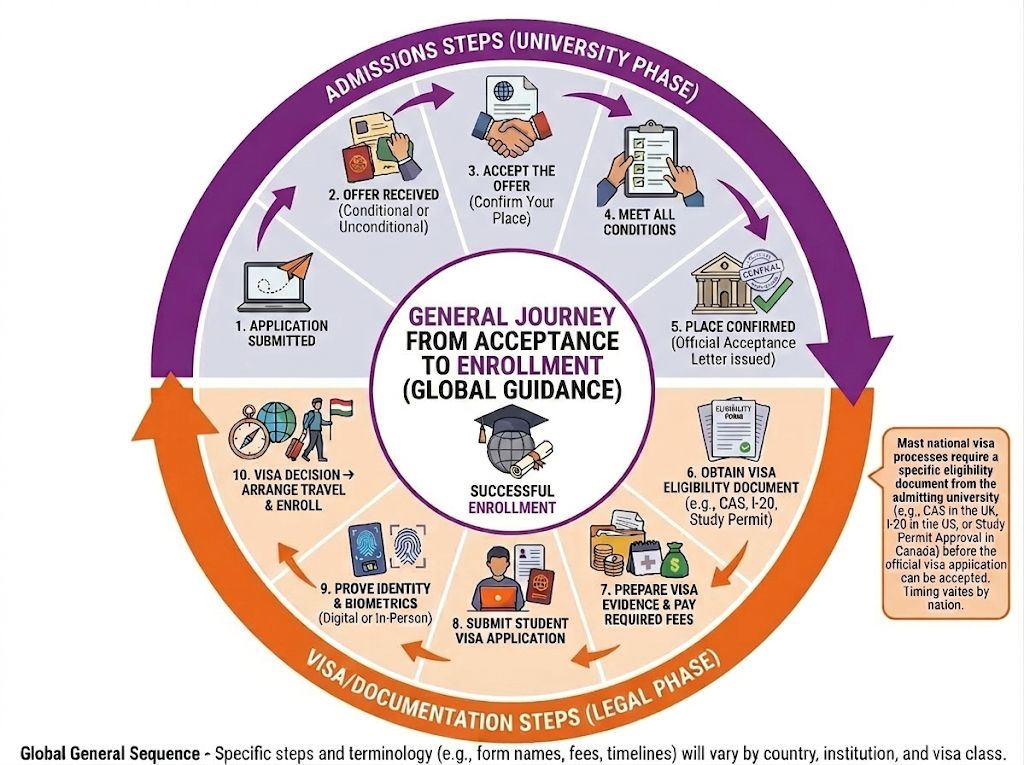
Admitted applicants usually need to confirm the study place by a deadline. Immigration steps, where relevant, follow once the applicant has the acceptance or confirmation documentation required for the permit process.
Offer type definitions
Conditional offer: A place is offered if the student meets stated conditions, often final results, missing documents, or other requirements.
Unconditional offer: The place is confirmed without academic conditions, but the student may still need to complete non-academic steps such as document verification, identity checks, payment, enrollment requirements, or right-to-study checks.
Deposits and acceptance steps
There is no single national deposit rule for all programs.
Deposit and payment practices, where they exist, are set by institutions and may vary by:
- Program
- Institution
- Applicant category
Acceptance and confirmation steps are time-bound and are the main mechanism used to secure a place and enable next steps, including immigration where relevant.
Student visa or residence permit overview
Official name
- Residence permit for studies for stays over 90 days
- EU or EEA citizens do not apply for a residence permit for studies and instead follow EU registration rules
Trigger event
A student usually applies after being accepted to a Finnish educational institution and receiving the acceptance or confirmation documents required for the application.
Typical steps
- Complete the online application in Enter Finland for a residence permit for studies
- Pay the application fee according to the official process
- Prove identity and provide biometrics as instructed, usually through a Finnish embassy, mission, or application center
- Submit required attachments and respond to any further requests
- Wait for the decision from the Finnish Immigration Service (Migri) and follow instructions for receiving the permit decision or card
Timing guidance
- Students should start the process after acceptance because the application requires proof of admission
- Processing time varies by case volume and completeness
- Applicants should allow weeks to months
- Biometrics and identity appointments depend on local availability
Core evidence categories
This is not exhaustive, but usually includes:
- Proof of acceptance or study place at a Finnish educational institution
- Valid passport or identity document
- Proof of sufficient funds for living in Finland
- Proof of insurance, where required
- Any additional documents requested by Migri for the student’s circumstances
❗ Permit timelines can depend on biometrics appointments. Even after admission, students may need an appointment to prove identity and give biometrics, so they should start the residence permit process promptly once they have the required acceptance or confirmation documents.
For full requirements and step-by-step instructions, see the detailed Finland student residence permit guide.
Country-specific rules and exceptions
- Joint application is nationally coordinated, but selection criteria remain largely program-specific, so applicants should use the program’s admissions criteria page as the working source of truth
- Programs may sit outside joint rounds, especially at master’s level and in specialized fields, so routes can differ even within the same institution
- Residence permit rules differ by citizenship group, such as EU or EEA vs. non-EU or EEA, and by study type and duration
❗ National timetable, local criteria. Studyinfo coordinates the window, but each program defines the documents, English evidence, and selection method, so the program’s admissions criteria page should be treated as the operational checklist.
Key differences for UAE-based counselors
- One country can use both joint national rounds and program-run separate applications in parallel
- Selection is often exam-based and or criteria-based at program level rather than following one national admissions formula
- Students usually move from admission and place confirmation to residence permit steps for long-term study, rather than entering first and formalizing later
- English proficiency and document rules are not national minima and can vary meaningfully across similar programs
Common counselor questions
Is there one national system for all applications?
No. Many programs use national joint application rounds through Studyinfo, but some programs use separate applications managed by institutions.
Who decides if an international qualification is eligible?
For admissions, the institution or program typically decides using published criteria. EDUFI provides qualification recognition services for some formal recognition purposes.
Do all programs require an entrance exam?
No. Some programs use entrance exams, some use certificate or grade evaluation, and some use portfolios, interviews, or combinations.
Where do students see the exact documents and criteria for a program?
The program’s admissions criteria page, often linked through Studyinfo, is the authoritative source for required documents and the selection method.
Is there a national English test minimum for Finland?
No. There is no national minimum. Institutions and programs set their own accepted evidence and minimum scores.
When can students start the residence permit process?
Usually after acceptance, and after any required confirmation step, because the permit application requires proof of admission or study place.
Do EU or EEA students need a residence permit for studies?
No. EU and EEA citizens do not apply for a residence permit for studies. They follow EU registration rules instead.
Studee customer support
Studee customer support can help counselors and students understand the overall process structure and direct them to the correct official platforms for program criteria and immigration steps.