
Australia has a mixed admissions system. Many undergraduate applicants apply through state-based Tertiary Admissions Centers (TACs), while other applications are made directly to universities, especially many postgraduate and international pathways.
The dominant undergraduate model is academic ranking-based selection, often using an ATAR-equivalent and a selection rank, with additional steps for regulated or competitive programs.
How applications work
System type: Mixed. Many undergraduate courses use state-based centralized processing, while other applications are made directly to institutions.
Who sets requirements: Universities set entry requirements and selection rules. TACs administer applications for participating institutions in their state or territory.
How students apply: Typical routes include:
- Undergraduate: Apply through the relevant TAC for that state or territory
- Direct route: Apply directly to the university, which is common for postgraduate and many international pathways
Structural variation: Requirements and deadlines vary by:
- State or territory TAC
- University
- Program type
- Applicant background
Application types and commitments
Main routes
Australia uses a mixed application model. Many undergraduate applications are submitted through state or territory Tertiary Admissions Center (TAC) systems, while direct university applications are common for postgraduate study, some international routes, pathway programs, and provider-specific applications.
Common routes include:
- TAC preference-based applications: Students list course preferences, and offers are issued in rounds according to TAC and institution rules
- Direct university applications: Common for postgraduate study and many international or non-standard routes
- Program-specific steps: Some courses require additional faculty or program-level requirements after or alongside the main application
Binding vs non-binding
Applications are generally non-binding at the submission stage. Commitment usually happens after the student accepts an offer and completes required institutional acceptance steps.
Deadline patterns
TACs operate multiple closing dates and offer rounds. Direct university deadlines vary by institution and program. Competitive programs may have earlier deadlines for testing, interviews, auditions, portfolios, or supplementary forms.
❗ In TAC systems, preference order can affect offer outcomes because offers are usually made in rounds based on rank, availability, and the applicant’s listed preferences.
Key caveats
The main application deadline is not always the only date that matters. Some program-specific assessments, tests, portfolios, interviews, or auditions may have earlier deadlines than the TAC or direct application deadline.
Eligibility and qualification recognition
Who decides eligibility
Universities decide whether applicants meet academic and subject prerequisites.
Recognition model
Australia operates under the Australian Qualifications Framework (AQF), but equivalence of international qualifications for admission is assessed by institutions.
Baseline expectations
- Undergraduate: A recognized senior secondary qualification comparable to Australian Year 12
- Postgraduate: A recognized bachelor’s degree or equivalent, plus any program prerequisites
How applicants are assessed
Dominant model: Academic ranking-based selection, supplemented by program-specific requirements.
Primary selection factors
Typical priority order includes:
- Academic results, such as school-leaving outcomes or equivalent
- Selection rank, meaning academic rank plus recognized adjustments where applicable
- Subject prerequisites
- Program-specific requirements, such as interviews, portfolios, or tests
Not a national rule
- Personal statements and references are not universally required across all programs
- There is no national holistic scoring framework
Application platforms and key documents
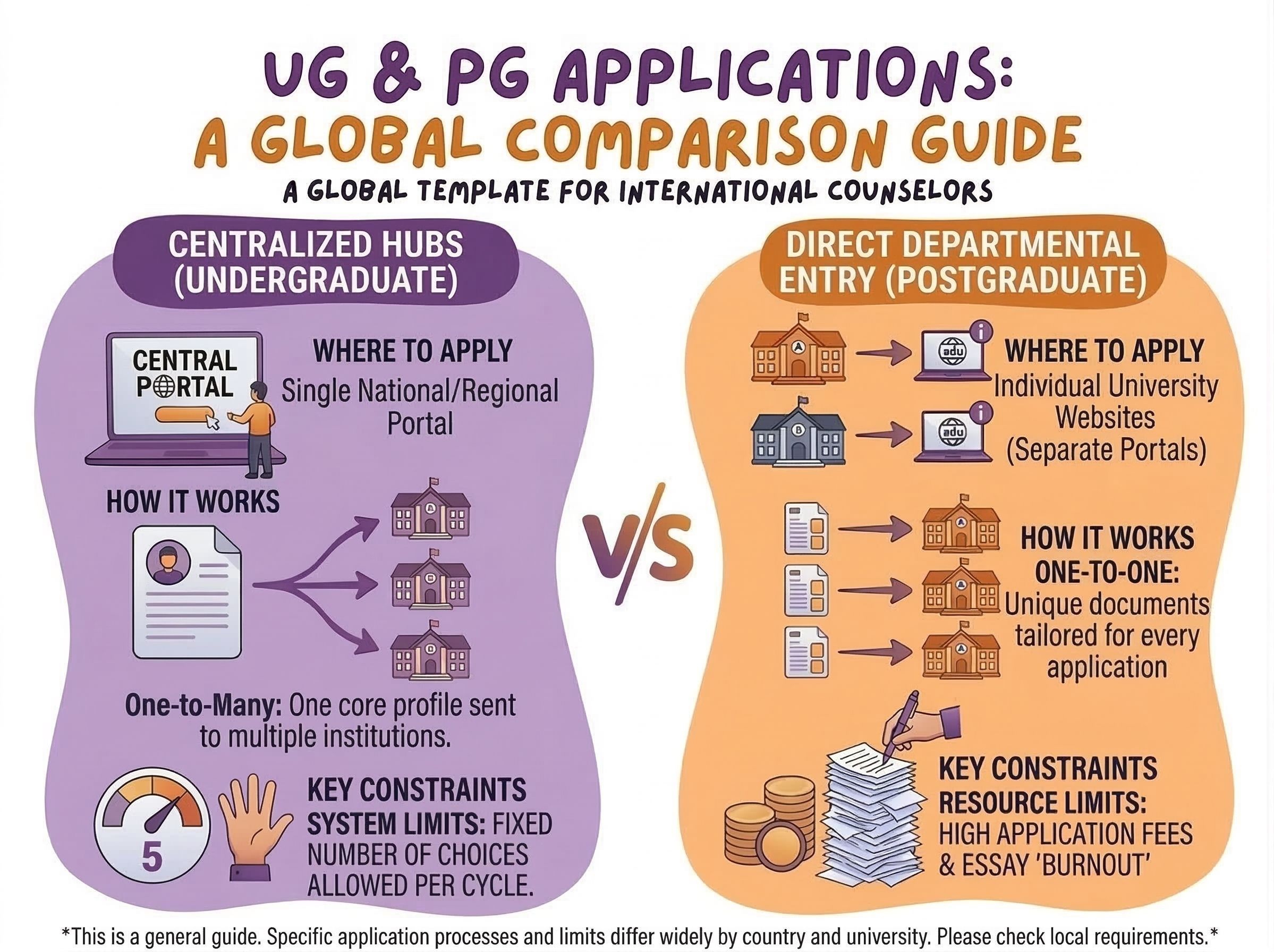
Tertiary Admissions Center routes
Many undergraduate applicants apply through a state or territory TAC. TACs administer applications and offer rounds for participating institutions, but universities still set entry requirements, prerequisites, selection rules, and final admissions decisions.
Examples of TAC systems include UAC, VTAC, QTAC, SATAC, TISC, and the University of Tasmania application route. Platform coverage and rules vary by state, territory, institution, applicant type, and course.
Direct university applications
Direct applications are common for postgraduate study and many international routes. They may also be used for pathway programs, non-award study, online study, some undergraduate courses, or applications to institutions not handled through a TAC route.
Undergraduate vs postgraduate routes
Undergraduate routes often use TAC systems where available, especially for domestic and school-leaver-style admissions. Postgraduate applicants usually apply directly through the university.
Preference-based applications
In TAC systems, students usually list course preferences. Offer behavior depends on the TAC’s rules, the student’s selection rank, course availability, and the order of preferences.
Platform rules and limitations
Australia does not have one national university application platform or one national application deadline. Application rules, preference limits, fees, document submission, offer rounds, and deadline dates vary by TAC, institution, and program.
Documents required generally include, but are not limited to
- Application form or platform profile
- Passport identity page
- Academic transcripts and completion certificates
- English proficiency evidence, where required
- Certified translations if documents are not in English
- Program-specific materials, such as a portfolio, audition, interview, test result, or supplementary form
- Credit or advanced standing documents, where relevant
- Financial or acceptance documents, often requested later for Confirmation of Enrolment and visa steps
Platforms
- State or territory TAC portals for many undergraduate courses
- University direct portals, common for postgraduate and many international routes
Documents typically include
- Passport ID page
- Academic transcripts and completion certificates
- English proficiency evidence, if required
- Program-specific materials, such as portfolio, interview, or test results
- Certified translations, if required
School documents and references
What schools commonly provide
Schools may provide academic transcripts, completion certificates, predicted or interim results where accepted, curriculum information, and confirmation of academic history.
Who submits
Submission methods vary by TAC, university, and applicant type. Some systems allow documents to be uploaded by the applicant, while others may require official records, certified copies, or documents sent directly by the school or awarding body.
References
References are not a national requirement for all Australian undergraduate applications. They may be required for specific programs, scholarships, postgraduate study, professional courses, or supplementary applications.
Predicted and interim grades
Universities may use predicted, interim, or equivalent international results where final results are not yet available. Final admission or enrollment may still depend on verified final results and meeting stated conditions.
Where process differs by route
Direct, postgraduate, pathway, and competitive program applications may ask for different school or referee documents from TAC undergraduate applications. Requirements are set by the TAC, institution, or program.
Student responsibilities
Students are usually responsible for:
- Confirming program-specific entry requirements and prerequisites
- Confirming whether the correct route is TAC or direct university application
- Creating accounts in the required TAC or university portal
- Completing the application form accurately
- Listing course preferences where the TAC route uses preference-based applications
- Paying application fees where applicable
- Submitting transcripts, certificates, translations, and supporting documents when requested
- Completing program-specific steps such as tests, interviews, auditions, portfolios, or supplementary forms
- Monitoring application portals and email for outcomes or document requests
- Responding to offers and completing acceptance steps by stated deadlines
- Preparing visa steps after receiving the Confirmation of Enrolment (CoE), if applicable
Key application timelines
- Main intakes are commonly February to March for Semester 1 and July for Semester 2
- TACs and institutions publish multiple application windows and offer rounds
- Competitive programs may set earlier fixed deadlines
- Visa lead time should be planned once the CoE is issued
Typical intake timeline
Timing varies by TAC, institution, program, and intake.
- Research and shortlist: Jun–Sep
- TAC/direct applications open: Aug–Oct
- Main Semester 1 applications: Sep–Dec
- Offer rounds and decisions: Dec–Feb
- Acceptance and CoE steps: Dec–Feb
- Student visa steps: Jan–Mar
- Semester 1 intake begins: Feb–Mar
- Semester 2 intake begins: Jul
English proficiency
Admissions requirement
There is no national minimum. English requirements are set by each institution and program.
Accepted evidence types
Accepted evidence commonly includes:
- IELTS
- TOEFL iBT
- PTE Academic
- Cambridge English
- Prior English-medium study
- Approved pathway completion
Typical minimums
Minimums are set by institutions and may vary by discipline.
Visa context
The Department of Home Affairs may require English evidence depending on the applicant’s profile and visa checklist.
Standardized or entrance testing
There is no single national entrance examination.
Testing requirements are program-specific.
Examples where required
- UCAT ANZ for some medicine and dentistry pathways
- GAMSAT for some graduate-entry medicine and health programs
Decision logic and offers
Decisions are communicated through TAC accounts and or institutional portals.
Common outcomes may include:
- Offer
- Waitlist
- Unsuccessful outcome
Offer types
Conditional offer: A place is offered subject to meeting stated conditions, such as final results or missing documents.
Unconditional offer: A place is confirmed academically, though non-academic steps such as verification, identity checks, payment, or enrollment tasks may still apply.
Post-offer sequence
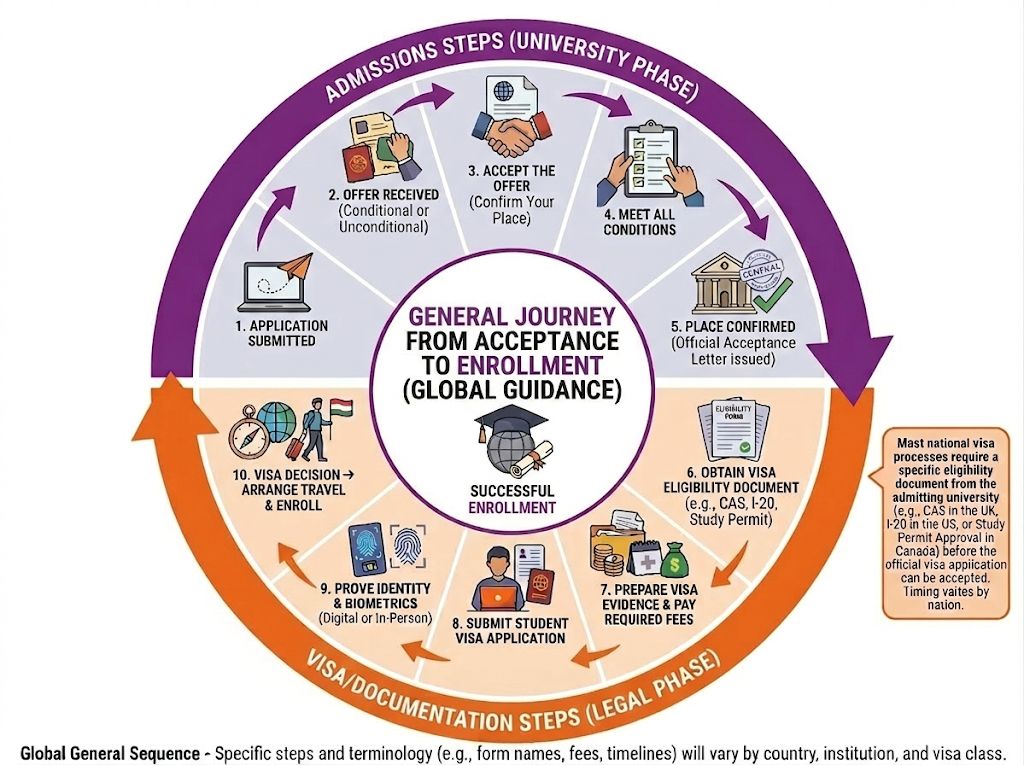
After an offer is accepted, acceptance steps and any required payments typically trigger CoE issuance for visa processing.
Deposits and acceptance steps
Deposits are common for international students, but they are institution-defined.
Acceptance steps usually unlock:
- Enrollment confirmation
- Housing access
- Issuance of the CoE
Student visa overview
Visa type
Student visa (subclass 500)
Trigger event
Receipt of a valid Confirmation of Enrollment (CoE)
Typical sequence
- Accept the offer and complete institutional steps
- Receive the CoE
- Apply through ImmiAccount
- Provide required evidence, such as identity, finances, and English where required
- Complete biometrics or health checks if requested
- Receive the visa decision
Timing guidance
- Apply as early as practical after CoE issuance
- Processing times vary by applicant profile and season
❗ Students usually cannot apply for the visa until the CoE is issued. CoE timing depends on completing acceptance steps, often including payment and document checks, so late acceptance can compress visa lead time.
Core evidence categories
- Passport
- CoE
- Financial capacity evidence, where required
- English evidence, where required
- Health and character evidence, where applicable
Country-specific rules and exceptions
- TAC procedures differ across states
- Selection rank, not ATAR alone, commonly determines offers
- Program-specific assessments may operate on fixed national schedules
- Credit and advanced standing decisions are institution-led
❗ Many offers are based on selection rank, not ATAR alone. Selection rank can include adjustments or bonus points under TAC or university rules, so two students with the same ATAR may not be assessed identically.
Key differences for UAE-based counselors
- Undergraduate routes are often preference-based through state TACs
- Offers are typically rank-based
- There is no single national portal
- Visa sequencing depends on CoE issuance
- Intake timing varies by state and program
Common counselor questions
Do students apply through one national system for Australia?
No. Many undergraduate applications are handled by state or territory TACs, and many postgraduate and some international routes are direct to the university.
Is the ATAR always required for international students?
Not always. Universities may assess international applicants using an equivalent academic ranking and prerequisites. Pathways and evaluation methods vary by provider.
What is a selection rank?
It is the rank used for admission decisions in many contexts and may combine academic ranking, such as ATAR, with adjustments depending on the institution and TAC rules.
Are interviews and personal statements standard for all courses?
No. These are program-specific and are more common in regulated or selective courses, such as some health or creative arts programs.
When can a student start the visa application?
Usually after the education provider issues the Confirmation of Enrollment following offer acceptance steps.
Is there a national English score requirement for university entry?
No. English requirements for admission are set by institutions and programs, although the immigration authority may require English evidence for some visa applications.
Can a student receive more than one offer?
In TAC-based systems, students may receive offers across rounds depending on preferences and rules. The exact behavior depends on the TAC and institution.
Studee customer support
Studee supports counselors and students with process guidance and platform help across the journey from program selection through application steps and post-offer sequencing.