
Finland is a strong choice for students who want a stable, publicly governed higher education system with a clear degree structure and a growing range of English-taught options. It is often compared with the Big 4 when students want a different study culture and a more predictable public-sector model, while accepting climate, language, and location trade-offs.
Finland at a glance
Finland is often shortlisted as a Northern Europe alternative to the Big 4 for students who want a structured European degree model and clear system rules. It suits students who are comfortable with a different study culture and can plan around climate, language, and location realities.
Quick signals
- International student momentum: Growing to stable
- English-taught availability: Moderate to high
- Total cost positioning: Moderate
- Employer recognition outside the region: Moderate
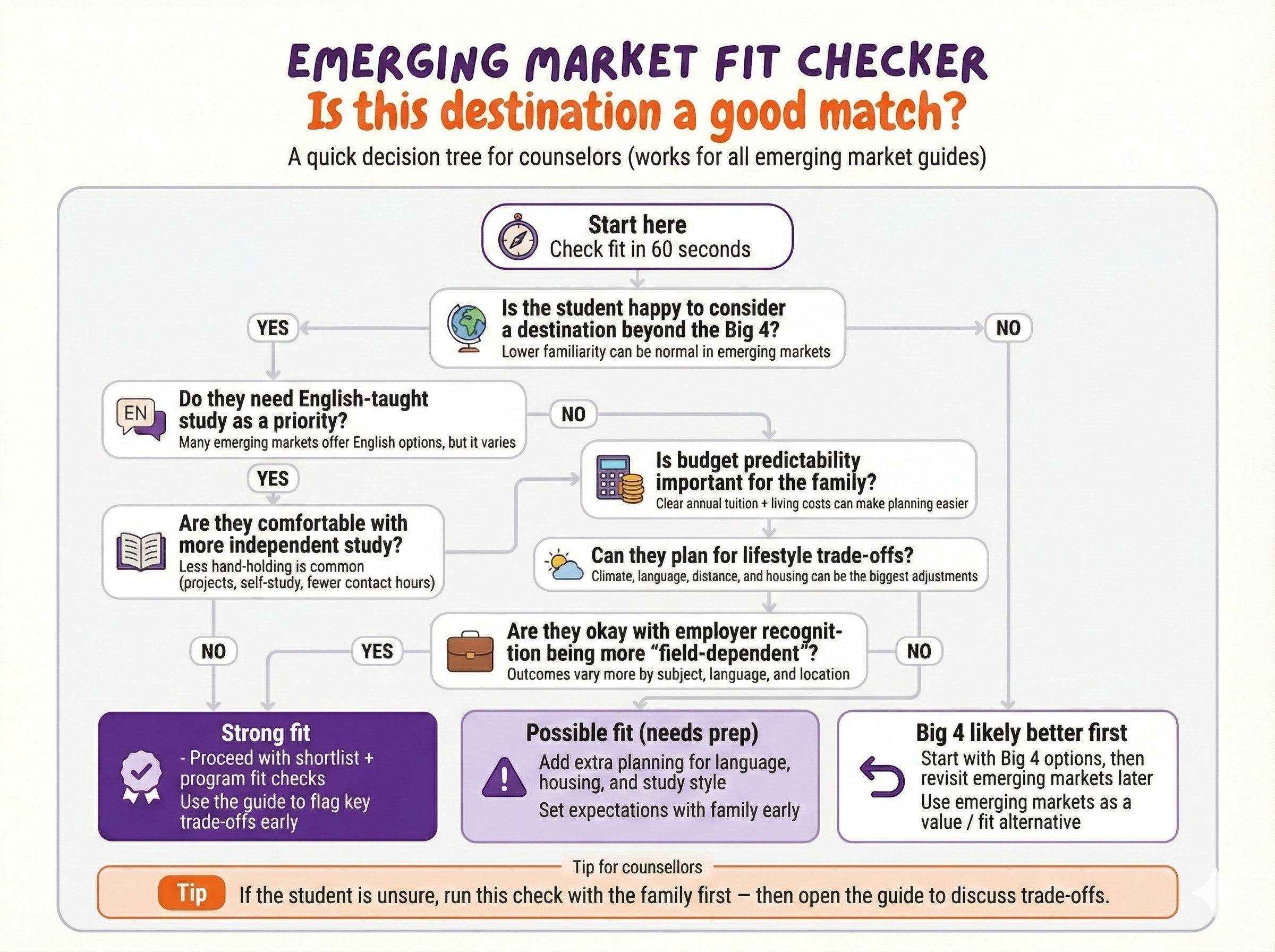
Why students are considering Finland
- International enrollment interest is generally seen as steady, with continued positioning as a Northern European option.
- Global visibility is supported by a small group of institutions appearing in major global rankings.
- Tuition fees for non-EU/EEA students apply to English-taught bachelor’s and master’s programs, creating clearer budget planning than high-variance fee markets.
- English-taught programs are widely present across universities and universities of applied sciences, with ongoing development.
- The country’s innovation-focused economy is often associated with technology, engineering, design, and sustainability-related fields.
- Public governance of higher education can make system rules and degree formats relatively consistent, while program details still vary.
Academic and ranking landscape
- Rankings presence is meaningful but concentrated, with Finland represented by a limited number of institutions in global tables.
- Overall system quality can feel consistent, with less "long tail" variation than in larger markets, though specialisms vary by institution.
- Academic strengths are often associated with technology, natural sciences, engineering, education, and health-related fields.
- Research intensity is visible at universities, while universities of applied sciences focus more on applied learning and regional industry links.
- The sector is structured into two main institution types, which shapes teaching style and program orientation.
Degree structure and study model
- Universities and universities of applied sciences operate as distinct sectors with different missions and teaching emphasis.
- A typical university bachelor’s degree is three years in the European credit framework.
- A typical university master’s degree is two years, commonly building on the bachelor’s level within the same broad discipline area.
- Universities of applied sciences bachelor’s degrees are commonly longer than university bachelor’s degrees in duration.
- Teaching culture often blends lectures, independent study, and project-based work, with assessment patterns set at the program level.
- Work placement and industry collaboration are commonly more embedded in universities of applied sciences, though practices vary by field.
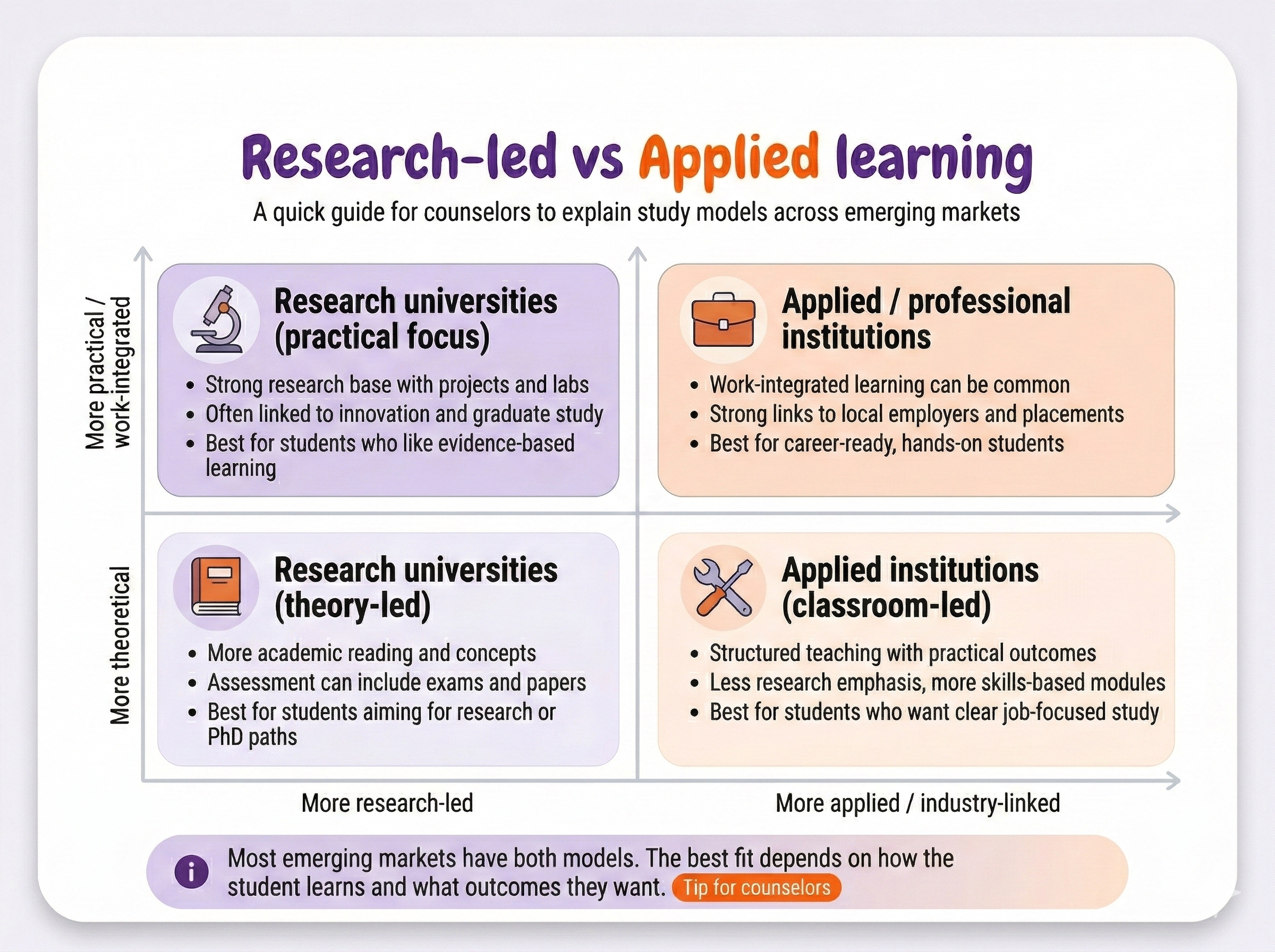
❗ Key consideration: The biggest decision is often university vs. university of applied sciences. Universities are typically more research- and theory-led, while universities of applied sciences are more practice- and work-linked, so "best fit" depends on learning style and career plan, not just program title.
Admissions and timeline reality
- Intake patterns commonly center on a main annual start, with some programs also offering an additional intake.
- Decision speed is often moderate, with timelines shaped by structured selection cycles rather than continuous rolling decisions.
- Competitiveness can range from moderate to high, depending on field and the match between applicant profile and program focus.
- The overall culture tends to be structured and standardized, which can reduce ambiguity but may limit flexibility.
- Application volume pressure is usually lower than the largest Anglo markets, but selective programs can still be oversubscribed.
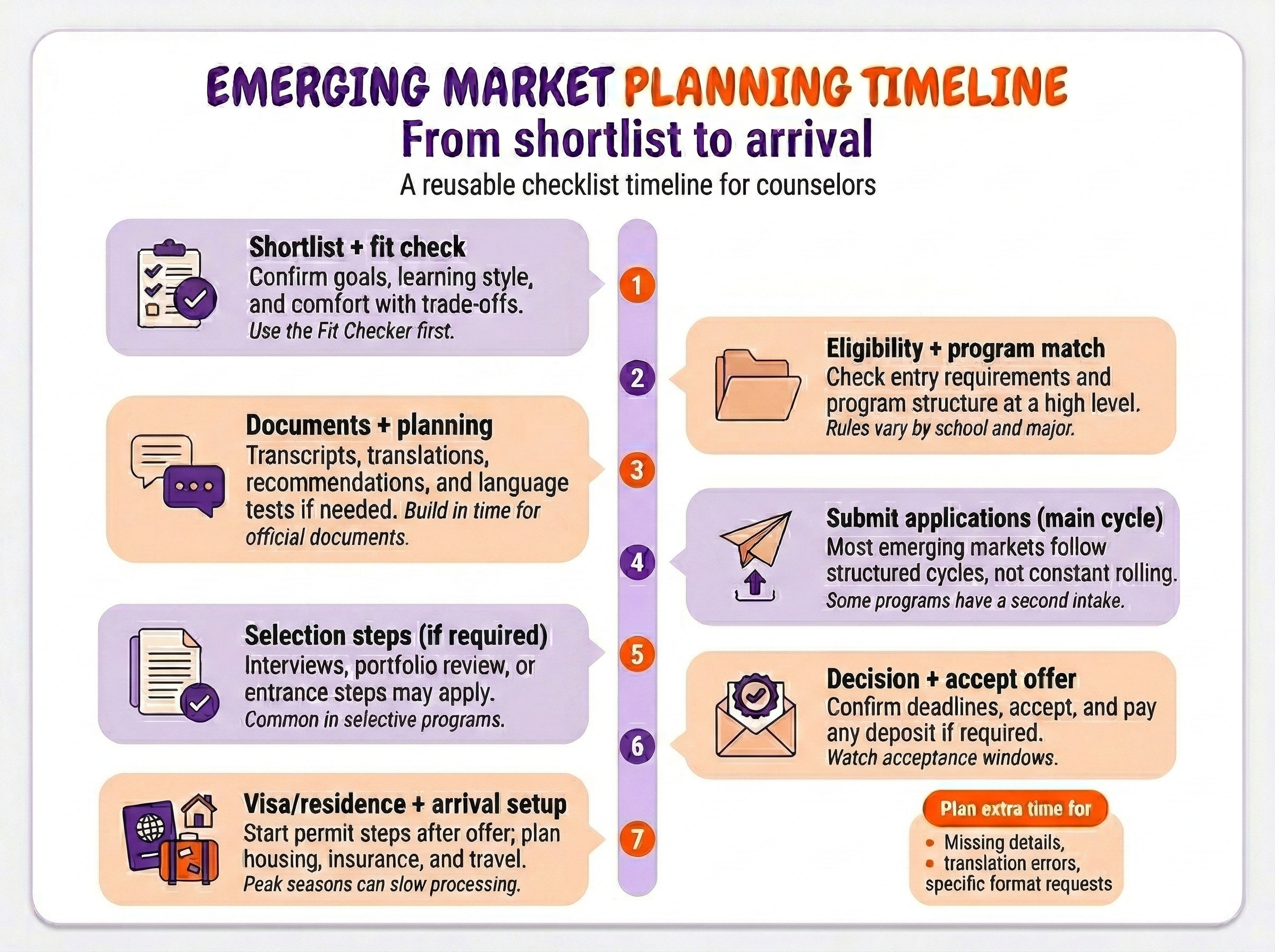
Visa and post-study environment
- Approval reputation is often seen as predictable when requirements are met, though individual outcomes vary.
- Financial evidence expectations are typically medium to high, reflecting a need to show ability to cover living costs and tuition where relevant.
- A post-study job-seeking or business-start permit route exists, subject to meeting conditions and maintaining lawful status.
- Policy stability is generally perceived as steady, but counselors should treat immigration requirements as changeable over time.
- Processing efficiency is often viewed as moderate, with timelines influenced by peak periods and individual case complexity.
Cost and value proposition
- For non-EU/EEA students, tuition fees apply for English-taught bachelor’s and master’s programs, with fees commonly presented as annual amounts.
- Tuition fee levels often sit below typical U.S. private university pricing, and can be comparable to lower-fee segments of the UK, Canada, and Australia.
- Living costs are commonly moderate to high versus the Big 4, with housing costs varying significantly by city.
- Scholarship support is usually offered by institutions rather than government-funded national schemes, and is often partial.
- Doctoral programs do not generally charge tuition regardless of nationality, though funding conditions vary by program.
- Degree duration is predictable in the European model, which can make total cost planning clearer than markets with longer standard pathways.
❗ Key consideration: Tuition is usually clear, but housing can change the whole budget. Living costs vary a lot by city and availability, so families should estimate costs using the specific city and housing plan, not a Finland-wide average.
Who this market is a good fit for
- Students who want a European degree structure with relatively consistent system rules.
- Students comfortable with a structured study culture and independent learning expectations.
- Families who prioritize transparent budgeting and are prepared for tuition plus a higher living-cost environment.
- Students considering technology, engineering, design, education, or applied professional pathways, depending on institution type.
- Students open to Northern European climate and seasonal light variation as a lifestyle factor.
- Students willing to engage with local language and culture for daily life, even when studying in English.
- Students who prefer a smaller-country environment over large-campus or high-profile sports-led university culture.
- Students who value program fit and learning model over destination familiarity.
Trade-offs to consider
- Employer recognition outside the region can be moderate, and outcomes depend on field, location, language, and employer.
- Brand visibility may be narrower than the Big 4, with awareness often concentrated in specific regions and sectors.
- English-taught options are available, but local-language skills can still matter for integration, part-time work, and some fields.
- Living costs can be high in key cities, and housing availability can be a practical constraint.
- Climate and winter conditions can be a significant adjustment for students from warmer regions.
- Program structures can be less flexible once started, with limited scope for changing direction depending on institution rules.
- Social integration may take more effort for some students due to cultural differences and smaller international communities outside major cities.
- Travel distance and limited direct flight options from some regions can add cost and complexity for family visits.
❗ Key consideration: English-taught study doesn’t always equal English-only life. Finnish (or Swedish) can matter for part-time work, internships, and day-to-day integration, so students who plan even basic language learning often adjust faster and access more opportunities.
Key differences for UAE-based counselors
- Finland is in the Schengen Area, so entry permissions and travel expectations differ from Big 4 models.
- Budget conversations often need to separate tuition and living costs clearly, since both are material for non-EU/EEA students.
- Students may need more preparation for climate and seasonal daylight changes than for most Big 4 destinations.
- Parents may be less familiar with the "two-sector" higher education model, so explaining the difference can reduce confusion.
Common counselor questions
How clear is the difference between universities and universities of applied sciences?
It is a formal system split, and it shapes teaching style and program orientation. The best fit depends on whether the student prefers research-led study or applied learning.
Are English-taught degrees widely available?
Availability is moderate to high, and it has been expanding across levels. The balance of options can vary by field and institution type.
Is Finland mainly a single intake system?
A main annual intake is common, and some programs also have an additional intake. The overall culture tends to be structured rather than continuously rolling.
What should families assume about scholarships?
Scholarships are usually offered by individual institutions and are often partial. Families should plan for living costs even if tuition support is available.
Can graduates stay after study?
A job-seeking or business-start residence permit route exists for eligible graduates, subject to conditions set by immigration authorities. Policy details can change, so counselors should keep framing high level.
Is tuition charged for all international students?
Tuition is generally charged to non-EU/EEA students in English-taught bachelor’s and master’s programs. Doctoral tuition is generally not charged, though funding structures vary.
Studee customer support
Studee provides general support to counselors and students exploring Finland as a study destination.
WhatsApp support link:
Counselor support email:
Sources
- Study in Finland — Fees and cost of living — https://www.studyinfinland.fi/funding-your-studies/fees-and-cost-living
- Study in Finland — Bachelor’s and master’s scholarships — https://www.studyinfinland.fi/funding-your-studies/bachelors-and-masters-scholarships
- Studyinfo — Tuition fees — https://opintopolku.fi/konfo/en/sivu/tuition-fees
- Studyinfo — Higher education degrees — https://opintopolku.fi/konfo/en/sivu/higher-education-degrees
- Finnish Immigration Service (Migri) — Seeking work after graduation or completion of research — https://migri.fi/en/seeking-work-after-graduation-or-completion-of-research
- Finnish Immigration Service (Migri) — Residence permit to look for work — https://migri.fi/en/residence-permit-to-look-for-work
- Ministry of Education and Culture Finland — Universities — https://okm.fi/en/universities
- Ministry of Education and Culture Finland — Universities of applied sciences — https://okm.fi/en/universities-of-applied-sciences
- Study in Finland — Finnish universities in QS World University Rankings 2026 — https://www.studyinfinland.fi/news-events/qs-world-university-rankings-2026